

Last Updated: September 6, 2026
The market for research peptides has exploded, and with it, the number of suppliers selling products that are underdosed, mislabeled, or outright counterfeit. A vial that looks legitimate can contain little more than salt water, or worse, a compound with an impurity profile that compromises your research data. This guide from Rejuvenation Wellness Solutions LLC breaks down six concrete ways to spot fake peptide suppliers before you waste money or compromise your work.
The barrier to entry for selling peptides online is almost nonexistent. A basic website, a few product photos, and a payment processor are all it takes to appear legitimate. Unlike pharmaceuticals, research peptides exist in a regulatory gray area, which means the burden of verification falls almost entirely on the buyer (the FDA).
Most researchers discover this the hard way. They receive a vial, reconstitute it, and only later realize the results make no sense. The product failed, but was it the peptide, the dosage, or the supplier? That uncertainty contaminates your entire experiment.
The core problem is information asymmetry. The supplier knows exactly what is in the vial. You do not. Closing that gap requires a systematic approach to vendor vetting, not a gut feeling about a professional-looking website.
A Certificate of Analysis is only meaningful if it corresponds to the exact vial you received. Many fake suppliers post a single CoA on their website and reference it for every batch they sell. That document may be real, but it may also describe a batch manufactured two years ago.
The verification process starts with the batch number. Every legitimate CoA lists a specific batch or lot number, and that number must match the one printed on your vial’s label. If the supplier cannot tell you which batch your product came from, or if the CoA they provide references a different batch, treat it as a red flag.
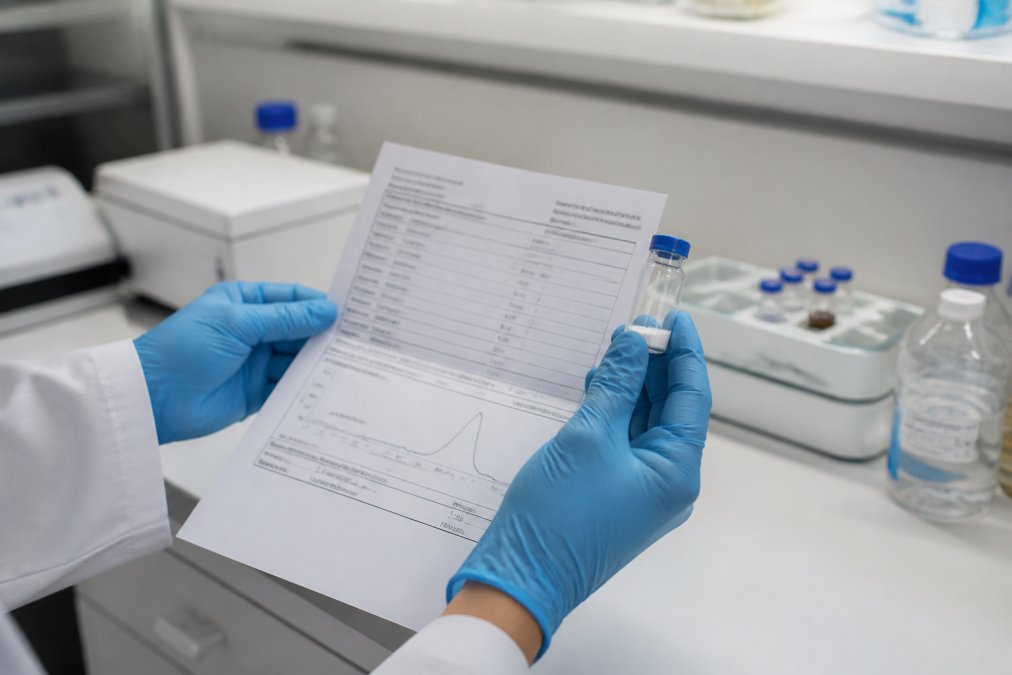
Cross-check the document itself. A legitimate CoA includes the testing laboratory’s name, the analytical method used, the date of analysis, and quantitative results for purity and identity. Look for the molecular weight confirmation and the impurity profile. If any of these fields are missing or vague, the document may be fabricated.
Knowing that a test was performed is only half the battle. The other half is interpreting the results correctly. Most fake suppliers will provide a lab report, but a closer look at the analytical methods reveals whether the document is meaningful or just a prop.
Two analytical methods dominate peptide testing: high-performance liquid chromatography (HPLC) and mass spectrometry (MS). HPLC separates the components of a sample and measures their relative abundance, giving you a purity percentage. Mass spectrometry identifies the exact molecular weight of the compound, confirming that the molecule present is the one you ordered. A complete report should include both. HPLC alone can tell you a sample is 99% pure, but it cannot always tell you what is pure. A vial of salt water with a peptide fragment could pass an HPLC purity check if the fragment elutes at the expected time.
When you review a CoA, look for the specific MS data. A legitimate report will list the observed molecular weight, often in daltons (Da), and compare it to the theoretical molecular weight of the peptide (PubMed). For example, if you ordered a peptide with a theoretical weight of 1,200 Da, the report should show an observed weight within a narrow tolerance, typically ±1 Da. If the report only shows a purity percentage and a chromatogram, without mass confirmation, the identity of the compound is unverified.
A second red flag appears when a supplier’s CoA is dated months before your purchase and references a batch number that does not match your vial. Some suppliers recycle a single CoA for all their products, hoping you will not notice the mismatch. Always ask for the batch-specific report. If the supplier cannot produce one within a reasonable time, treat the product as unverified.
Independent verification services offer a workaround. Services like Janoshik Analytical accept shipped samples and provide batch-specific reports for a fee. This adds cost and time, but for high-value experiments, the certainty is worth it. The process is straightforward: order a small vial, send a sample to the lab, and wait for the results before committing to a larger purchase.
For researchers who want to go deeper, the key is to compare the observed molecular weight against the theoretical value. Most reputable suppliers will list both on their CoA. If the numbers do not align, the product is either mislabeled or degraded. This level of scrutiny separates a real supplier from one that simply posts a PDF to look credible.
A supplier that cannot be physically located is a supplier you cannot hold accountable. Before ordering, verify that the company operates from a real address, not a P.O. box or a residential home masquerading as a warehouse.
Search the address on mapping services and confirm it matches a commercial or industrial location. Cross-reference the business name against state registration databases. Most states require businesses to register with the Secretary of State, and those records are public (usa.gov). A company that has not registered, or that registers under a name different from its website, warrants suspicion.
Contact information matters as well. Does the supplier list a phone number that works? Do they respond to email? A legitimate operation has staff who can answer questions about their products. A fake supplier often relies on contact forms that go nowhere.
Counterfeit peptide suppliers often cut corners in ways that are visible if you know what to look for. Product labeling is the first clue. Legitimate suppliers label vials with the compound name, the batch number, the manufacturing date, the expiration date, and the peptide content in milligrams. Vague labeling, missing batch numbers, or inconsistent typography across products suggests poor quality control.
But the physical state of the product itself is a signal most guides overlook. Peptides are fragile molecules. They degrade when exposed to heat, light, or moisture. A lyophilized (freeze-dried) peptide should appear as a white to off-white powder or a loose plug at the bottom of the vial. If the powder has collapsed into a sticky film, clumped together, or turned a yellowish color, it has likely been exposed to moisture or heat during storage or transit. This is a chemical stability indicator that no paperwork can fix.
Reconstitution behavior also matters. When you add bacteriostatic water to a legitimate lyophilized peptide, it should dissolve readily into a clear, colorless solution. If the solution appears cloudy, has particulates, or foams excessively, the peptide may have degraded or contain impurities. A simple visual check after reconstitution can reveal problems that a CoA cannot.
Packaging tells a story too. Peptides are sensitive to heat and light. They should ship in insulated packaging with cold packs during warm months. A vial that arrives warm, or in a plain envelope, may have degraded during transit. Chemical stability depends on proper storage from the moment of manufacture. Ask the supplier how they store their inventory and whether they ship with temperature control. A supplier that cannot answer this question has not thought about it.
The website itself offers signals. Look for detailed product pages with specific technical information: molecular weight, purity percentage, storage instructions, and reconstitution guidance. Vague descriptions that avoid technical specifics suggest the seller does not understand the product. Check for a published physical address, a privacy policy, and clear terms of service. A supplier that hides its operational details is a supplier that cannot be held accountable.
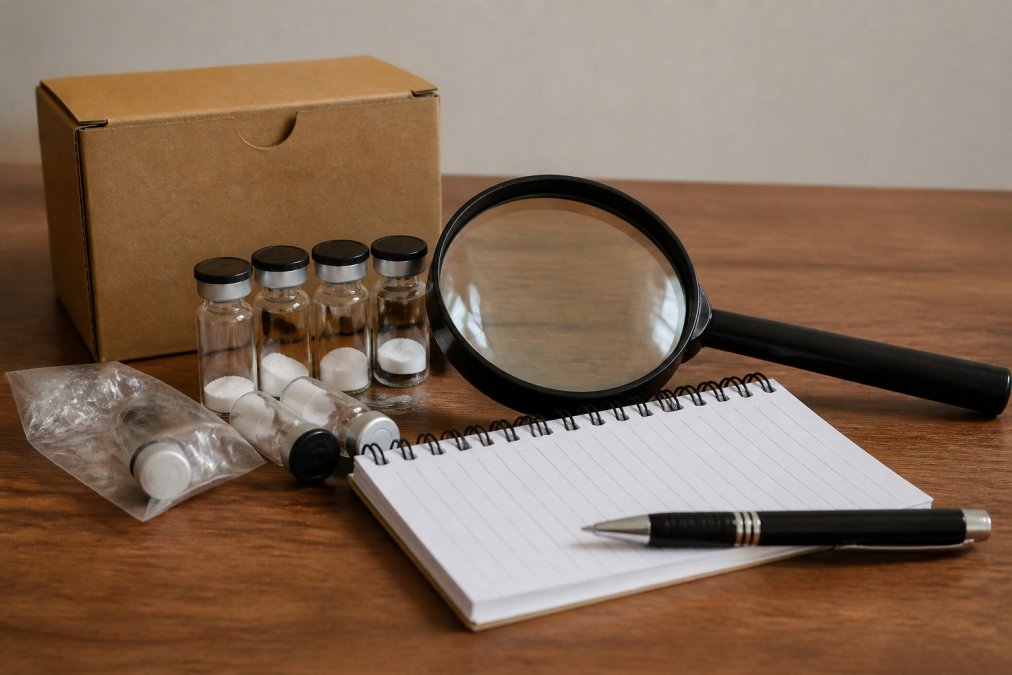
One practical habit is to photograph the vial immediately upon arrival, before reconstitution. Document the batch number, the appearance of the lyophilized powder, and the condition of the packaging. This creates a record you can reference if the product fails later. It also forces you to look closely at what you received, rather than assuming it matches the product page.
Customer support is your window into a supplier’s operations. A fake supplier often has none. Before placing an order, send a technical question about a product. Ask about the batch number, the testing laboratory, or the reconstitution volume. Gauge not just whether they respond, but how quickly and how accurately.
A knowledgeable support team can discuss analytical testing methods, explain the difference between lyophilized and liquid peptides, and answer questions about storage. They understand the supply chain and can trace their products back to the manufacturer. An evasive or generic response suggests the person on the other end knows less about the product than you do.
Response time matters. Suppliers that take days to answer simple questions will take even longer if a shipment arrives damaged or a product tests poorly. At Rejuvenation Wellness Solutions LLC, we prioritize reaching customers within hours by text, phone, or email, because we understand that research timelines do not wait. We stand out against our competitors by offering same day order fulfillment, UPS 2-day air shipping and can be reached by text message, phone and email customer service within hours, not days. We are here to support you in your peptide research.
No single source of truth exists for peptide supplier legitimacy, but the research community has built its own verification networks. Forums and discussion boards where researchers share their experiences with specific suppliers can reveal patterns that individual reviews miss.
These communities often maintain lists of verified and blacklisted suppliers. Members post their own lab results from independent testing services, comparing purity data across batches and suppliers. A supplier with a history of failed tests or inconsistent results will surface quickly.
Exercise judgment when using these tools. Competitors sometimes post fake reviews, both positive and negative. Look for detailed accounts with specific data points: batch numbers, test results, shipping times. Vague complaints or praise without substance carry less weight. Cross-reference information across multiple communities before drawing conclusions.
The market in 2026 demands more diligence than ever. As demand for research peptides grows, so does the incentive for counterfeiters to enter the space. The six verification methods above form a complete vetting protocol, but they work best when applied together.
| Verification Method | What to Check | Red Flag |
|---|---|---|
| Certificate of Analysis | Batch number matches vial label | Mismatched or missing batch numbers |
| Third-Party Testing | HPLC and MS data from independent lab | HPLC results only, no identity confirmation |
| Physical Address | Commercial location, business registration | P.O. box only, unregistered business |
| Labeling & Packaging | Batch number, dates, cold-chain shipping | Vague labels, warm arrival |
| Customer Support | Technical knowledge, response time | Evasive answers, days-long delays |
| Community Verification | Lab results shared by other researchers | Pattern of failed independent tests |
A supplier that passes all six checks still warrants caution on your first order. Start with a small purchase to evaluate the entire process: ordering, shipping, packaging, documentation, and product quality. If the first order checks out, scale up with confidence.
The most important habit is verification before purchase, not after. Once you have reconstituted a peptide and started your experiment, the damage from a bad batch is already done. The time to spot fake peptide suppliers is before you enter your payment information.
For researchers seeking a supplier that meets these standards, Rejuvenation Wellness Solutions LLC partners exclusively with WHO/GMP and ISO-certified manufacturers and 503B compounding pharmacies. Every product is tested for purity and identity, with a Certificate of Analysis available for each batch. Products are verified at 99%+ purity through independent laboratory testing.
Start by comparing the batch number on the vial label to the batch number listed on the supplier’s Certificate of Analysis (CoA). The purity percentage and test date should match the specific batch you received, not a generic report. For definitive verification, consider sending a sample to an independent lab like Janoshik Analytical for HPLC and mass spectrometry testing. This confirms both the identity and purity of the compound, protecting your research from underdosed or counterfeit products.
A legitimate CoA must list the product name, a specific batch number, the test date, and the purity percentage. It should also name the testing method used, such as HPLC or mass spectrometry, and include the signature of the lab analyst. Look for the lab’s contact information and verify the report is from a third-party facility, not the supplier’s own in-house testing. If any of these details are missing, treat the CoA as incomplete and contact the supplier for the full report.
Third-party lab testing provides an unbiased check on the supplier’s claims. When a supplier tests its own products, there is a conflict of interest that can lead to inaccurate purity reports or missed impurities. Independent testing verifies both the identity and purity of the peptide, catching issues like underdosed vials, incorrect molecular weight, or contamination. Always confirm the supplier uses an external lab, and check if you can verify the report directly with that lab.
The biggest red flags include a missing or unverifiable Certificate of Analysis, a lack of a physical business address, and no responsive customer support. Be cautious of suppliers who only accept cryptocurrency or wire transfers, as these payment methods offer no buyer protection. Also watch for unrealistic purity claims without supporting lab data, and websites that use stock photos or vague product descriptions. A professional supplier will provide transparent documentation and answer your technical questions directly.
Search your state’s business registry to confirm the supplier has an active business registration and a verifiable physical address, not just a P.O. box. A legitimate supplier should also have a professional website with clear contact information, including a phone number and email. Call or email their customer support with a technical question about their products or testing methods. A slow or vague response is a strong indicator that the supplier may not be operating transparently.
Finding a trustworthy supplier in this market takes effort, but the alternative is compromising your research with products of unknown origin and composition. At Rejuvenation Wellness Solutions LLC, we make that verification process easier by handling third-party testing, providing batch-specific documentation, and offering same-day fulfillment with UPS 2-day air shipping. Get started with Rejuvenation Wellness Solutions LLC and source peptides you can actually trust for your next study.








