
Last Updated: August 4, 2026
Underdosed peptides, those containing less active pharmaceutical ingredient than specified, compromise trial outcomes, skew efficacy data, and waste months of investigative work. A vial labeled as containing 10 mg might actually contain 7 mg due to degradation during storage, reconstitution errors, or supplier inconsistencies. When researchers rely on underdosed peptides, clinical endpoints shift, statistical power diminishes, and they cannot distinguish between a compound that genuinely doesn’t work and one administered at insufficient strength. This guide shows you how to verify peptide integrity, implement rigorous quality controls, and establish dosing protocols that eliminate this risk.
Peptides degrade through hydrolysis, oxidation, and enzymatic breakdown. A peptide synthesized at 95-99% purity begins degrading immediately. Temperature fluctuations accelerate this exponentially: a peptide stored at room temperature for two weeks may lose 20-30% potency, while the same peptide at -20°C loses only 2-3%.
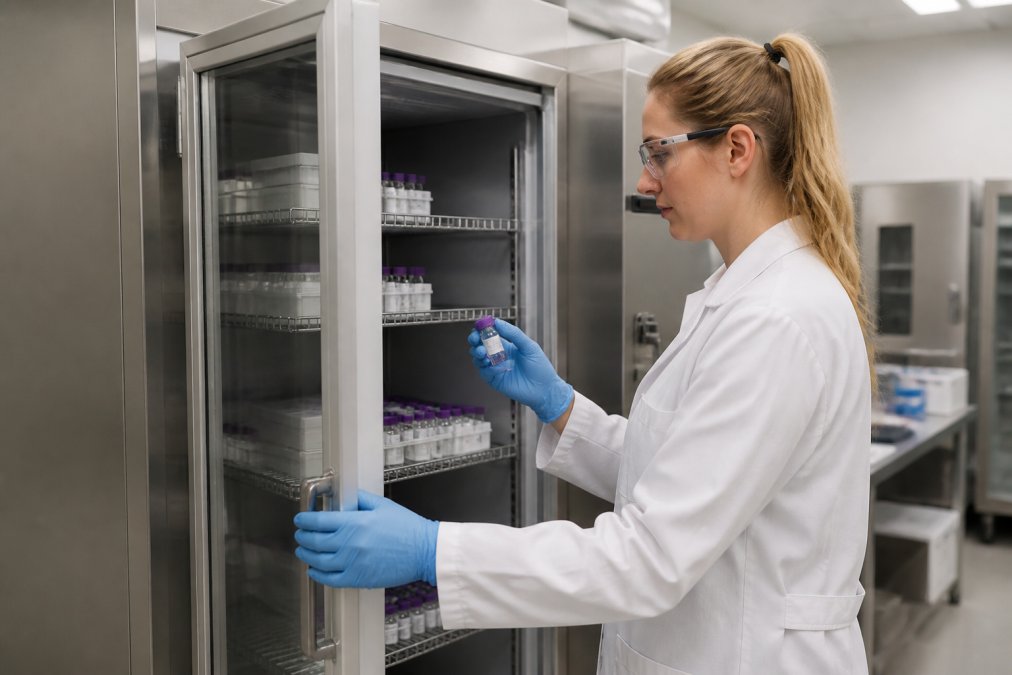
Reconstitution introduces another failure point. When lyophilized peptide powder is reconstituted with bacteriostatic water, rapid mixing, incorrect pH, or contaminated diluent trigger aggregation and precipitation, compromising the final solution’s active concentration.
Supply chain integrity compounds these risks. A manufacturer may produce a batch at 99% purity, but if it sits in a warehouse at 25°C for six months before shipping, the peptide concentration at receipt may be substantially lower. Without independent verification, researchers have no way to know.
The clinical consequence is dose-response relationship confusion. When dosing protocols assume full potency but receive 60-70% of the expected amount, researchers observe weaker effects than literature predicts and may incorrectly conclude the compound is less efficacious.
Stability testing protocols define how peptides degrade under specified conditions and predict shelf-life accurately. These protocols form the backbone of quality assurance in clinical peptide research.
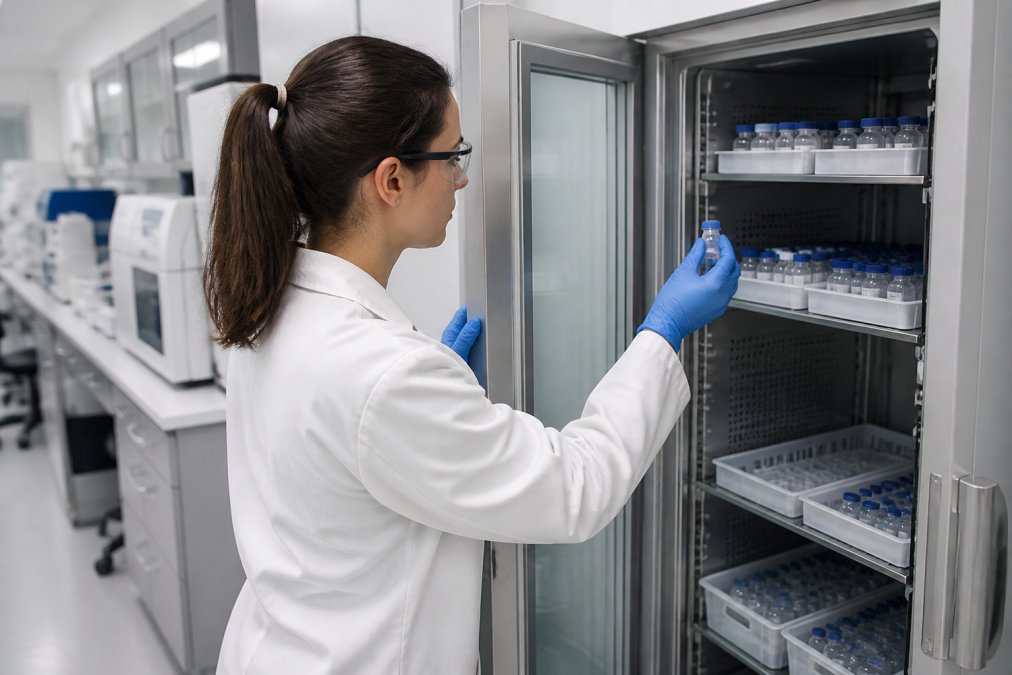
Accelerated stability testing compresses real-world degradation into shorter timeframes. A peptide stored at 25°C for three months undergoes similar degradation to one stored at 4°C for twelve months, following Arrhenius equation principles. Request accelerated stability data from suppliers; it reveals how peptides perform under stress.
Real-time stability testing runs in parallel, with samples stored under actual use conditions (typically 4°C) and assayed at regular intervals. A well-characterized peptide shows predictable, gradual potency loss. Sudden drops flag manufacturing or storage problems.
Most peptides require storage at -20°C for long-term stability; some specialized peptides need -80°C. Verify the exact requirement from your supplier’s CoA. Use data-logging thermometers that record temperature continuously. If your freezer failed for four hours with no record, you cannot know whether peptides were compromised. This documentation also protects you if trial results are questioned.
When peptides arrive, verify package temperature immediately using thermal monitoring stickers. If a package arrived warm, contact the supplier and request replacement. Do not use peptides from compromised shipments in clinical trials.
Use only pharmaceutical-grade bacteriostatic water (0.9% sodium chloride with 0.9% benzyl alcohol). Non-pharmaceutical water introduces contaminants and pH variability that trigger peptide aggregation. Store bacteriostatic water in the refrigerator once opened.
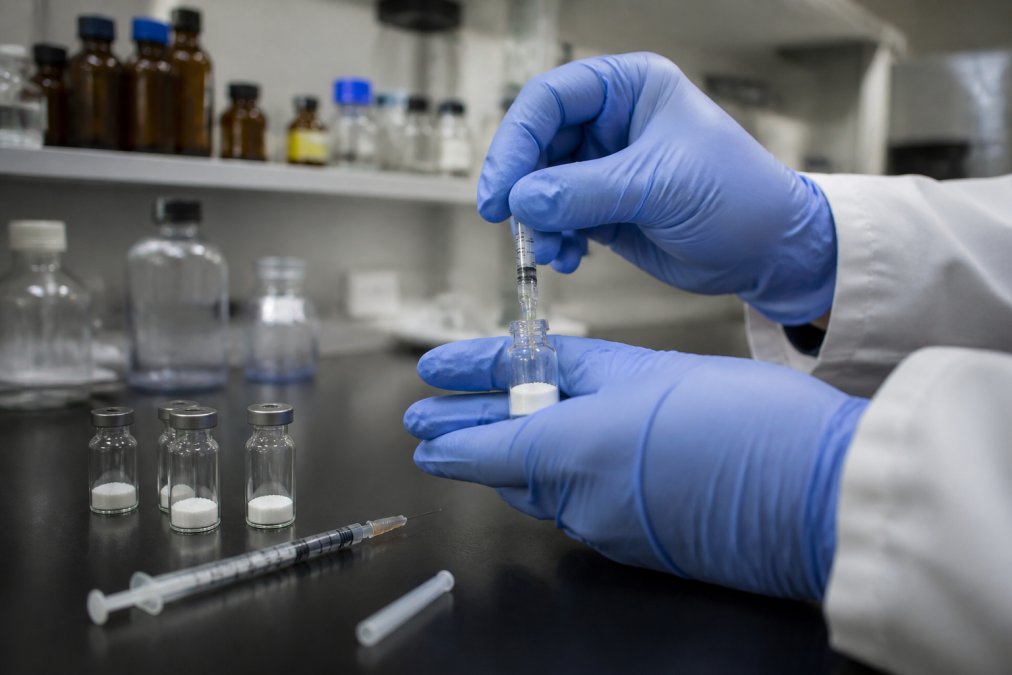
Add water slowly to the peptide vial. Rapid addition creates shear stress causing aggregation and precipitation. Draw the required volume into a sterile syringe, then inject it slowly into the peptide vial at a 45-degree angle. Let the vial sit for five minutes without shaking; gentle swirling is acceptable.
Document the reconstitution date and time on every vial. Most reconstituted peptides remain stable for 14-30 days at 4°C. Record the concentration of your reconstituted solution explicitly. If you reconstitute 10 mg of lyophilized peptide in 10 mL of bacteriostatic water, your concentration is 1 mg/mL. Write this on the vial label so that when you withdraw 1 mL for injection, you know you’re administering 1 mg.
Verifying peptide concentration before administration is the most direct way to prevent underdosed trials. Analytical methods provide quantitative proof of what you’re actually administering.
High-performance liquid chromatography (HPLC) is the gold standard. It separates peptide components by chemical properties and quantifies each. When you run HPLC on your reconstituted peptide, you receive a chromatogram showing purity and concentration. If HPLC shows 6.5 mg/mL instead of the labeled 10 mg/mL, you know the dose must be adjusted or the batch rejected.
Liquid chromatography-mass spectrometry (LC-MS) integrates HPLC with mass spectrometry, confirming both identity and quantity. It’s the preferred method for clinical-grade peptide verification. The cost is higher than HPLC alone, but for trials where dosing accuracy determines success, LC-MS is worth the investment.
A Certificate of Analysis documents the peptide’s purity and concentration at manufacture, but is insufficient for clinical trials alone. It proves quality at production, not at use.
Third-party verification adds an independent check. Send a sample of your received peptide to an analytical laboratory not affiliated with the manufacturer. Request HPLC or LC-MS analysis. This costs $200-500 per sample but provides unbiased confirmation of potency.
Select laboratories following USP (United States Pharmacopeia) or EP (European Pharmacopoeia) standards for peptide analysis. Verify accreditation by organizations like CLIA or ISO 17025.
Compare the third-party result to the manufacturer’s CoA. If they align closely (within 5%), the batch is reliable. If they diverge significantly (>10%), investigate. The manufacturer may have overstated purity, or degradation occurred during storage or shipping.
Bioanalytical validation confirms that the dose you intend to administer actually reaches the research subject at the expected concentration. For injectable peptides, draw your peptide solution into a sterile syringe, inject it into a collection tube, then analyze using HPLC or LC-MS. If you drew 1 mL expecting 10 mg and analysis confirms 10 mg in the collection tube, your delivery is accurate.
For reconstituted peptides used across multiple administrations, validate each reconstitution batch.
The FDA regulates peptide drugs under current good manufacturing practices (cGMP). For investigational new drug (IND) applications, the FDA requires chemistry, manufacturing, and controls (CMC) data demonstrating consistent and safe production.
Peptides manufactured under cGMP must be produced in FDA-inspected and approved facilities. Each batch receives a unique identifier and traceability documentation. Quality control testing is mandatory, including identity, purity, potency, sterility, endotoxin levels, and moisture content.
If your supplier cannot provide documentation of FDA cGMP compliance or equivalent regulatory approval from international authorities (WHO-GMP, EMA), be cautious. Peptides manufactured outside regulated facilities carry higher risk of underdosing and contamination.
For clinical trials, the FDA requires that investigators use only peptides manufactured under IND protocols or obtained from FDA-approved sources. Using research-grade peptides from unregulated suppliers in a clinical trial violates FDA regulations and invalidates trial data.
Choosing the right supplier is the first line of defense against underdosed peptides. Request the supplier’s cGMP certification or equivalent. In the United States, this means FDA inspection records showing the facility is registered and compliant. Internationally, WHO-GMP certification or EMA compliance serves the same purpose. Legitimate suppliers provide these documents readily.
Ask for quality assurance documentation including standard operating procedures (SOPs) for manufacturing, testing, storage, and shipping. Verify third-party testing and which laboratory the supplier uses for final release testing. Check for ISO certifications. ISO 13485 (medical devices) and ISO 9001 (quality management) indicate formal quality systems requiring annual audits and ongoing compliance.
GMP certification ensures peptides are manufactured under conditions preventing contamination and ensuring consistency. For peptides compounded specifically for clinical use, 503B compounding pharmacy standards apply. A 503B pharmacy is a federal facility licensed to compound drugs for clinical use, operating under state pharmacy boards and FDA oversight with regular inspections.
Rejuvenation Wellness Solutions LLC partners with WHO/GMP and ISO-certified manufacturers and 503B compounding pharmacies to ensure every peptide meets these standards. Peptides are synthesized in regulated facilities, tested by independent laboratories, and documented with Certificates of Analysis confirming 99%+ purity.
When you source peptides through a supplier with 503B compounding partnerships, you gain access to peptides manufactured under the same standards as pharmaceutical-grade drugs. The cost is higher than research-grade peptides, but the assurance of dosing accuracy is worth the investment.
Vague or missing documentation is a primary red flag. If a supplier cannot provide a CoA with specific purity percentages, potency assays, and batch numbers, they’re not following standard practices.
Prices significantly lower than competitors suggest cost-cutting. If one supplier charges half the price of others for the same peptide, ask why. Often, the answer is that they skip quality control steps or store peptides in suboptimal conditions.
Lack of temperature control during shipping and unwillingness to provide third-party verification should concern you. Any supplier confident in their product should welcome independent testing. Absence of stability data is a critical gap. If a supplier cannot provide accelerated and real-time stability reports, they don’t know how their products degrade over time.
Even with high-quality peptides, inconsistent dosing protocols introduce variability that mimics underdosing. Standardization ensures every research subject receives the intended dose.
Establish your expected dose-response curve before the trial begins. Review published literature on the peptide. If available studies show that 1 mg produces measurable effects and 5 mg produces maximal effects, target doses within that range.
Define clinical endpoints quantitatively. Don’t rely on subjective assessments like "improved energy." Instead, measure specific biomarkers, performance metrics, or physiological parameters. Document the therapeutic window, the dose range where the peptide is effective without excessive side effects.
Every peptide vial must be tracked from receipt through administration. Implement a batch tracking system recording supplier name and contact information, batch number and manufacturing date, receipt date and condition upon arrival, storage location and temperature, reconstitution date and person, concentration after reconstitution, administration date and subject ID, and expiration date.
Use a simple spreadsheet or laboratory information management system (LIMS) to maintain these records in real-time. When analyzing trial results, correlate them to batch numbers. If one batch produced weaker effects than others, investigate that batch’s history.
| Element | Frequency | Responsibility | Documentation |
|---|---|---|---|
| Receipt verification | Upon arrival | Lab manager | CoA, temperature log, visual inspection |
| Storage condition check | Daily | Lab technician | Temperature log entry |
| Pre-reconstitution testing | Before each batch | Quality assurance | HPLC or LC-MS results |
| Reconstitution documentation | At time of reconstitution | Researcher | Concentration, date, time, initials |
| Dose verification | Before each administration | Clinician | Syringe volume, subject ID, time |
| Post-administration recording | Immediately after | Clinician | Dose delivered, subject response notes |
Assuming manufacturer potency persists unchanged. After three months in a standard freezer with temperature fluctuations, a 99% pure peptide may be 85% pure. Verify potency independently before using peptides in trials.
Reconstituting with non-pharmaceutical water. Using distilled water, tap water, or generic "sterile water" introduces contaminants and pH variability that degrade peptides. Only pharmaceutical-grade bacteriostatic water is appropriate.
Storing peptides at incorrect temperatures. A freezer at -10°C instead of -20°C doubles the degradation rate. Invest in a dedicated freezer with a thermostat and temperature alarm.
Rapid or vigorous reconstitution. Shaking a vial vigorously causes peptide aggregation and precipitation. Use slow, gentle mixing every time.
Failing to document reconstitution details. Without documentation, you cannot determine if a vial has exceeded its stability window.
Using research-grade peptides in clinical trials. Research-grade peptides are labeled "not for human use" because they were not manufactured under cGMP. Clinical trials require clinical-grade peptides manufactured under FDA oversight or equivalent standards.
Skipping third-party verification. Relying solely on manufacturer CoAs leaves you vulnerable to supplier errors or degradation during shipping. Independent verification costs money but prevents costly trial failures.
Incorrect dose calculations. A vial labeled "10 mg" reconstituted in 10 mL yields 1 mg/mL. If you intend to administer 5 mg, you need 5 mL. Use explicit concentration labels and standardized syringes with clear volume markings.
Avoiding underdosed peptides requires vigilance across supplier selection, storage and handling, analytical verification, and protocol standardization. Each step builds on the previous one. A peptide beginning at 99% purity can degrade to 70% through careless storage. An excellent peptide can be rendered ineffective through improper reconstitution. A well-designed trial can fail if dosing protocols lack precision.
The most effective approach integrates all these elements. Start by selecting suppliers like Rejuvenation Wellness Solutions LLC who partner with WHO/GMP and ISO-certified manufacturers and 503B compounding pharmacies. Every peptide undergoes independent lab testing with a Certificate of Analysis confirming 99%+ purity. From there, maintain rigorous storage, implement standardized reconstitution protocols, verify potency before administration, and track every batch meticulously. When you combine these practices, underdosed peptides become a non-issue, your trial measures the peptide’s true efficacy, and your results are reliable.
Ensuring peptide dosing accuracy is non-negotiable for clinical research. Rejuvenation Wellness Solutions LLC provides affordable, high-purity research peptides with comprehensive product kits including peptides, bacteriostatic dilution water, syringes, and alcohol swabs, all backed by independent lab testing. With same-day order fulfillment and UPS 2-day air shipping, plus customer service available by text, phone, and email within hours, you get the reliable support your research demands. Shop with confidence and focus on what matters: advancing your research with peptides you can trust.
Request a Certificate of Analysis from your supplier before accepting any peptide shipment. This document should detail purity levels, identity confirmation, and results from independent analytical testing. Verify the testing was performed by a third-party laboratory, not the manufacturer. Cross-reference the batch number on the vial with the Certificate of Analysis. Ask your supplier if they partner with WHO/GMP or ISO-certified manufacturers, this indicates they follow standardized quality control protocols. Never proceed with a trial batch if you cannot obtain and verify this documentation.
Peptide stability testing protocols measure how quickly peptides degrade under different conditions, temperature, light, humidity, and time. Degradation directly reduces the active concentration in your vial, meaning a dose that was 100 micrograms on day one may be 85 micrograms by day five. Stability data tells you the shelf life, optimal storage temperature, and whether reconstitution affects potency. Without this information, you cannot know if your dose-response calculations are accurate. Always request stability data from suppliers and store peptides according to their specifications to maintain therapeutic window integrity throughout your trial.
The FDA requires that any peptide used in human trials meet Current Good Manufacturing Practice (cGMP) standards for pharmaceutical manufacturing. This includes documented testing for identity, purity, potency, and sterility. For investigational peptides, the manufacturer must provide a Chemistry, Manufacturing, and Controls (CMC) section in your Investigational New Drug (IND) application showing analytical methods, quality control procedures, and stability data. The FDA also requires batch-to-batch consistency documentation. Working with 503B compounding pharmacies or GMP-certified manufacturers helps ensure your peptide supply meets these standards without requiring you to manage all regulatory documentation independently.
Common mistakes include: not verifying supplier credentials before ordering, failing to check reconstitution instructions (improper dilution reduces concentration), storing peptides at incorrect temperatures (causing rapid degradation), mixing peptide batches without documenting which batch was used for which subjects, and assuming purity claims without requesting third-party lab verification. Researchers also sometimes skip dose-response validation after receiving new batches. To avoid these, establish a written protocol for batch acceptance, storage, reconstitution, and administration. Document every step. Never assume two batches from the same supplier have identical potency, treat each batch as a new verification requirement.
[EXTERNAL_LINK: FDA Guidance for Industry: Chemistry, Manufacturing, and Controls (CMC) Information for Human Gene Therapy Investigational New Drug Applications | fda.gov]
[EXTERNAL_LINK: United States Pharmacopeia (USP) Standards for Peptide Purity and Potency Testing | usp.org]
[EXTERNAL_LINK: International Organization for Standardization (ISO) 17025 Accreditation for Laboratory Competence | iso.org]
This article was written using GrandRanker