
Last Updated: August 8, 2026
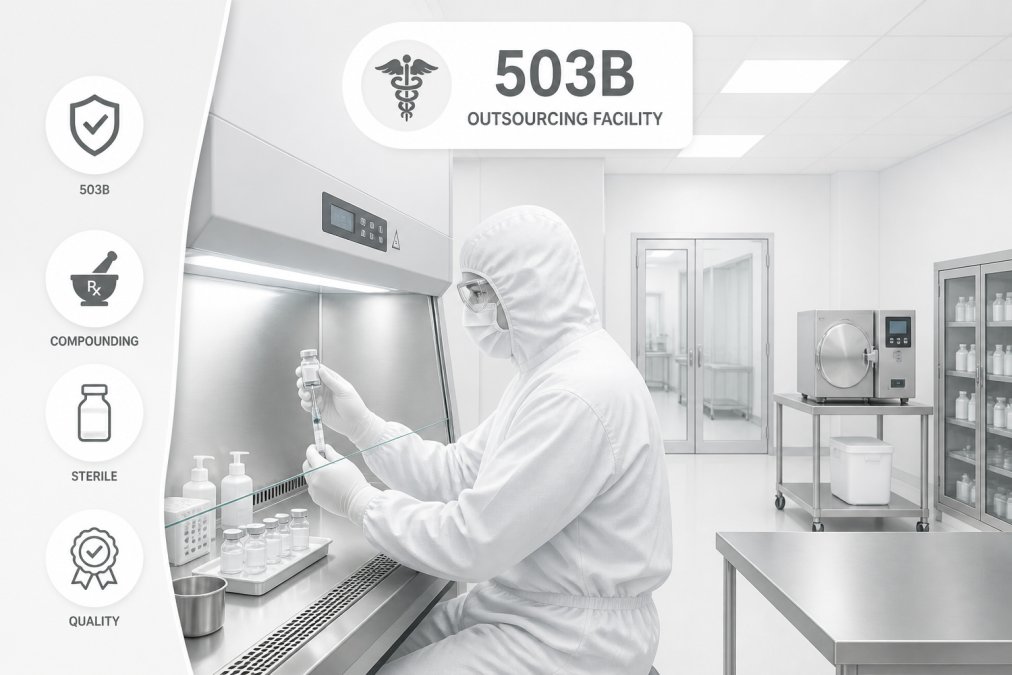
A 503B outsourcing facility is a licensed pharmaceutical operation authorized by the FDA to compound sterile preparations in bulk for dispensing by licensed pharmacies and healthcare providers. These facilities operate under Section 503B of the Federal Food, Drug, and Cosmetic Act and manufacture larger batches of standardized medications under stringent cGMP (current Good Manufacturing Practice) standards, unlike 503A in-office compounding pharmacies that prepare patient-specific compounds in response to individual prescriptions.
The regulatory framework emerged from the Drug Quality and Security Act of 2013, establishing a pathway for large-scale pharmaceutical manufacturing outside the traditional FDA approval process. This addresses critical gaps in drug availability, particularly for medications experiencing supply disruptions or requiring specialized formulations that commercial manufacturers no longer produce.
At Rejuvenation Wellness Solutions LLC, we partner with WHO/GMP and ISO-certified 503B compounding pharmacies to ensure that research peptides and pharmaceutical preparations meet the highest standards of purity and safety. These partnerships provide access to high-purity compounds that have undergone rigorous quality assurance protocols, including independent lab testing with Certificates of Analysis verifying 99%+ purity.
The 503B model balances accessibility with safety by requiring facilities to register with the FDA, comply with pharmaceutical manufacturing standards, and maintain detailed records of all production batches, creating accountability while enabling access to medications that might otherwise be unavailable.
503A compounding pharmacies operate at the individual prescription level, compounding specific medications for individual patients under state pharmacy board regulation without FDA registration. 503B outsourcing facilities manufacture standardized batches in advance without a specific patient prescription, requiring FDA registration and federal cGMP compliance.
The regulatory distinction determines oversight scope. 503A pharmacies answer primarily to state boards with limited FDA oversight. 503B facilities face federal inspection, batch testing requirements, stability studies, and adverse event reporting obligations. This higher regulatory bar exists because 503B products serve multiple patients across multiple healthcare settings.
From a sourcing perspective, 503B facilities offer reliability that 503A operations cannot match. Products are manufactured under pharmaceutical-grade controls, tested against documented standards, and backed by regulatory accountability. Every batch includes a Certificate of Analysis documenting purity and composition.
Rejuvenation Wellness Solutions LLC works exclusively with 503B compounding pharmacies for this reason. The regulatory framework ensures that every peptide and preparation has undergone independent lab testing and carries verified documentation of purity and composition, protecting researchers and ensuring experimental results are not confounded by product quality variability.
cGMP, current Good Manufacturing Practice, is the federal standard governing pharmaceutical manufacturing quality. For 503B facilities, cGMP compliance is a legal requirement enforced through FDA inspection and enforcement action.
cGMP standards address facility design, equipment maintenance, personnel training, production processes, quality control testing, and documentation. Specific requirements include:
These requirements prevent manufacturing errors that could introduce contamination, render medications ineffective, or cause overdose. For researchers and healthcare providers, cGMP compliance means products have been manufactured under conditions designed to prevent these failures.
Drug shortages create clinical challenges when manufacturers discontinue medications or production cannot meet demand. 503B facilities address this gap by manufacturing medications no longer available through traditional commercial channels. This benefit extends to pediatric formulations, rare dosages, and niche products that manufacturers cannot justify producing profitably.
Consistency is a hallmark of 503B manufacturing. Every batch is produced under the same conditions, using the same materials, following documented procedures. Every batch undergoes potency testing to confirm active ingredients are present at declared strength and microbial testing to verify sterility. This consistency is essential for research applications where experimental results depend on using materials with known, verified properties.
When prescribers order medications from 503B facilities rather than compounding in-office, clinical workflow improves. Medications arrive ready to dispense, eliminating in-house compounding time and equipment needs. For high-volume prescribers and specialized medications, the advantage is substantial.
Maintaining in-house compounding capacity requires capital investment in equipment, supplies, and trained personnel. Outsourcing to 503B facilities eliminates inventory holding costs, reduces waste from expired materials, and decreases storage space requirements. The facility’s volume spreads fixed costs across many orders, lowering per-unit prices.
Standardization improves safety and reduces errors. When medications come in single, documented formulations, prescribers and patients know exactly what they are receiving. Batch production enables this standardization at scale, with hundreds of identical units each verified to meet the same specifications. For medications requiring precise dosing, particularly injectables and pediatric formulations, standardization is critical.
FDA oversight of 503B facilities creates accountability and establishes standards providers can rely on. When you source from a 503B facility, you gain assurance that the product has been manufactured under federal oversight, inspected by the FDA, and backed by regulatory accountability. For healthcare providers, this oversight reduces liability. For researchers, regulatory compliance translates to credibility.
In-office compounding generates waste from unused raw materials, expired compounds, and preparation byproducts. 503B facilities achieve economies of scale that reduce per-unit waste and enable more precise material ordering based on known demand patterns.
503B facilities maintain comprehensive documentation of every batch: materials used, manufacturing conditions, testing results, personnel involved, and distribution records. This documentation enables rapid response if problems are identified and supports investigation of root causes. For providers using 503B products, this documentation reduces liability exposure.
503B facilities manufacture specialized formulations that commercial manufacturers do not produce: injectable formulations, pediatric strengths, allergen-free versions, or medication combinations. For research applications, specialized formulations are essential when researchers need peptides in specific concentrations, purity levels, or delivery forms.
Outsourcing sterile preparations to 503B partners is most advantageous when you need medications infrequently or in small quantities. The cost of maintaining in-house compounding equipment, supplies, and trained personnel exceeds the cost of purchasing pre-made preparations.
For research institutions, outsourcing ensures access to verified, documented materials. Products manufactured under cGMP standards with Certificates of Analysis documenting purity and composition are essential for research credibility. The partnership model provides flexibility to adjust production as research needs change without requiring investment in new equipment or expertise.
Rejuvenation Wellness Solutions LLC partners with 503B compounding pharmacies to provide high-purity research peptides from facilities operating under cGMP standards. Every product undergoes independent lab testing and carries a Certificate of Analysis, allowing individual researchers and small institutions to access pharmaceutical-grade materials without the cost and complexity of in-house manufacturing.
Selecting a 503B partner requires careful evaluation. Start by verifying FDA registration through the FDA’s establishment database. Request documentation of cGMP compliance, including recent FDA inspection results. Examine quality assurance procedures by asking how the facility validates processes, what testing it performs on finished products, and how it maintains environmental controls. Request Certificates of Analysis for products you plan to order.
Verify personnel qualifications by asking about training requirements for manufacturing staff. Check for adverse event reporting and ask how the facility investigates and responds to problems. Evaluate stability data to verify products maintain potency and sterility throughout shelf life. Consider supply reliability by asking about lead times, minimum order quantities, and rush order capability.

Assess communication and support by evaluating response times and availability of technical expertise. Finally, verify that the facility’s quality standards align with your requirements. Rejuvenation Wellness Solutions LLC ensures our 503B partners maintain responsive communication channels so researchers and healthcare providers receive support within hours, not days.
Selecting a 503B compounding partner is one of the most important sourcing decisions you can make. Rejuvenation Wellness Solutions LLC partners with WHO/GMP and ISO-certified 503B facilities to ensure that every research peptide and pharmaceutical preparation meets rigorous quality standards. Our same-day order fulfillment and UPS 2-day air shipping, combined with customer service available by text, phone, and email within hours, means you get the materials you need when you need them. Shop with Rejuvenation Wellness Solutions LLC and access the high-purity research peptides that power credible science.
503A facilities are traditional pharmacies that compound medications under state pharmacy board oversight for individual patients with prescriptions. 503B outsourcing facilities operate under FDA oversight and cGMP standards, producing larger batches of sterile preparations for multiple healthcare facilities. The key difference: 503B facilities are regulated as manufacturers under federal law, while 503A pharmacies operate under state regulation. This means 503B facilities undergo rigorous FDA inspection, maintain documented stability studies, and meet pharmaceutical manufacturing standards that 503A compounders do not.
FDA cGMP (Current Good Manufacturing Practice) requirements for 503B facilities mandate environmental monitoring, batch testing, quality assurance protocols, and adverse event reporting. These standards ensure sterile compounded preparations meet pharmaceutical-grade purity and potency. Healthcare providers gain confidence in consistent product quality, reduced contamination risk, and documented stability data. Patients benefit from medications that have undergone rigorous quality oversight comparable to FDA-approved drugs, reducing the risk of substandard or contaminated preparations entering clinical workflows.
503B outsourcing reduces operational burden by eliminating the need for in-house sterile compounding infrastructure, specialized staff, and equipment maintenance. Facilities gain access to batch-produced medications that address drug shortages, reduce inventory carrying costs, and improve prescriber convenience through standardized dosing. Because 503B facilities operate under FDA oversight and cGMP standards, healthcare organizations transfer regulatory and liability risk to an accredited partner, while maintaining supply chain reliability and clinical efficiency.
Yes, 503B outsourcing facilities are regulated by the FDA under Section 503B of the Federal Food, Drug, and Cosmetic (FD&C) Act. They must register with the FDA, comply with cGMP standards, undergo routine FDA inspections, maintain batch records and stability studies, and report adverse events. This federal oversight distinguishes 503B facilities from 503A pharmacies, which operate under state pharmacy board regulation. FDA regulation ensures consistent pharmaceutical manufacturing standards across all 503B facilities nationwide.
This article was written using GrandRanker