
Last Updated: September 14, 2026
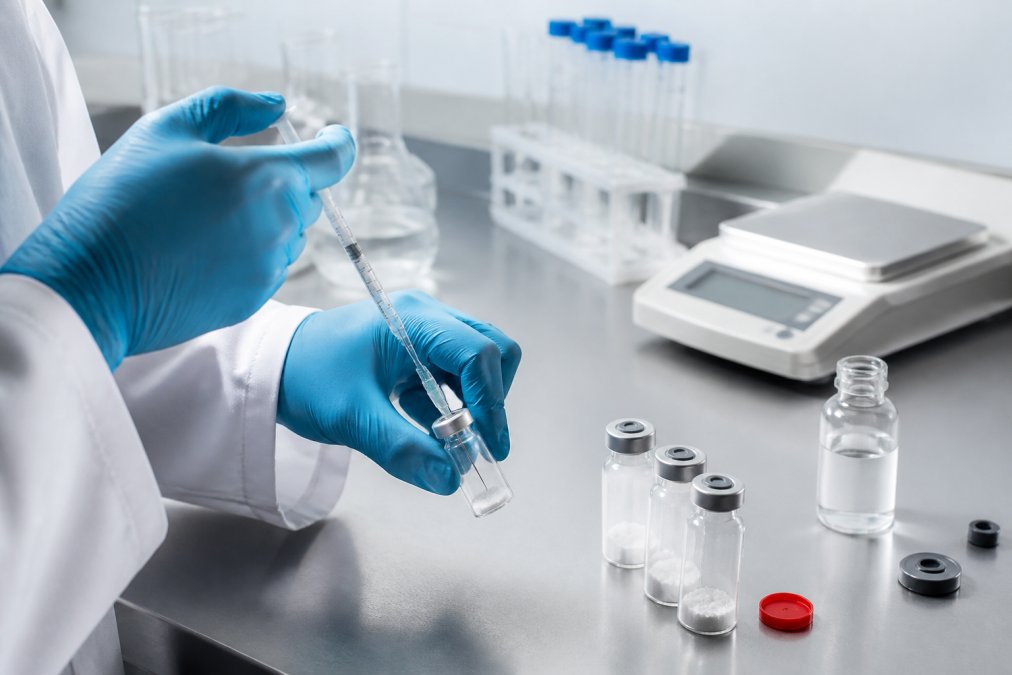
Peptide reconstitution is dissolving a lyophilized (freeze-dried) peptide powder in a liquid solvent to create a solution at a known concentration. This peptide dosage calculation guide from Rejuvenation Wellness Solutions LLC covers the math, syringe conversions, and errors that ruin experiments.
If your reconstitution volume is off by even a small margin, every dose you draw afterward inherits that error.
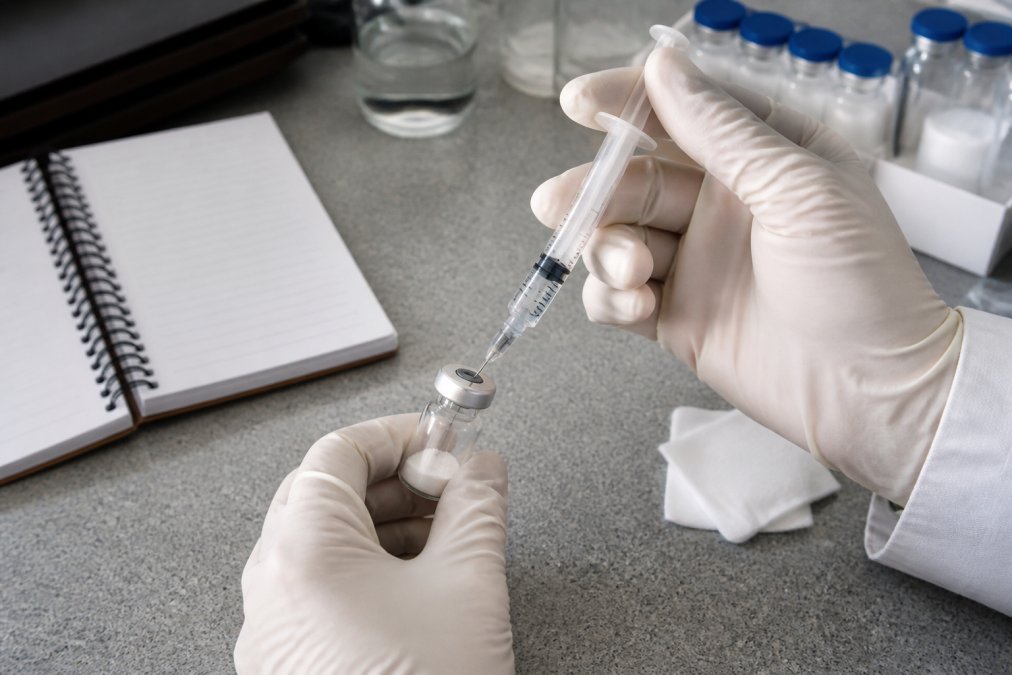
A solute is the substance being dissolved; the solvent is the liquid doing the dissolving. In peptide work, the solute is your lyophilized powder and the solvent is typically bacteriostatic water. Get the ratio wrong and your concentration, and dosage protocol, is wrong.
Inconsistent reconstitution is a leading source of unexplained variability in small studies. The fix costs nothing: measure carefully, record everything, and verify your math before drawing a single unit.
The core peptide dosage calculation formula is concentration (mg/mL) = peptide mass (mg) ÷ diluent volume (mL). Every other step is a conversion built on it.
Once you know your concentration, you can work out how much liquid delivers your target dose. Keep units consistent, mixing milligrams and micrograms is where most errors begin.
The conversion factor is 1,000: one milligram equals 1,000 micrograms (Approximate Conversions from U.S. Customary Measures to Metric | NIST). If a vial contains 5 mg of peptide, that is 5,000 mcg. When a protocol calls for a dose in micrograms, convert the vial content first, then divide by your concentration, and write the conversion out longhand rather than doing it in your head.
Diluent volume is your control variable. You choose how much solvent to add, and that choice sets your final concentration.
| Vial Content | Diluent Added | Final Concentration | Dose per 0.1 mL |
|---|---|---|---|
| 5 mg | 2 mL | 2.5 mg/mL | 250 mcg |
| 5 mg | 5 mL | 1 mg/mL | 100 mcg |
| 10 mg | 2 mL | 5 mg/mL | 500 mcg |
| 10 mg | 5 mL | 2 mg/mL | 200 mcg |
More diluent means a lower concentration and a larger injection volume for the same dose; less diluent means the opposite. Choose the volume that keeps your injection volume comfortably readable on your syringe.
Insulin syringe unit conversion depends on the syringe’s scale. A U-100 syringe is calibrated so 100 units equal 1 mL, meaning each unit represents 0.01 mL.
To find your injection volume, divide the desired dose by the concentration, then convert to syringe units. A 250 mcg dose from a 2.5 mg/mL solution needs 0.1 mL, or 10 units on a U-100 syringe.
Syringe markings vary by brand and capacity, so read the scale before you draw. Common U-100 barrels show half-unit or full-unit graduations.
Work the formula in one direction only, writing each step down.
If your answer requires drawing less than the smallest graduation, your solution is too concentrated. Add more diluent and recalculate rather than guessing at a partial unit.
A Certificate of Analysis (COA) reports what is actually in the vial, including purity, identity, and testing method. Reading it properly tells you whether the label mass is the mass to use in your calculations, and in most cases, it is not exactly.
A COA reports several figures that look similar but mean different things:
Researchers often treat the purity percentage as if it were the peptide content. They are different measurements: purity describes how much of the detected material is the target peptide; peptide content describes how much of the vial’s total mass is peptide at all.
A vial can be 98% pure by HPLC yet contain only 80-85% peptide by mass once counter-ions (commonly acetate or trifluoroacetate) and bound water are accounted for (pubmed.ncbi.nlm.nih.gov). Calculating concentration from label mass alone can leave your actual concentration meaningfully lower than your calculated one.
If your COA reports peptide content, use it to adjust the mass you plug into the concentration formula:
If your COA does not report peptide content, note that in your records and treat the label mass as an upper bound, not an exact figure.
Rejuvenation Wellness Solutions LLC sources peptides from WHO/GMP and ISO-certified manufacturers and 503B compounding pharmacies, and every product undergoes independent lab testing with a Certificate of Analysis. That documentation lets you calculate from a verified mass rather than a claimed one.
The most frequent error is unit mismatch: dividing micrograms by milligrams per milliliter without converting first, producing an answer that looks plausible but is wrong by a factor of 1,000.
Other recurring mistakes include:
Two problems account for most “impossible” results: reversed arithmetic and syringe dead space. Both can shift your delivered dose by more than the tolerance of a small study.
Dead space is the liquid remaining in the needle hub, hub cavity, and needle after you depress the plunger. It is not zero, and on insulin syringes it is often larger than the smallest graduation on the barrel.
Typical patterns researchers observe:
Why it matters: if your target draw is 10 units and your dead space equals 1-2 units, the delivered volume can be off by 10-20% before you make a single arithmetic mistake. Across draws from the same vial the offset is consistent, but it is still an offset.
How to manage it:
Before you draw, run a three-question check on your calculated volume:
The most common math error is dividing when you should multiply, or dividing by the wrong quantity. It produces an answer that looks plausible and is wrong by a factor of 1,000 or more.
To catch it, recalculate from scratch on paper rather than re-reading your previous work. Re-reading your own steps tends to confirm the mistake rather than reveal it. Then check the result against the table in the concentration section: if your answer does not fall between the smallest and largest plausible volumes for that vial size, stop and find the error.
A degraded solution no longer matches its calculated concentration, so a correct calculation can still produce an incorrect dose. Temperature and light exposure are the two most common drivers of degradation (pubmed.ncbi.nlm.nih.gov).
The math behind peptide work is not difficult, but it is unforgiving of small shortcuts. Converting units carefully, verifying concentration, and documenting every step separates reproducible research from guesswork.
Rejuvenation Wellness Solutions LLC supplies affordable, high-purity research peptides to individual researchers, backed by independent lab testing and a Certificate of Analysis with every product. Comprehensive kits include peptides, bacteriostatic dilution water, syringes, and alcohol swabs, so your reconstitution setup is complete from the first draw. We offer same-day fulfillment and support reachable by text, phone, or email.
Get started with Rejuvenation Wellness Solutions LLC and give your calculations a verified foundation.
First, determine the total peptide mass in the vial (e.g., 5 mg). Add your chosen volume of diluent (e.g., 2 mL) to reconstitute. This gives a concentration of 2.5 mg/mL. If you need a 250 mcg dose, convert to mg (0.25 mg) and divide by concentration: 0.25 mg ÷ 2.5 mg/mL = 0.1 mL. Then convert to syringe units based on your syringe type (e.g., 10 units on a U-100 syringe). Always verify your math before drawing up.
The core formula is: Concentration (mg/mL) = Total peptide mass (mg) ÷ Volume of diluent added (mL). For dosing, use: Volume to inject (mL) = Desired dose (mg) ÷ Concentration (mg/mL). For example, a 10 mg vial reconstituted with 5 mL of bacteriostatic water yields 2 mg/mL. A 500 mcg (0.5 mg) dose requires 0.5 ÷ 2 = 0.25 mL. This formula works for any peptide and diluent volume.
Insulin syringe unit conversion depends on the syringe scale. On a U-100 syringe, 100 units = 1 mL. So if your concentration is 2 mg/mL and you need a 200 mcg (0.2 mg) dose, you calculate 0.2 mg ÷ 2 mg/mL = 0.1 mL, which equals 10 units. On a U-50 syringe, 50 units = 0.5 mL, so 0.1 mL would be 20 units. Always match the unit markings to the syringe you are using.
A Certificate of Analysis (CoA) provides independent lab verification of a peptide’s identity, purity, and concentration. It confirms the product meets research-grade standards, typically 99% or higher purity. Without a CoA, you cannot verify the actual peptide content, which directly affects your dosage calculations. A reliable CoA includes HPLC and mass spectrometry data, lot number, and testing date. Always request and review the CoA before using any peptide in your study.