
Last Updated: October 8, 2026
Peptide research in drug discovery is shifting from a niche corner of biochemistry into one of the most active areas of therapeutic development, driven by advances in computational design, delivery science, and manufacturing quality control. At Rejuvenation Wellness Solutions LLC, we supply high-purity research peptides to the laboratories doing this work, which gives us a close view of where the field is heading.
The old knock on peptides was that they were fragile, expensive to make, and nearly impossible to deliver without an injection. That criticism is fading. Researchers now treat peptides as a modular platform: short chains of amino acids that can be tuned for specificity, then produced at scale with far better consistency than a decade ago.
Peptide research sits at the intersection of three moving parts, and each one is loosening a constraint that used to hold the field back.
AI in peptide drug discovery is the use of machine learning models to predict which amino acid sequences will bind a target, remain stable, and avoid toxicity, replacing much of the trial-and-error of physical screening. Instead of synthesizing thousands of candidates, teams now generate and rank them computationally first.
The practical effect is a shorter list of better candidates entering the lab. Machine learning models trained on structural and binding data can flag sequences that would have taken months to rule out manually.
The biggest change is the order of operations. Traditional workflows synthesized first and tested later; modern workflows predict first and synthesize only the most promising sequences. That reordering cuts both cost and time per candidate, and it lets smaller labs compete on design rather than budget.
What most guides miss is that model output is only as good as the training data behind it. A prediction is a hypothesis, not a result, and it still has to be confirmed at the bench.
Peptide drug delivery has historically meant injection, because peptides break down in the digestive tract and struggle to cross biological barriers (pubmed.ncbi.nlm.nih.gov). That constraint is easing as researchers develop formulations that protect the peptide long enough to reach its target.
Non-injectable formats, including topical and oral delivery systems, matter for a simple reason: they change who can participate in a study and how faithfully they follow the protocol. A format that is easier to administer tends to improve adherence, which in turn makes trial data cleaner.
We are expanding our own catalog beyond injectable forms toward topical and oral options, because that is where researcher demand is moving.
| Delivery Format | Typical Challenge | Why It Matters for Research |
|---|---|---|
| Injectable | Requires sterile technique | Precise dosing, established protocols |
| Topical | Barrier penetration | Easier administration, adherence |
| Oral | Digestive breakdown | Convenience, larger study populations |
Peptide stability is the ability of a peptide to maintain its structure and activity during storage and handling. It is the quiet variable that decides whether a promising molecule ever becomes a usable product.
Instability shows up as degradation, aggregation, or loss of potency, and it can invalidate results if it goes unnoticed. Common fixes include lyophilization, cold-chain storage, and formulation additives that slow breakdown. For researchers, the practical rule is simple: store peptides exactly as the supplier specifies, and check the certificate of analysis before assuming a batch is sound.
Therapeutic peptides are gaining ground in areas where small molecules lack specificity and antibodies are too large or costly (pubmed.ncbi.nlm.nih.gov). Metabolic, oncology, and immunology research programs have become especially active.
A common approach is to use peptides as targeted signaling agents, engineering them to hit a receptor with high precision while limiting off-target effects. The trade-off is that therapeutic peptides still face delivery and stability hurdles, which is why the three shifts above matter so much to the pipeline’s growth.
For labs sourcing material, that growth means demand for consistent, well-documented peptides rather than one-off purchases.
Trustworthy peptide sourcing comes down to documentation and verification, not marketing claims. A supplier that cannot show you independent lab testing and a certificate of analysis is asking you to take purity on faith.
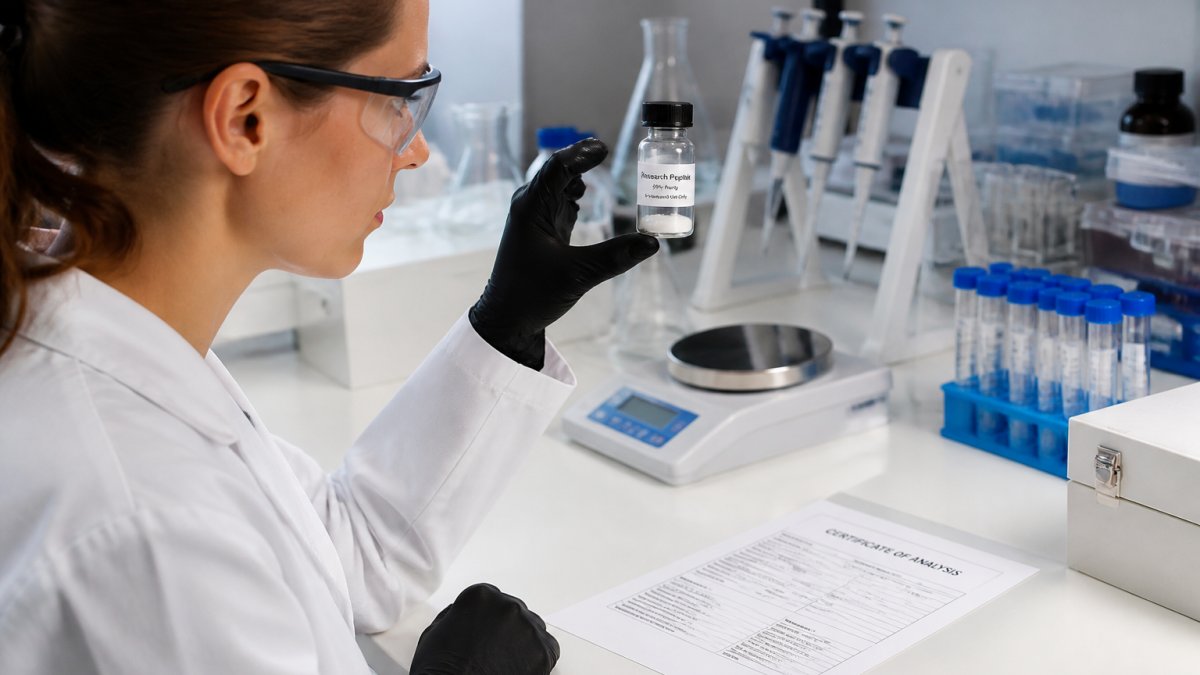
At Rejuvenation Wellness Solutions LLC, every product undergoes independent lab testing with a Certificate of Analysis, and we partner with WHO/GMP and ISO-certified manufacturers and 503B compounding pharmacies. Our products are 99%+ pure, and we work with individual researchers aged 21 and over, not just institutions. Use this checklist before you commit to any supplier:
We also offer same-day order fulfillment, UPS 2-day air shipping, and customer service by text, phone, or email within hours. If you are weighing a switch from your current supplier, start with a single verified batch rather than moving your whole workflow at once.
Peptide research is moving fast, and the labs that keep pace are the ones with reliable material and clean documentation behind every batch. If sourcing uncertainty is slowing your work, Rejuvenation Wellness Solutions LLC can help: every product is independently tested with a Certificate of Analysis, backed by WHO/GMP and ISO-certified manufacturing partners, and shipped with same-day fulfillment and UPS 2-day air. Get started with Rejuvenation Wellness Solutions LLC and run your research on peptides you can actually verify.
The near-term direction is toward computational design, better delivery formats, and more stable molecules. AI models can now propose peptide sequences with desired binding properties before any lab work begins, which shortens early-stage timelines. On the delivery side, researchers are testing oral, topical, and inhaled formats to reduce reliance on injections. Stability engineering, including modifications that resist enzymatic breakdown, is making once-fragile peptides viable as commercial therapeutics. Together these shifts are moving peptide research from a niche specialty toward a core part of mainstream drug development.
Peptide stability improves through chemical modifications such as cyclization, non-natural amino acids, and PEGylation, all of which slow enzymatic degradation and extend shelf life. For delivery, researchers are testing cell-penetrating peptides, lipid nanoparticles, and permeation enhancers to move peptides across biological barriers. Oral formulations remain the hardest target, but topical and subcutaneous options are advancing faster. For laboratory work, proper storage matters just as much: lyophilized peptides kept cold and reconstituted with bacteriostatic dilution water hold their integrity longer than poorly stored stock.
Peptides sit between small molecules and large biologics. They bind targets with the specificity of biologics but can be synthesized chemically like small molecules, which keeps manufacturing more controllable. Their main drawbacks are short half-life in circulation and poor oral absorption, both of which active research is addressing. Small molecules still win on oral convenience; biologics win on durability. Peptides are gaining ground in areas like metabolic disease and oncology, where target selectivity matters more than pill-form convenience.
AI contributes at several stages of peptide research. Generative models propose novel sequences predicted to bind a target, reducing the number of candidates that need synthesis and testing. Structure-prediction tools estimate how a peptide will fold before it is made. Machine learning also helps predict stability and permeability, flagging sequences likely to degrade or fail absorption tests. The result is fewer dead ends in early discovery. Researchers still validate every prediction in the lab, but the screening funnel is narrower and faster than it was a decade ago.