


Last Updated: September 27, 2026
Good Manufacturing Practice (GMP) is the quality system that governs how a peptide moves from a laboratory bench to a regulated product, and GMP peptide synthesis is the process of building that peptide under documented, reproducible, and auditable conditions. This guide from Rejuvenation Wellness Solutions LLC walks through each stage, from resin selection to the Certificate of Analysis that ships with the vial.
Research-grade peptides are manufactured for laboratory experimentation, where the buyer accepts the risk of variable purity and limited documentation. GMP peptides are manufactured under a quality management system, which means every batch carries a traceable record of materials, process parameters, and analytical results.
The GMP peptide synthesis process follows six stages, each with its own documentation and release criteria.
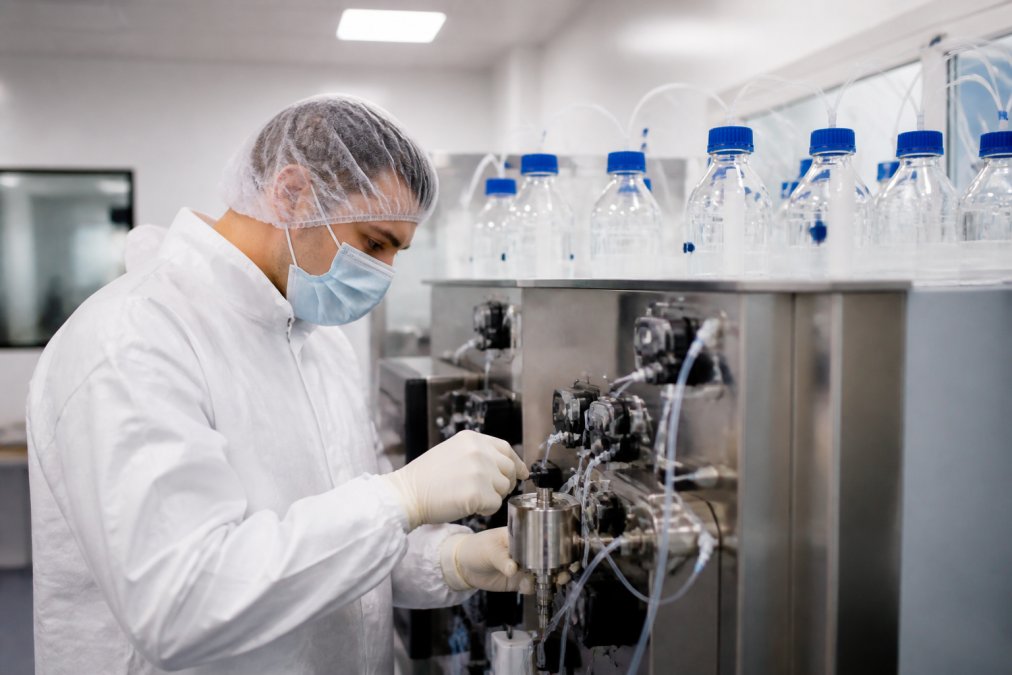
Solid-phase peptide synthesis (SPPS) builds the chain while it is anchored to an insoluble resin bead, allowing excess reagents to be washed away after each coupling reaction. It is the standard method for peptides up to roughly 50 residues.
cGMP peptide manufacturing standards are the current Good Manufacturing Practice requirements enforced by the FDA for any facility producing peptides intended for regulated use. The word “current” is doing real work in that sentence: the expectations shift as technology, guidance, and inspection findings evolve, so a facility that passed an inspection five years ago is not automatically aligned with today’s standard.
The requirements that most affect peptide production specifically are:
The recurring inspection focus areas for peptide facilities are:
For the underlying framework, the FDA’s current Good Manufacturing Practice regulations set out the baseline expectations that peptide facilities are inspected against, and the FDA’s guidance documents on cGMP cover the sector-specific interpretations that apply to peptides and sterile compounding.
Peptide purity testing methods combine separation techniques with structural confirmation. No single test proves a peptide is what the label says; the release decision rests on several orthogonal methods agreeing. The word “orthogonal” matters here: two methods that rely on the same physical principle can fail in the same way, so a release panel is built from techniques that measure different properties.
The standard release panel for a GMP peptide includes:
| Test | What It Confirms | Typical Method | Typical Acceptance Criterion |
|---|---|---|---|
| Purity | Percentage of target peptide relative to total peak area | RP-HPLC with UV detection at 214 nm | ≥95.0% for research-grade GMP; ≥98.0% for clinical material |
| Identity | Correct molecular mass | Electrospray ionization mass spectrometry (ESI-MS) or MALDI-TOF | Observed mass within ±0.5 Da of theoretical |
| Counterion content | TFA or acetate load | Ion chromatography | Reported value; specification set by intended use |
| Water content | Residual moisture | Karl Fischer titration | Typically ≤8% for lyophilized powder |
| Appearance | Visual quality | Visual inspection against a reference | White to off-white powder |
| Amino acid analysis | Composition matches sequence | Acid hydrolysis followed by HPLC or GC | Molar ratios within ±10% of theoretical |
| Residual solvents | Organic solvent carryover | Gas chromatography (GC) headspace | Per ICH Q3C limits |
| Endotoxin | Bacterial contamination | LAL assay | <5 EU/mg for injectable-grade material |
This is the part most guides gloss over, and it is where the release specification actually gets built. The impurities in a peptide batch are not random; they are the predictable byproducts of the chemistry used to make it, and different synthesis routes leave different signatures.
Analytical validation ensures each method performs consistently before it is used for release. The ICH Q2(R1) framework requires documented evidence for accuracy, precision (repeatability and intermediate precision), specificity, limit of detection, limit of quantitation, linearity, range, and robustness. For a purity method, specificity means the method resolves the target peptide from its known impurities, truncated sequences, epimers, and oxidized forms, not just from the solvent front.
FDA 503B compounding pharmacy regulations govern outsourcing facilities that compound sterile drugs without a patient-specific prescription. These facilities sit in a different regulatory category from traditional 503A pharmacies, with stricter requirements around sterility assurance, batch testing, and adverse event reporting.
Scale-up is where a process that worked flawlessly at bench scale starts producing out-of-specification batches. The failures cluster in a few predictable places.
A Certificate of Analysis (CoA) is the document that reports the measured results for a specific batch: purity by HPLC, identity by mass spectrometry, appearance, and any other release tests the specification requires. It is batch-specific, not product-specific, which is the detail most buyers miss.
GMP-grade peptide synthesis requires a quality management system, validated processes, traceable raw materials, controlled cleanroom environments, and documented batch records. Every step from amino acid coupling to purification and lyophilization must follow written procedures. Analytical testing including HPLC and mass spectrometry confirms identity and purity. A Certificate of Analysis documents the results. These requirements ensure the final therapeutic peptide meets the consistency and safety standards needed for clinical and research use.
Research-grade peptides prioritize cost and speed, often with purity around 95% and limited documentation. GMP peptide synthesis follows cGMP peptide manufacturing standards, which demand validated equipment, controlled environments, full traceability, and extensive batch records. Purity typically exceeds 98%, and every lot undergoes independent testing. The trade-off is higher cost and longer lead times, but the result is a peptide suitable for regulatory filing, clinical trials, and reproducible research outcomes.
A Certificate of Analysis (CoA) is the primary document proving a peptide batch meets its specifications. It reports purity percentage from HPLC, molecular weight confirmation from mass spectrometry, and often residual solvents or trifluoroacetic acid content. For researchers, the CoA provides traceability and confidence that the peptide is what the label claims. Without a CoA, you cannot verify purity or identity, which undermines reproducibility and raises safety concerns for any study.
Quality control in peptide manufacturing includes raw material testing, in-process checks during coupling and cleavage, purification monitoring via chromatography, and final product testing. Final tests cover purity by HPLC, identity by mass spectrometry, residual solvents, water content, and sterility when required. Stability studies confirm shelf-life under defined conditions. Each step is documented in the batch record, and deviations trigger investigation before release. This sequence ensures the peptide meets its specifications before it reaches the researcher.








