

Last Updated: September 10, 2026
Peptide synthesis is the laboratory process of building short chains of amino acids into defined sequences through controlled chemical reactions, producing molecules used as therapeutic agents, enzyme inhibitors, and research standards. Rejuvenation Wellness Solutions LLC supplies researchers with synthetic peptides manufactured under strict purity standards, because reliable results depend on a reliable molecule.
A single missed coupling step can leave a truncated sequence that behaves nothing like the target compound, and that failure often goes unnoticed until late-stage assays produce confusing data. Below, we break down how peptide synthesis works in clinical research, how solid-phase and liquid-phase methods differ, and what documentation you need before a peptide touches your study.
Recombinant expression works well for large proteins, but short sequences of 5 to 50 residues are difficult to produce biologically with the structural precision clinical work requires. Synthetic routes give researchers exact control over sequence length, terminal modifications, and stereochemistry.
Peptide bonds form through condensation reactions between the carboxyl group of one amino acid and the amine group of the next. Each cycle requires protecting groups to prevent unwanted side reactions, and each deprotection and coupling step must go to completion. When researchers need a modified peptide, such as a D-amino acid substitution to resist enzymatic breakdown, no biological system offers comparable precision.
Solid-phase peptide synthesis (SPPS) anchors the growing chain to an insoluble resin support, while liquid-phase peptide synthesis (LPPS) builds the sequence in solution with purification between steps. SPPS dominates clinical and research applications because excess reagents wash away by filtration, driving coupling reactions toward completion.
The trade-off is scale. SPPS is efficient for sequences under roughly 50 residues, but longer chains accumulate deletion impurities as coupling efficiency compounds across cycles. LPPS handles larger quantities and shorter sequences economically, though it demands more labor and solvent per gram of final product.
| Factor | Solid-Phase (SPPS) | Liquid-Phase (LPPS) |
|---|---|---|
| Chain length | Up to ~50 residues | Short sequences, 2-10 residues |
| Scale | Milligrams to grams | Grams to kilograms |
| Purity control | Wash-away excess reagents | Purification each step |
| Typical use | Research and clinical peptides | Bulk and fragment synthesis |
| Main limitation | Deletion impurities at length | Labor and solvent intensity |
Many labs now combine both approaches, synthesizing fragments by SPPS and joining them in solution, a hybrid strategy that extends achievable sequence length without sacrificing purity.
Every synthesis follows the same core steps regardless of scale, but the chemistry inside each step is where batches succeed or fail. Understanding the workflow at the reagent level helps you interpret the purity profile and analytical data that accompany your material, and ask suppliers the right questions.
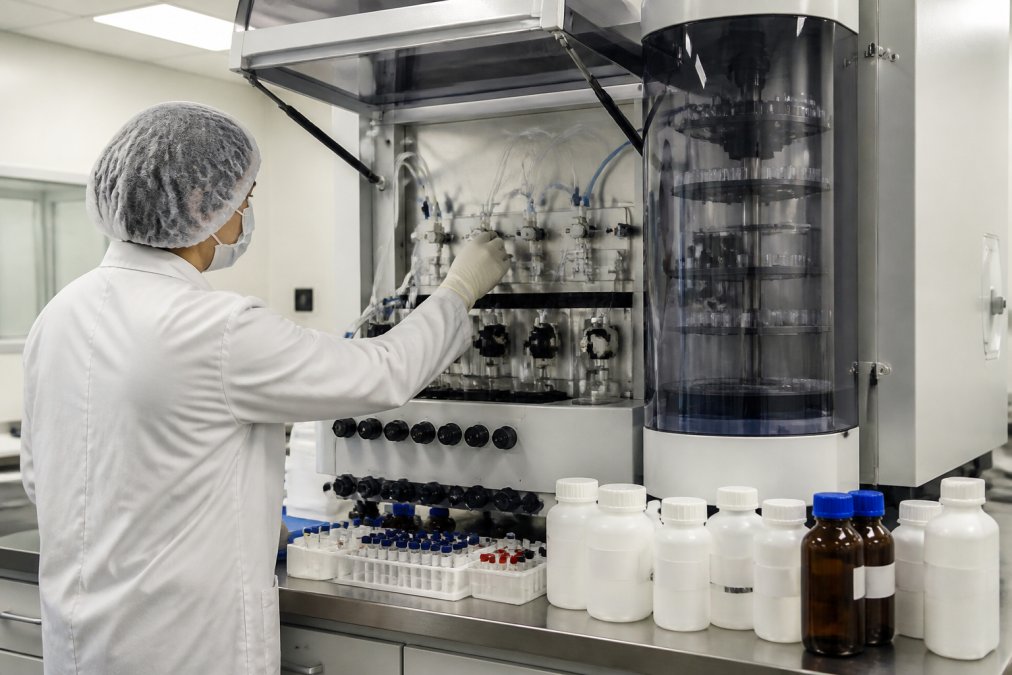
Reagent optimization at the coupling stage separates a clean synthesis from a costly one. Incomplete coupling is the most common failure point, showing up later as a shoulder on the chromatography trace. Aggregation during chain assembly, driven by beta-sheet propensity in sequences with alternating hydrophobic residues, is the second most common cause of truncated product.
Research-grade and clinical-grade synthesis follow the same chemistry but diverge sharply in documentation and control. Clinical workflows add:
The chemistry is identical, but the evidence package is not. If your study will be reviewed by an institutional review board or submitted to the FDA, workflow documentation matters as much as the molecule.
GMP certified peptides are synthetic peptides manufactured under Good Manufacturing Practice conditions, meaning every batch is produced with documented control over facilities, equipment, materials, and personnel. For clinical research, that documentation is not optional.
Certification signals traceable records, validated processes, and consistent quality across batches. Rejuvenation Wellness Solutions LLC partners with WHO/GMP and ISO-certified manufacturers and 503B compounding pharmacies so every product carries that chain of accountability. Independent lab testing with a Certificate of Analysis backs each batch, letting you defend your reagent sourcing to an institutional review board or funding body.
The FDA does not regulate research peptides as a single category. How a synthetic peptide is regulated depends on its intended use: a peptide used as an investigational drug falls under the agency’s drug requirements, while one used purely as a laboratory reference standard does not. Researchers should check the FDA guidance on drug development and clinical trials to determine which framework applies to their work.
For peptides intended for clinical use, expect requirements covering manufacturing controls, characterization, stability data, and documentation of the analytical methods used to confirm identity and purity. The FDA’s current Good Manufacturing Practice regulations set the baseline for how those materials must be produced. Individual researchers running non-clinical studies operate under different expectations, but sourcing from a documented, certified supply chain protects the integrity of the work either way.
A Certificate of Analysis (CoA) ties a specific batch to its analytical results. A useful CoA is batch-specific, not a generic template reused across products. But the fields matter less than the methods behind them, and most researchers never ask which method produced the number.
Purity by RP-HPLC. Reverse-phase high-performance liquid chromatography separates the target peptide from deletion sequences, truncated fragments, and oxidation products. Reported purity is the area percentage of the main peak. A single sharp peak at 220 nm is a good sign; a broad peak or multiple shoulders indicates impurities. Ask for the chromatogram, not just the percentage.
Identity by mass spectrometry. Electrospray ionization (ESI) or matrix-assisted laser desorption/ionization (MALDI) confirms the molecular weight matches the theoretical value for the intended sequence. A mass off by a known adduct (sodium, potassium, TFA) is usually fine; a mass off by an amino acid residue indicates a sequence error.
Peptide content by weight. This is the percentage of the vial’s mass that is actual peptide, versus counterions, water, and residual solvents. A peptide can be 98% pure by HPLC and only 70% peptide content by weight. Calculating working concentrations from vial mass without correcting for peptide content makes assay concentrations wrong by 30% or more.
Amino acid analysis (AAA). Acid hydrolysis followed by chromatographic quantification of individual residues confirms expected amino acid ratios. AAA catches substitutions and deletions that mass spectrometry alone can miss when the mass shift is small.
Counterion and residual solvent testing. TFA is the most common counterion from RP-HPLC purification. Residual TFA can be cytotoxic in cell-based assays, so many clinical workflows require acetate or hydrochloride exchange. Residual solvent testing (by gas chromatography) covers DMF, DCM, and other process solvents.
Water content by Karl Fischer titration. Lyophilized powders absorb moisture. Water content affects stability and the accuracy of weight-based concentration calculations.
The distinction between purity and peptide content trips up many researchers. A product can show high purity by HPLC while containing a significant fraction of counterions and moisture by weight, changing how you calculate working concentrations.
For peptides intended for clinical use, the FDA’s current Good Manufacturing Practice regulations set the baseline for what batch documentation must contain. A research-grade CoA and a clinical-grade CoA may look similar on the surface, but the clinical version is backed by validated methods, retained samples, and an auditable batch record. If your study will face regulatory review, confirm which standard your supplier’s CoA actually meets.
Most synthesis failures trace back to a handful of causes: incomplete coupling, premature cleavage of protecting groups, aggregation during chain assembly, and oxidation of sensitive residues such as methionine and cysteine. Each leaves a detectable signature in the analytical data, which is why running mass spectrometry alongside chromatography catches problems purity percentages alone can hide.
Cost follows method and scale. SPPS consumes more reagent per gram at large scale, while LPPS burns labor hours on repeated purification. Researchers weighing methods should factor in the cost of failed batches, not just the sticker price of reagents. For a fuller picture of how compliance and manufacturing standards shape supply, the FDA’s compounding and outsourcing facility information explains how 503B pharmacies fit into the regulatory picture.
Rejuvenation Wellness Solutions LLC offers same-day order fulfillment and UPS 2-day air shipping. Customer service is available by text, phone, or email within hours, aiming to prevent delays to your timeline.
Sourcing peptides that hold up to scrutiny is where too many studies quietly lose their footing. Rejuvenation Wellness Solutions LLC supplies affordable, high-purity research peptides from WHO/GMP and ISO-certified manufacturers and 503B compounding pharmacies, with 99%+ purity and independent lab testing documented by a Certificate of Analysis on every batch. Shop with Rejuvenation Wellness Solutions LLC for a reliable, traceable peptide supply.
Peptide synthesis in clinical research is the laboratory process of building peptides from amino acids for use in trials and studies. Solid-phase synthesis is the standard method, assembling chains on a resin support. The resulting synthetic peptides are purified by high-performance liquid chromatography and verified by mass spectrometry. Researchers use them to study disease mechanisms, test drug candidates, and develop therapeutic agents with precise sequences.
GMP certified peptides are manufactured under Good Manufacturing Practice conditions, ensuring consistent quality, purity, and safety. For clinical trials, GMP certification is critical because regulatory agencies require it for any peptide administered to human subjects. It covers every step from raw materials to final packaging. When sourcing, ask for documentation of GMP compliance from the manufacturer or compounding pharmacy.
The FDA regulates synthetic peptides as drugs when intended for human use. Investigational New Drug (IND) applications are required before clinical trials. The peptide must be produced under GMP, with full analytical characterization including purity, identity, and stability data. For research-grade peptides not intended for human use, different rules apply. Always confirm the regulatory pathway with a qualified professional before starting a study.
A Certificate of Analysis (CoA) should include the peptide’s molecular weight, purity percentage (typically 98% or higher for research), sequence verification, and the analytical methods used, such as HPLC and mass spectrometry. It should also list the batch number, date of analysis, and storage recommendations. Reputable suppliers provide a CoA from an independent lab for every batch. Review it carefully to confirm the peptide meets your study’s requirements.
Peptide synthesis requires specialized equipment, reagents, and expertise. While solid-phase synthesis can be performed manually, achieving high purity and yield demands precise control over coupling reactions, protecting groups, and cleavage steps. For clinical research, GMP-grade synthesis is mandatory and typically outsourced to certified facilities. Individual researchers usually purchase synthesized peptides rather than producing them in a home lab.
Solid-phase peptide synthesis (SPPS) is the most common method. It involves anchoring the first amino acid to a resin support, then sequentially adding protected amino acids through coupling reactions. After chain assembly, the peptide is cleaved from the resin and purified. SPPS is favored for its speed, automation, and ability to produce peptides of varying sequence lengths with high structural precision.
The FDA oversees synthetic peptides intended for human use under its drug regulatory framework. This includes requirements for an Investigational New Drug (IND) application, GMP manufacturing, and rigorous quality control. Peptides must be thoroughly characterized for identity, purity, and stability. For peptides used only in laboratory research, FDA drug rules do not apply, but researchers should still ensure quality and safety.
Quality control for clinical research peptides includes high-performance liquid chromatography (HPLC) for purity, mass spectrometry for molecular weight confirmation, amino acid analysis for composition, and testing for residual solvents or counterions. Sterility and endotoxin testing are required for injectable peptides. Each batch should be accompanied by a Certificate of Analysis. These measures ensure the peptide’s purity profile and bioavailability meet study needs.








