
Last Updated: July 22, 2026
When researchers need reliable peptide compounds for clinical trials and laboratory work, independent verification separates trustworthy suppliers from unreliable ones. Third party tested research peptides represent the gold standard because they’ve been evaluated by laboratories with no financial stake in the outcome. According to the NIH’s guidance on research peptide sourcing, approximately 30-40% of peptides purchased from unverified suppliers contain impurities or incorrect concentrations. Third party tested research peptides come with Certificates of Analysis (CoAs) that prove purity levels, identify contaminants, and confirm identity through HPLC and Mass Spectrometry.
Third party tested research peptides are synthetic amino acid chains manufactured under strict quality control and verified by independent laboratories with no affiliation to the supplier. Testing confirms purity levels (typically 99%+ for research-grade compounds), identifies contaminants, and verifies the peptide matches its stated sequence and molecular weight. HPLC (High-Performance Liquid Chromatography) separates the compound into constituent parts, revealing impurities. Mass Spectrometry determines exact molecular weight, confirming identity.
Independent testing creates a documented chain of custody satisfying regulatory requirements for institutional research, clinical trials, and academic publications.
Independent verification removes the conflict of interest inherent when suppliers test their own products. Contaminated peptides can skew experimental results through impurities like heavy metals, bacterial endotoxins, or synthesis byproducts that trigger unexpected biological responses.
Research institutions and regulatory bodies increasingly require third party verification. The FDA scrutinizes source and purity of research materials in investigational new drug evaluations. Academic journals publishing peptide-based research expect authors to document compound sourcing. Supply chain integrity depends on transparency at every stage.
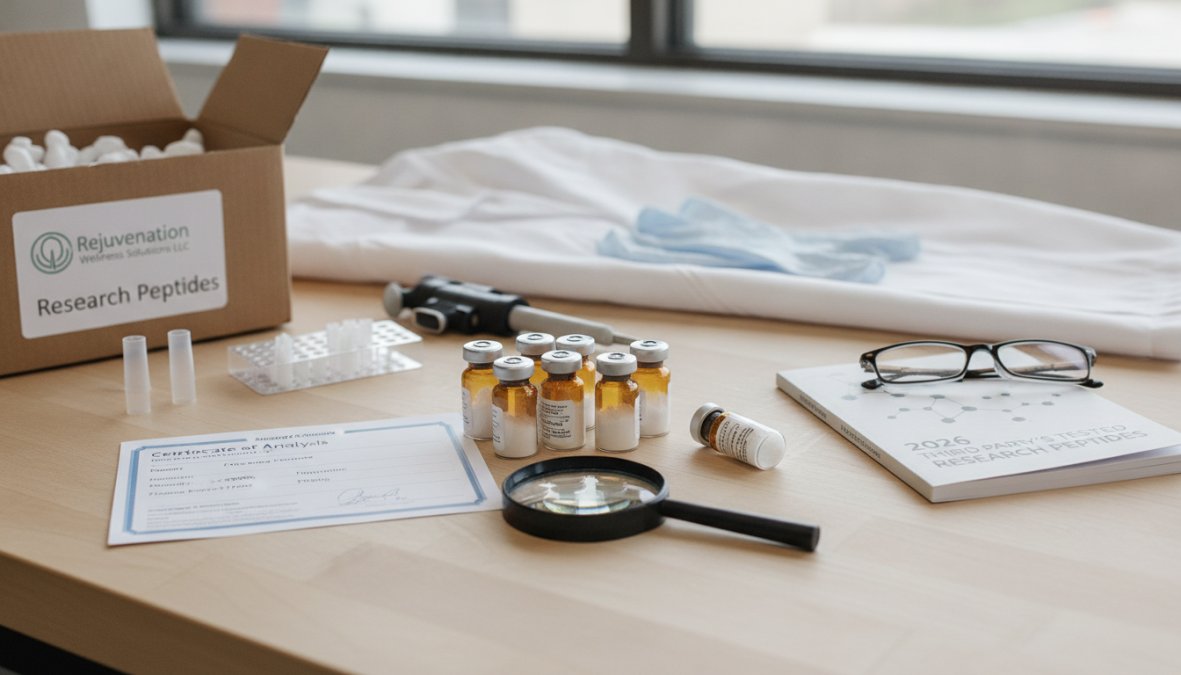
A Certificate of Analysis is formal proof of quality from an independent laboratory detailing chemical testing results on a specific batch. The CoA includes batch number, testing date, purity percentage, identity confirmation, and detected contaminants.
A complete CoA contains the header identifying the testing laboratory, peptide name, and batch/lot number; the purity section reporting percentage via HPLC; the identity section confirming molecular weight via Mass Spectrometry; and contaminant analysis screening for endotoxins and microbial contamination. Look for the HPLC chromatogram showing visual representation of compound composition. A pure peptide produces a single dominant peak; multiple peaks suggest impurities. Endotoxin levels should be below 0.5 EU/mg.
Legitimate testing laboratories have verifiable contact information, accreditation credentials (ISO 17025 certification), and traceable testing procedures. Fake CoAs lack specific details, use vague language, or provide rounded numbers instead of precise measurements.
| CoA Element | What It Means | Red Flag |
|---|---|---|
| Batch/Lot Number | Identifies the specific production run tested | Missing or generic |
| Purity % | Percentage of pure peptide (target 99%+) | Rounded to whole number or vague |
| HPLC Chromatogram | Visual proof of compound composition | Absent or illegible |
| Molecular Weight | Confirms peptide identity via Mass Spec | Doesn’t match theoretical calculation |
| Endotoxin Level | Bacterial contamination screening (EU/mg) | Above 0.5 EU/mg or not tested |
| Lab Accreditation | ISO 17025 or equivalent certification | No verifiable credentials |
HPLC (High-Performance Liquid Chromatography) determines peptide purity by dissolving the sample in liquid solvent and forcing it through a column packed with microscopic beads. Different components move through at different speeds based on chemical properties. As each component exits, a detector measures its presence, creating a chromatogram showing peaks representing individual compounds.
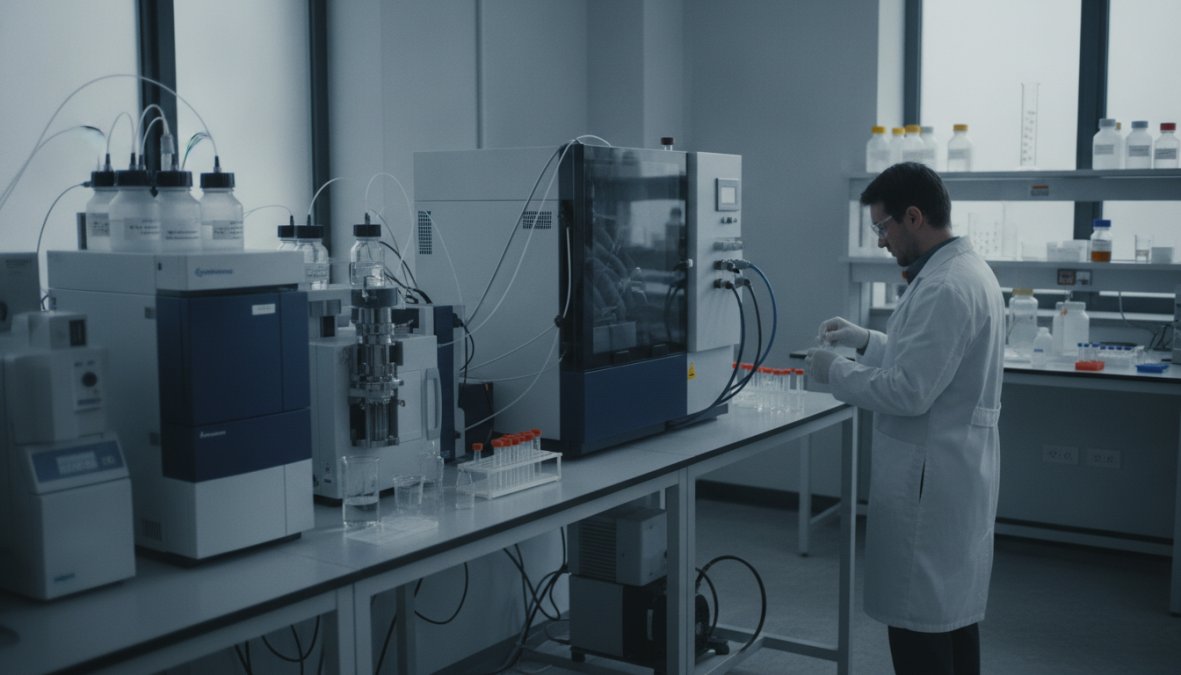
For a pure peptide, expect one dominant peak representing the target compound. Peak area is proportional to compound amount, allowing labs to calculate purity percentage by comparing target peak area to total peak area. A 99.2% pure peptide means the target peak represents 99.2% of total peak area.
Mass Spectrometry confirms molecular identity by ionizing peptide molecules and measuring their mass-to-charge ratio. Since each peptide has unique molecular weight based on amino acid sequence, Mass Spectrometry definitively proves whether the compound matches its label. The molecular ion peak should match theoretical molecular weight within a small margin (typically ±1 Da for peptides).
Research-grade peptides typically target 95-99%+ purity depending on application. Custom peptides for structural studies might require 99%+ purity; peptides for cell culture might be acceptable at 95-97%. Specification should match research needs.
Quality assurance in peptide manufacturing follows established international standards. GMP (Good Manufacturing Practice) certification indicates FDA-regulated procedures for manufacturing, testing, and documentation. WHO/GMP certification extends this to World Health Organization standards. ISO 9001:2015 certification demonstrates systematic quality management processes.
503B compounding pharmacy standards apply to facilities manufacturing peptides for clinical or investigational use. These pharmacies operate under FDA oversight and follow stringent procedures for ingredient sourcing, sterility assurance, and documentation.
Rejuvenation Wellness Solutions LLC combines affordability with rigorous quality standards. They partner exclusively with WHO/GMP and ISO-certified manufacturers and 503B compounding pharmacies. Every batch undergoes independent lab testing with Certificate of Analysis. Same-day order fulfillment means orders placed in the morning ship via UPS 2-day air the same day. Customer service via text, phone, and email responds within hours.
Pros:
Cons:
Protide Health publishes a public library of batch-specific Certificates of Analysis available before purchase. Published data shows average batch purity of 99.53%, significantly exceeding the 99% standard. Testing involves triple verification: HPLC for purity, Mass Spectrometry for identity, and bacterial endotoxin LAL assay for safety. ISO 9001:2015 compliance demonstrates systematic quality management.
Pros:
Cons:
Ion Peptide guarantees 99%+ purity across their catalog with batch-tested, lot-specific Certificates of Analysis for every order. Same-day shipping for eligible orders accelerates researcher access. Over 100 research-use-only (RUO) peptides available offer breadth for exploring multiple compounds.
Pros:
Cons:
Nationwide Peptides differentiates through American ownership and rigorous in-house testing by accredited laboratories. All catalog items guarantee 99%+ purity tested via HPLC and Mass Spectrometry. Full Certificates of Analysis with chromatograms are available for download on each product page.
Pros:
Cons:
Cosmic Peptides provides access to Certificates of Analysis, HPLC results, and end-to-end tracking data before purchase. They guarantee 99%+ purity for every lot using rigorous independent third-party analysis. Same-day shipping for orders placed before 2 PM CST appeals to researchers on tight timelines.
Pros:
Cons:
Pure Health Peptides, operating as GLP Supplies, emphasizes independent batch testing conducted within the USA. Every batch is tested independently with detailed Certificates of Analysis accessible by batch number. KYC (Know Your Customer) verification required for qualified research professionals adds operational accountability.
Pros:
Cons:
Phoenix Pharmaceuticals represents the institutional market end. ISO 9001 certified with in-house production in Burlingame, California, they offer over 9,000 catalog SKUs and extensive custom synthesis capabilities. Purity ≥98% by HPLC with Certificates of Analysis on every order.
Pros:
Cons:
| Vendor | Best For | Purity Guarantee | Testing Transparency | Shipping Speed | Price Position |
|---|---|---|---|---|---|
| Rejuvenation Wellness Solutions | Individual researchers, affordability | 99%+ | Batch-specific CoA | Same-day fulfillment | Budget-friendly |
| Protide Health | Institutions prioritizing transparency | 99.53% avg | Public CoA library | Fast US | Premium |
| Ion Peptide | Speed + quality balance | 99%+ | Lot-specific CoA | Same-day eligible | Mid-range |
| Nationwide Peptides | US researchers, domestic sourcing | 99%+ | Full CoAs downloadable | Fast nationwide | Mid-range |
| Cosmic Peptides | Pre-purchase verification preference | 99%+ | Pre-purchase data access | Same-day (before 2 PM) | Premium |
| Pure Health Peptides | US-based testing priority | High standards | Batch-specific by number | Standard | Mid-range |
| Phoenix Pharmaceuticals | Large institutions, custom synthesis | 98%+ | CoA included | Standard | Institutional |
Rejuvenation Wellness Solutions offers the fastest fulfillment combined with competitive pricing, a rare combination appealing to researchers needing quick access without premium pricing. Protide Health and Cosmic Peptides command higher prices for exceptional transparency and triple-testing protocols. Ion Peptide and Nationwide Peptides occupy the middle ground with solid quality, reasonable pricing, and reliable shipping.
Most established vendors target institutions because they offer volume and predictability. Rejuvenation Wellness Solutions explicitly welcomes individual researchers aged 21+, removing barriers competitors create.
Legitimate third party testing labs have no financial relationship with peptide vendors and profit only from honest results. Labs should be ISO 17025 accredited, meeting international testing competence standards. Verify accreditation by checking lab credentials directly or reviewing CoA accreditation statements.
Red flags include vague language ("tested for purity" without percentage), missing batch numbers, rounded purity numbers, and lack of verifiable lab contact information. Request the name and contact information of WHO/GMP or ISO-certified manufacturers vendors partner with. Call manufacturers directly to confirm relationships.
Check whether purity claims align with industry norms. Vendors claiming 99.9% purity across all peptides are exaggerating. Real-world purity typically ranges from 95-99.5%, with premium suppliers consistently achieving 99%+.
Selecting a third party tested research peptide supplier depends on balancing priorities: budget, transparency, speed, and support. Rejuvenation Wellness Solutions LLC offers the most accessible entry point for individual researchers wanting reliable, independently tested peptides without institutional overhead. Same-day fulfillment, batch-specific Certificates of Analysis, and responsive customer service mean quality without compromise. Start by reviewing their current peptide inventory and requesting batch-specific CoAs for target compounds, this confirms transparency and provides documentation needed for publication or regulatory purposes.
Third party tested means an independent laboratory, not the manufacturer, verifies peptide purity, identity, and safety. This independent verification uses methods like HPLC and mass spectrometry to confirm the product meets stated standards. Third party tested research peptides provide objective proof of quality and help protect researchers from contaminated or mislabeled products.
Check that the CoA includes batch-specific lot numbers, HPLC chromatograms showing purity percentages, mass spectrometry results confirming peptide identity, and the testing laboratory's accreditation details. Verify the CoA is dated recently and matches your order. Cross-reference the vendor's name and contact information. Legitimate suppliers provide CoAs before purchase and allow you to download them directly from product pages.
Non-tested peptides may contain contaminants, bacterial endotoxins, heavy metals, or incorrect molecular structures that compromise research validity and safety. Contaminated peptides produce unreliable experimental results, waste time and resources, and can introduce unknown variables into your studies. Using untested peptides also raises regulatory and legal concerns, especially for institutional research. Third party tested peptides eliminate these risks through independent verification.
Pricing differences reflect testing rigor, manufacturing standards, and supply chain transparency. Suppliers using rigorous third party testing, WHO/GMP and ISO-certified manufacturers, and batch-specific documentation typically charge more than vendors using minimal or in-house testing only. Higher-priced suppliers often provide same-day fulfillment, comprehensive kits with dilution water and syringes, and responsive customer service. Quality assurance and regulatory compliance justify premium pricing for serious researchers.
Many reputable suppliers now serve individual researchers aged 21 and over, not just institutions. Vendors like Rejuvenation Wellness Solutions, Ion Peptide, and Cosmic Peptides explicitly support independent researchers with same-day fulfillment and direct customer service. However, some institutional suppliers like Phoenix Pharmaceuticals primarily serve qualified research accounts. Always verify that a vendor accepts individual orders before purchasing, and confirm you meet their age and qualification requirements.
This article was written using GrandRanker