
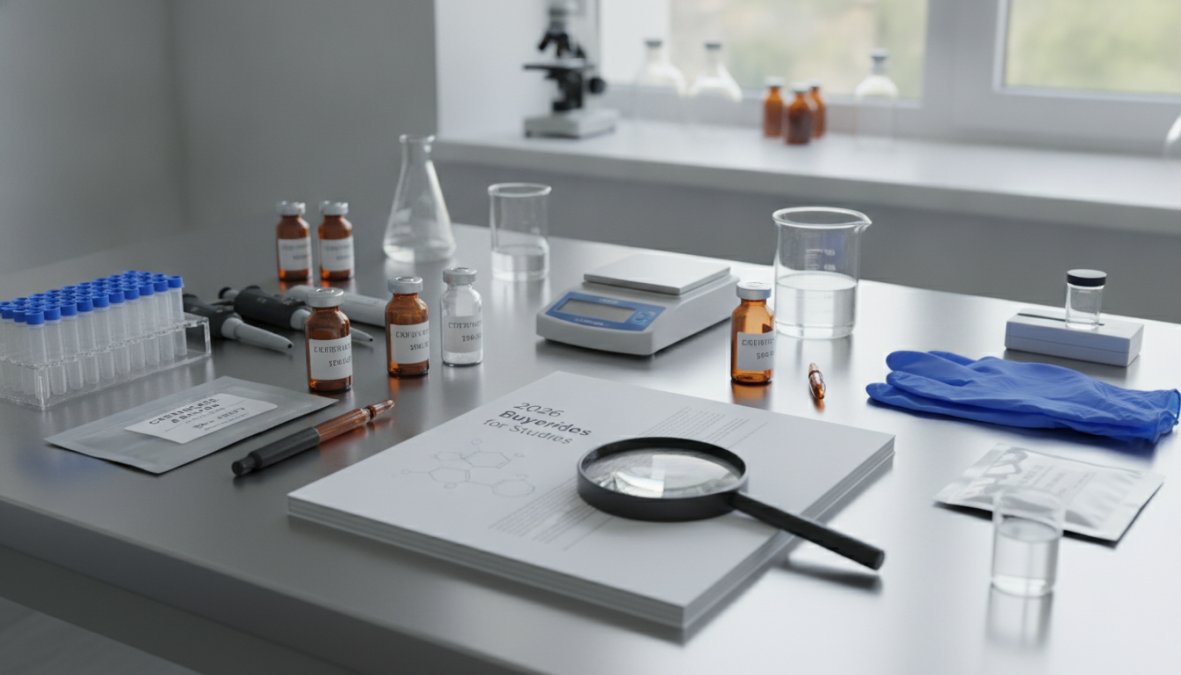
Last Updated: July 19, 2026
Lab grade peptides for studies demand rigorous quality standards, transparent testing protocols, and reliable suppliers. This guide helps you identify high-purity peptides that meet research standards and avoid pitfalls that compromise experimental integrity.
Lab grade peptides are synthetic amino acid chains manufactured for research applications, distinct from pharmaceutical-grade products intended for clinical use. These peptides range from short sequences (dipeptides and tripeptides) to longer chains exceeding 50 amino acids, synthesized using solid-phase peptide synthesis (SPPS) or liquid-phase methods. Research-grade peptides typically achieve 75-99%+ purity through rigorous purification and testing.
Research-grade peptides are designated "Research Use Only" (RUO) and operate under different regulatory frameworks than pharmaceutical-grade products. This allows researchers to access modern peptide solutions at more accessible price points while maintaining scientific integrity through independent laboratory verification.
Research-grade peptides differ fundamentally from pharmaceutical-grade products in manufacturing standards and regulatory oversight. Pharmaceutical-grade peptides must meet FDA cGMP standards and include comprehensive safety data for human use, driving costs 30-50% higher. Research-grade peptides prioritize analytical verification over regulatory compliance, allowing manufacturers to offer them at significantly lower costs.
Pharmaceutical-grade peptides include stabilizers and come with extensive stability data. Research-grade peptides require careful handling, with storage at -20°C or lower and precise reconstitution procedures. Both types undergo rigorous purity testing via HPLC and mass spectrometry.
Peptide purity represents the percentage of desired peptide present in your sample, with the remainder consisting of synthesis byproducts, salts, or water. A 95% pure peptide contains 95% target peptide and 5% other compounds. This distinction matters: a 90% pure peptide introduces 10% unknown variables into your experimental system.
Purity requirements vary by application. In vitro cell culture studies typically tolerate 90-95% purity. Animal studies and quantitative research demand 95%+ purity for precise dosing. Immunology research often requires 98%+ purity to avoid cross-reactivity with contaminants.
The relationship between purity and cost is non-linear. Moving from 95% to 99% purity can cost 40-60% more due to additional purification cycles required. Understanding your actual purity requirements prevents overpaying for unnecessary refinement while avoiding the false economy of cheap, low-purity peptides.
High-Performance Liquid Chromatography (HPLC) separates peptide molecules based on chemical properties, allowing technicians to quantify the percentage of target peptide present. Mass spectrometry (MS) identifies the molecular weight of your peptide, confirming that the synthesized sequence matches the intended structure. When HPLC and MS results align, showing both high purity and correct molecular weight, you have strong evidence that your peptide is authentic.
HPLC answers "how pure is it?" while MS answers "is it the right molecule?" A peptide could show high HPLC purity while MS reveals an incorrect molecular weight, indicating a synthesis error.
Good Manufacturing Practices (GMP) ensure consistent product quality through documented procedures, trained personnel, and facility controls. ISO 9001 and ISO 13485 certifications indicate documented quality management systems, with ISO 13485 specifically addressing medical device manufacturing and signaling more rigorous oversight.
When evaluating suppliers, distinguish between "GMP-certified manufacturing" and "GMP-certified for research peptides." A facility might operate GMP-compliant production lines for pharmaceutical products while maintaining separate, less stringent processes for research peptides. Ask suppliers directly whether their research peptide production occurs in GMP-certified facilities.
A Certificate of Analysis (COA) documents testing results for a specific peptide batch, including purity percentage, molecular weight confirmation, water content, and endotoxin levels. The COA serves as your quality assurance document, proof that an independent laboratory tested your peptide and verified its specifications.
A credible COA includes the peptide sequence, batch number, purity data with HPLC chromatogram, molecular weight confirmation via mass spectrometry, water content, and endotoxin testing. The target peptide peak should be clearly labeled and quantified as a percentage of total peaks. Molecular weight confirmation should show observed mass and calculated mass, with agreement within 0.01 Da for peptides under 5,000 Da.
Water content testing ensures your peptide hasn’t absorbed atmospheric moisture. Endotoxin testing confirms the absence of bacterial lipopolysaccharides that could trigger immune responses in animal studies. For cell culture work, endotoxin levels should be below 0.1 EU/mg.
The COA should include the testing date and laboratory name. Reputable suppliers use independent third-party laboratories rather than in-house testing, reducing bias and increasing credibility.
Verify that a COA comes from a legitimate, independent laboratory by checking whether the laboratory name appears in public databases of accredited facilities. ISO/IEC 17025 accreditation indicates that a laboratory meets international standards for testing competence. Contact the testing laboratory directly if the COA raises questions, reputable labs will confirm whether they performed the analysis.
Cross-reference the COA’s specifications against your peptide’s intended use. If you’re planning an animal study requiring endotoxin-free peptides, a COA showing endotoxin levels of 0.5 EU/mg doesn’t meet your requirements, regardless of purity percentage.
Body Protection Compound-157 (BPC-157) is a 15-amino acid peptide derived from a protective protein found in gastric juice. Research has explored BPC-157’s potential effects on tissue healing, wound healing, tendon and ligament repair, and neurological function through modulation of growth factors like VEGF and bFGF.
BPC-157 research typically involves subcutaneous or intravenous administration in animal models, with doses ranging from 10 ng/kg to 10 µg/kg. When sourcing BPC-157, purity becomes critical because effects appear dose-dependent and sensitive to structural integrity. Most rigorous research uses BPC-157 at 95%+ purity with HPLC and MS confirmation, stored at -20°C or lower.
CJC-1295 is a 30-amino acid peptide functioning as a growth hormone-releasing hormone (GHRH) analog. Ipamorelin is a 5-amino acid peptide acting as a growth hormone secretagogue. Research often pairs these peptides to examine synergistic effects on growth hormone dynamics and metabolic markers.
CJC-1295 exists in two forms: with DAC (drug affinity complex) for longer half-life, and without DAC for more rapid action. Ensure your supplier clearly specifies which version you’re purchasing. Both require 95%+ purity and storage at -20°C or below.
GHK-Cu is a copper-peptide complex that has shown promise in wound healing, skin health, and collagen synthesis research. TB-500 (Thymosin Beta-4) is a 43-amino acid peptide with immune-modulating properties and potential effects on wound healing and neuroprotection.
Both represent emerging research areas where literature is still developing. When working with emerging peptides, ensure your supplier provides comprehensive COAs with independent lab testing.
| Peptide | Amino Acids | Primary Research Area | Typical Purity | Storage |
|---|---|---|---|---|
| BPC-157 | 15 | Tissue repair, neuroprotection | 95%+ | -20°C or below |
| CJC-1295 | 30 | Growth hormone research | 95%+ | -20°C or below |
| Ipamorelin | 5 | Growth hormone secretion | 95%+ | -20°C or below |
| GHK-Cu | 3 + Cu | Wound healing, collagen | 95%+ | -20°C or below |
| TB-500 | 43 | Tissue regeneration | 95%+ | -20°C or below |
Selecting a peptide supplier shapes your research quality, timeline, and budget. The right supplier becomes a reliable partner who understands your research needs and delivers consistently.
Legitimate peptide suppliers often partner with established manufacturers rather than producing peptides in-house. Ask directly about manufacturing partnerships and request documentation of GMP or ISO certification. The supplier should provide verifiable information about which facilities manufacture their peptides.
503B compounding pharmacies represent a specific regulatory category in the United States, facilities licensed to compound medications and research compounds under specific oversight. Some suppliers partner with 503B pharmacies to ensure their peptides meet pharmaceutical-level quality standards while maintaining the research-use designation. Verify partnerships by requesting specific facility names and certification numbers, then confirm independently through the certifying body’s database.
Reliable suppliers clearly state their purity standards, testing protocols, and storage requirements. They provide sample COAs before you purchase, allowing you to evaluate the quality of testing they conduct. They answer detailed questions about manufacturing partners and quality assurance without evasion.
Pricing varies significantly based on peptide type, purity level, and quantity. A supplier offering "BPC-157 at $50 per vial" might be selling 10 mg at 80% purity, while another offers 10 mg at 98% purity for $75. Most reputable suppliers offer volume discounts. Be cautious of suppliers offering dramatically lower prices than competitors, as this often indicates lower purity or less rigorous testing.
Suppliers unwilling to provide COAs before purchase, offering only generic "purity guaranteed" claims, or claiming 100% purity (analytically impossible) raise concerns. Suppliers offering peptides at prices significantly below market rates or making medical claims about peptide effects should trigger skepticism.
Lack of clear communication about manufacturing partnerships, inability to verify claimed certifications, or resistance to independent lab verification all suggest quality concerns. Check whether a supplier maintains consistent inventory and can reliably deliver the same peptide batch-to-batch.
Proper storage and handling preserve peptide integrity and ensure your experiments produce reliable results. Peptides degrade over time through oxidation, hydrolysis, and microbial contamination.
Most research peptides require storage at -20°C or lower to minimize degradation. At room temperature, peptides typically remain stable for only days to weeks. Freezer storage extends viability to months or years, though exact shelf life depends on the specific peptide and storage conditions.
Humidity represents a critical but often-overlooked storage factor. Lyophilized peptides are extremely hygroscopic and absorb moisture from the air. Store lyophilized peptides in airtight vials with desiccant packets in a low-humidity environment. Avoid repeated freeze-thaw cycles, which damage peptides through temperature fluctuations. If you need frequent access to a peptide, divide your stock into smaller aliquots, freezing the bulk at -80°C and keeping a smaller working aliquot at -20°C.
Reconstitution requires bacteriostatic water or saline to prevent bacterial growth. Never use sterile water alone, as it lacks preservatives and allows rapid bacterial colonization. Bacteriostatic water contains benzyl alcohol (0.9%), which inhibits bacterial growth.
The reconstitution process demands sterile technique to prevent contamination. Use sterile syringes and needles, alcohol-prep swabs to sterilize vial tops, and aseptic technique throughout. Calculate the exact volume of reconstitution liquid needed based on your target concentration. A 10 mg vial reconstituted in 10 mL yields a 1 mg/mL solution. Store reconstituted peptides at 4°C for short-term use, or at -20°C for longer storage.
The RUO designation indicates that a product is intended exclusively for research, not for human consumption, medical treatment, or veterinary use. RUO products have not undergone FDA approval for human use and lack the safety data required for therapeutic applications. This allows manufacturers to bring products to market more quickly and at lower cost.
RUO products are legal to purchase and use for legitimate research purposes. The restriction applies to intended use and marketing, you cannot legally sell RUO peptides as dietary supplements or recommend them for therapeutic use.
Individual researchers operating outside institutional settings must ensure their work complies with local regulations and institutional review boards (IRBs) if research involves human subjects or animals. Document your research protocols and maintain records of peptide sourcing, including supplier information and COAs.
While purchasing RUO peptides is legal, the intended use matters. Conducting rigorous research with proper controls and documentation is legitimate. Purchasing peptides with the intention to consume them yourself or recommend them to others for health purposes is not.
In vitro studies using cultured cells provide a controlled environment for examining peptide mechanisms. A typical protocol involves adding your peptide to cell culture media at various concentrations, incubating for a defined period, then measuring cellular responses through viability assays or gene expression analysis.
Account for the peptide’s stability in culture media. Some peptides degrade rapidly due to proteases naturally present in serum-containing media. Including protease inhibitors or using serum-free media can extend peptide stability. Document your media composition and additives, as these choices affect whether other researchers can reproduce your findings.
Animal studies require institutional approval through an Institutional Animal Care and Use Committee (IACUC). The critical detail is precise dosing. Calculate your dose based on the animal’s body weight, ensuring you’re delivering the intended concentration. Use high-purity peptides (95%+ minimum) to ensure your calculated dose actually represents the peptide amount you intend to administer.
The most common mistake is assuming cheaper peptides represent equivalent quality. A peptide priced 50% below market rate likely reflects lower purity or less rigorous testing. This false economy wastes time and resources when low-quality peptides produce inconsistent results.
Researchers frequently underestimate the importance of proper storage and handling. Peptides stored at room temperature, exposed to light, or subjected to repeated freeze-thaw cycles degrade rapidly. Inadequate documentation creates confusion when troubleshooting results. Record the peptide batch number, purity percentage, storage conditions, and reconstitution date.
Many researchers source peptides from suppliers lacking third-party testing or COAs. Without independent verification, you’re relying entirely on supplier claims. Finally, researchers often overlook dose-response studies. When starting with a new peptide, conduct preliminary dose-response experiments to establish the concentration range that produces measurable effects in your system.
Choosing lab grade peptides for studies involves navigating purity standards, verifying supplier quality, and understanding regulatory frameworks. Rejuvenation Wellness Solutions LLC simplifies this process by partnering with WHO/GMP and ISO-certified manufacturers, conducting independent lab testing, and providing comprehensive Certificates of Analysis with every product. Their commitment to 99%+ purity and transparent sourcing helps researchers focus on their work rather than worrying about material quality.
Research-grade peptides are synthesized and purified to strict quality standards (typically 99%+ purity) specifically for laboratory and scientific studies. Unlike pharmaceutical-grade peptides used in clinical settings, research-grade peptides undergo rigorous HPLC and mass spectrometry testing with accompanying Certificates of Analysis (COA). These peptides are designated 'Research Use Only' (RUO) and manufactured under GMP or ISO-certified conditions to ensure consistency, identity, and safety for in vitro and animal research applications.
Peptide purity is verified using two primary analytical methods: High-Performance Liquid Chromatography (HPLC) measures the percentage of pure peptide versus impurities, while Mass Spectrometry (MS) confirms the peptide's molecular weight and identity. Every legitimate lab-grade peptide should include a Certificate of Analysis (COA) documenting these results from an independent laboratory. The COA also tests for contaminants like endotoxins and confirms net peptide content, ensuring the product meets research standards for reproducible and reliable experimental outcomes.
A valid Certificate of Analysis should include: (1) HPLC purity percentage (ideally 99%+), (2) mass spectrometry confirmation of molecular weight, (3) net peptide content, (4) endotoxin and sterility testing results, (5) the independent lab's name and accreditation, and (6) batch/lot number matching your order. Verify the lab is third-party and GMP-certified, not the supplier's internal lab. The COA should be publicly accessible or provided before purchase, allowing you to confirm quality claims before committing to your research.
Common research peptides include BPC-157 for tissue repair studies, CJC-1295 and Ipamorelin for growth hormone research, GHK-Cu for skin and wound healing applications, and TB-500 for immune and metabolic support research. Semax and Selank are used in cognitive function studies, while newer peptides like Tirzepatide and Retatrutide appear in metabolic research. The choice depends on your research focus, tissue repair, metabolic pathways, cognitive function, or immune support, and should align with peer-reviewed literature on efficacy and safety in your specific application.
Store lyophilized (freeze-dried) peptides in airtight vials at 2-8°C (refrigerator) or -20°C (freezer) away from light and moisture. Once reconstituted with bacteriostatic water, peptides are typically stable for 2-4 weeks at 2-8°C. Avoid repeated freeze-thaw cycles, which degrade peptide bonds and reduce efficacy. Use sterile syringes and alcohol swabs during handling to prevent contamination and endotoxin introduction. Proper storage and handling directly impact your research's reproducibility and the reliability of your experimental results.
This article was written using GrandRanker