

Last Updated: August 9, 2026
The purity of your peptide directly determines whether your research results are reliable, reproducible, and scientifically valid. A contaminated or impure batch can skew your data, waste months of experimental time, and compromise the integrity of your entire study. This is especially critical in clinical trials and laboratory research where regulatory compliance demands rigorous documentation.
At Rejuvenation Wellness Solutions LLC, we recognize that individual researchers and laboratory managers need reliable access to high-purity peptides backed by transparent testing. That’s why every product undergoes independent lab testing with a Certificate of Analysis, ensuring you have the documentation needed to verify purity before your research begins.
A Certificate of Analysis is your primary tool for verifying peptide purity. This document provides objective, third-party verification of what’s actually in your vial rather than relying on manufacturer claims alone.
A comprehensive peptide certificate of analysis explained should include identification information: the peptide sequence, molecular weight, lot number, and batch date. The core of any COA is the analytical results section, which typically includes the purity percentage determined by HPLC (High-Performance Liquid Chromatography), detected impurities, synthesis by-products, degradation products, and residual solvents with their percentages. For lyophilized peptides, moisture content and acetate content are reported separately, since these affect the actual peptide content in your vial.
Most COAs include a methods section explaining which analytical techniques were used and references to ISO 17025 accreditation, indicating the laboratory follows standardized quality control procedures.
Purity percentages on a COA are expressed as a single number: typically 95%, 98%, or 99%+ for research-grade peptides. However, this number alone doesn’t tell the complete story. Understanding what that purity percentage actually means requires looking at the impurity profile. If a COA shows 99% purity but doesn’t specify what makes up the remaining 1%, you’re missing critical information.
Pay attention to the difference between peptide purity and peptide content. A vial might be 99% pure by HPLC analysis, but if it contains 15% water by weight, your actual peptide content is lower. High-quality suppliers clearly distinguish between these measurements on their COAs.
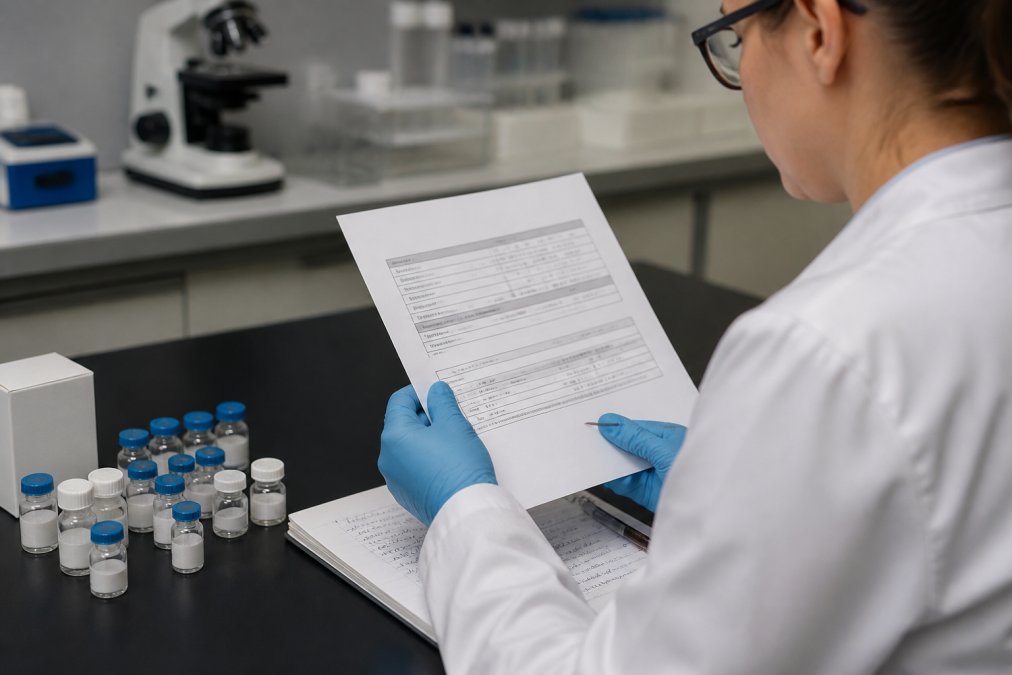
HPLC peptide purity analysis has become the standard method for measuring peptide quality because it provides quantifiable, reproducible results. This analytical chemistry technique separates peptide molecules based on their interaction with a stationary phase, allowing technicians to identify and measure individual components in a sample.
High-Performance Liquid Chromatography works by injecting a dissolved peptide sample into a column packed with a stationary material. A mobile phase flows through the column, and different peptide molecules move through at different rates based on their chemical properties. As molecules exit the column, a detector measures them, typically using UV detection at 214 nm, a wavelength where peptide bonds absorb strongly.
The result is a chromatogram: a graph showing peaks that represent individual compounds. The largest peak is your target peptide. Smaller peaks represent impurities. By comparing peak areas, technicians calculate what percentage of your sample is pure peptide versus contaminants. This method works reliably because it’s based on physical separation rather than assumptions, and it’s standardized across ISO 17025 accredited labs.
When you look at an HPLC chromatogram on your COA, focus on three elements: retention time, peak integration, and the baseline. Retention time is how long it takes each compound to move through the column; your target peptide should appear at a consistent time every time it’s tested. Peak integration refers to the calculation of area under each peak, which is where the purity percentage comes from. A reputable lab will report not just the total purity percentage but also the individual percentages of major impurities. The baseline should be clean and stable; a noisy baseline suggests instrument problems or sample contamination.
While HPLC measures purity by separating compounds, mass spectrometry peptide verification methods confirm the identity of your peptide by measuring its molecular weight. Mass spectrometry ionizes peptide molecules and measures their mass-to-charge ratio. For a peptide with a known sequence, the molecular weight is predictable. If your peptide’s mass matches the expected value within acceptable tolerance, you have confirmation that the amino acid sequence is correct.
Many high-quality COAs include both HPLC purity data and mass spectrometry confirmation, providing two independent confirmations: this is the right peptide (mass spec), and it’s pure (HPLC).
ISO 17025 accreditation is the international standard for laboratory competence. A lab holding this accreditation has undergone rigorous evaluation to demonstrate that its testing methods are accurate, its equipment is properly maintained, and its procedures are documented and consistent.
For peptide testing, ISO 17025 accreditation means the lab follows standardized protocols for sample preparation, instrument calibration, and result reporting. When reviewing potential suppliers, checking for ISO 17025 accreditation is a practical way to filter for quality. Rejuvenation Wellness Solutions LLC partners with WHO/GMP and ISO-certified manufacturers and 503B compounding pharmacies, ensuring that every peptide you receive has been tested by labs meeting these rigorous international standards.
Verification doesn’t end when you receive your peptide. A systematic approach to checking your shipment and confirming the COA matches your expectations protects your research investment and ensures your data integrity.
Before you place an order, confirm that your supplier will provide a COA with your shipment. When your peptide arrives, verify it matches your order: correct peptide sequence, correct lot number, and correct quantity. Note the testing date; a COA from six months ago is less reliable than one from last week, since peptides can degrade over time. Check which analytical methods were used and look for the lab’s contact information and accreditation details.
Verify that the testing lab claims ISO 17025 accreditation and that this claim is legitimate. Most accredited labs provide an accreditation number on their reports. You can verify this number through the ILAC (International Laboratory Accreditation Cooperation) database or the relevant national accreditation body. This step takes just a few minutes but significantly increases your confidence in the data.
If you’ve ordered the same peptide multiple times, compare the COAs from different batches. The purity percentage should be consistent within a narrow range, typically within 1-2 percentage points. Significant variations between batches suggest inconsistent manufacturing or testing practices. If you notice a pattern of declining purity across successive batches, contact your supplier immediately.
Before using your peptide, perform a basic visual inspection. A lyophilized peptide powder should be a solid cake or fine powder with uniform color. Discoloration, clumping, or unusual texture can indicate moisture absorption, contamination, or degradation. For peptides in solution, check for cloudiness, particles, or unusual color. If something looks wrong, don’t use the peptide.
Understanding what impurities appear on your COA helps you assess whether they’ll affect your research.
Synthesis by-products are incomplete peptide chains created during the synthesis process. These are unavoidable in chemical peptide synthesis and are present in virtually every peptide. Most quality suppliers remove the majority through purification, but trace amounts typically remain and are generally not problematic for most research applications.
Degradation products form when peptides break down over time due to oxidation, hydrolysis, or exposure to light and heat. If your COA shows unexpected degradation products, this could indicate the peptide was stored improperly before testing or has aged significantly since synthesis.
Residual solvents like trifluoroacetic acid (TFA) are used in the synthesis and purification process. While most are removed, trace amounts often remain and are typically acceptable at low levels. Acetate content in lyophilized peptides comes from acetate salts used during synthesis and is normal and expected, though high acetate content means you’re paying for salt rather than peptide.
Some researchers consider testing their own peptides to avoid the cost of professional lab analysis. DIY testing typically involves visual inspection and possibly simple solubility tests, which catch obvious problems but provide no quantitative data about purity.
Professional lab testing through an ISO 17025 accredited facility provides quantifiable, reproducible results that meet regulatory standards and are widely accepted in the scientific community. For clinical trials, institutional research, or any work that will be published or presented, professional testing is essential. Rejuvenation Wellness Solutions LLC includes independent lab testing with every peptide, ensuring you have professional-grade COAs without additional testing costs.
Verifying peptide purity is the foundation of credible research. By understanding how to read a Certificate of Analysis, recognizing the value of HPLC and mass spectrometry verification, and systematically checking your peptides before use, you ensure that your results reflect genuine findings rather than artifacts of impure materials. When you source peptides from suppliers like Rejuvenation Wellness Solutions LLC that partner with ISO 17025 accredited laboratories and provide comprehensive COAs with every order, you gain the confidence that your research is built on a foundation of verified, high-purity peptides.
| Verification Step | What to Check | Why It Matters |
|---|---|---|
| Request COA | Lab accreditation, testing date, methods used | Ensures data comes from credible source |
| Review purity data | HPLC percentage, impurity profile, mass spec confirmation | Confirms peptide quality meets your needs |
| Check accreditation | ISO 17025 status, ILAC verification | Validates lab follows standardized procedures |
| Compare batches | Consistency across multiple orders | Identifies manufacturing or storage issues |
| Visual inspection | Color, texture, solubility, stability | Catches obvious contamination or degradation |
Request the Certificate of Analysis (COA) from your supplier before purchase. A legitimate COA includes HPLC chromatography data, molecular weight confirmation via mass spectrometry, and the testing lab's accreditation status (look for ISO 17025 certification). Verify the lab is independent and accredited, not operated by the supplier. Cross-check the batch number on your product against the COA to ensure it matches. Rejuvenation Wellness Solutions provides independent lab testing with every product, so you can verify purity claims with actual analytical data.
For most research applications, 95% purity or higher is standard. Clinical trial work and sensitive experiments often require 98-99%+ purity to minimize interference from degradation products and synthesis by-products. The specific requirement depends on your research protocol and analytical methods. Check your study's methodology or consult with your research lead to determine the minimum acceptable purity threshold. Your peptide supplier should provide products that meet or exceed these specifications with supporting HPLC and mass spectrometry data in the COA.
Visual and physical inspection can identify obvious quality issues (discoloration, contamination, improper storage), but cannot verify actual purity percentages. True purity verification requires HPLC chromatography and mass spectrometry analysis, which need laboratory equipment and trained technicians. Home testing is a preliminary screening step only. For definitive purity confirmation, rely on professional lab testing from ISO 17025 accredited facilities. This is why purchasing from suppliers who provide independent COAs is essential for research integrity.
Peptide purity measures the percentage of your sample that is the correct peptide versus impurities (degradation products, synthesis by-products, residual salts). Peptide content measures the actual amount of active peptide in a lyophilized powder after accounting for water, acetate, trifluoroacetic acid, and other non-peptide components. A sample can be 98% pure but only 70% peptide content if the remaining 2% is water and the pure peptide includes acetate counterions. Both metrics matter: purity tells you about contamination, while content tells you the true dose in your vial. Your COA should report both values.
This article was written using GrandRanker








