
Last Updated: August 11, 2026
Low quality research peptides fail on the fundamentals: purity, safety, and transparency. When a peptide doesn’t meet its claimed specifications, your research suffers. You’re building conclusions on contaminated or mislabeled material. That’s not just wasted time, it’s corrupted data.
The problem starts upstream. Many suppliers cut corners on manufacturing, skip third-party testing, or source from manufacturers without proper quality controls. Some operate in regulatory gray areas where oversight is minimal. The result is a market flooded with products that look legitimate but aren’t.
Signs of low quality research peptides typically emerge in three areas: the vendor’s credibility, the product documentation, and what happens when you actually use the material. A legitimate supplier provides transparent sourcing, independent lab verification, and clear communication about what they’re selling and why it matters.
At Rejuvenation Wellness Solutions LLC, we’ve built our entire operation around the opposite approach. We partner with WHO/GMP and ISO-certified manufacturers and work with 503B compounding pharmacies. Every product undergoes independent lab testing with a Certificate of Analysis. This isn’t marketing, it’s the baseline for research-grade material.
Understanding what separates quality from counterfeit or substandard peptides requires knowing where to look. Most buyers focus on price first, which is exactly where problems start. The cheapest option almost never reflects actual purity or safety standards.
Buying peptides online carries inherent risk. The unregulated market for research peptides means anyone can claim anything. Your job is identifying which vendors actually stand behind their claims.
Start with the vendor’s transparency. Do they publish their manufacturing standards? Can you verify their certifications? Legitimate suppliers are eager to discuss their quality controls because those controls are real. Vague vendors, ones that talk around your questions or avoid specifics, are hiding something.
Red flags appear quickly if you know what to look for. A vendor claiming "pharmaceutical grade" without documentation is likely exaggerating. A company with no verifiable contact information or customer service is a warning sign. Extremely low pricing relative to competitors suggests either corner-cutting or counterfeit material. A website with poor design, spelling errors, or vague product descriptions indicates a less-than-professional operation.
Risks of buying peptides online extend beyond wasted money. Contaminated peptides can introduce microbial contamination, heavy metals, or endotoxins into your research. Mislabeled products mean your dosing is wrong, invalidating your study results. Counterfeit peptides, material that’s not actually what’s on the label, corrupt your entire dataset. Some low quality research peptides contain adulterants or impurities that skew bioavailability measurements, making comparisons across batches impossible.
The supply chain matters enormously. If a vendor can’t explain where their peptides come from, how they’re manufactured, or who tests them, that’s a major problem. Legitimate suppliers trace their material back through documented manufacturing partners. They can tell you which compounding pharmacy filled the vial, which independent lab ran the analysis, and when the testing occurred.
A Certificate of Analysis (COA) is your primary verification tool. It documents what an independent lab actually found when they tested the peptide. Learning to read one correctly is non-negotiable for anyone buying research peptides. However, reading a COA is only half the battle, verifying its authenticity is equally important, and this is where most buyers fail.
The COA should list the peptide name, lot number, testing date, and the lab that performed the analysis. Look for the impurity profile, the breakdown of what’s in the vial beyond the target peptide. Purity percentage should be clearly stated, typically expressed as a percentage by high-performance liquid chromatography (HPLC) or mass spectrometry. A legitimate COA shows 99% or higher purity for research-grade material.
Check the testing methodology. HPLC is the standard for peptide purity verification. Mass spectrometry confirms molecular weight. Microbial testing screens for bacterial and fungal contamination. Endotoxin testing measures bacterial byproducts that can trigger immune responses. A thorough COA includes results from all these tests.
Pay attention to the impurity profile details. The report should identify specific impurities, residual solvents, degradation products, and related peptides. If it just says "impurities: <1%" without breakdown, that’s incomplete. You need to know what those impurities are. Some impurities matter more than others. A small amount of a related peptide might be acceptable; bacterial endotoxins are never acceptable.
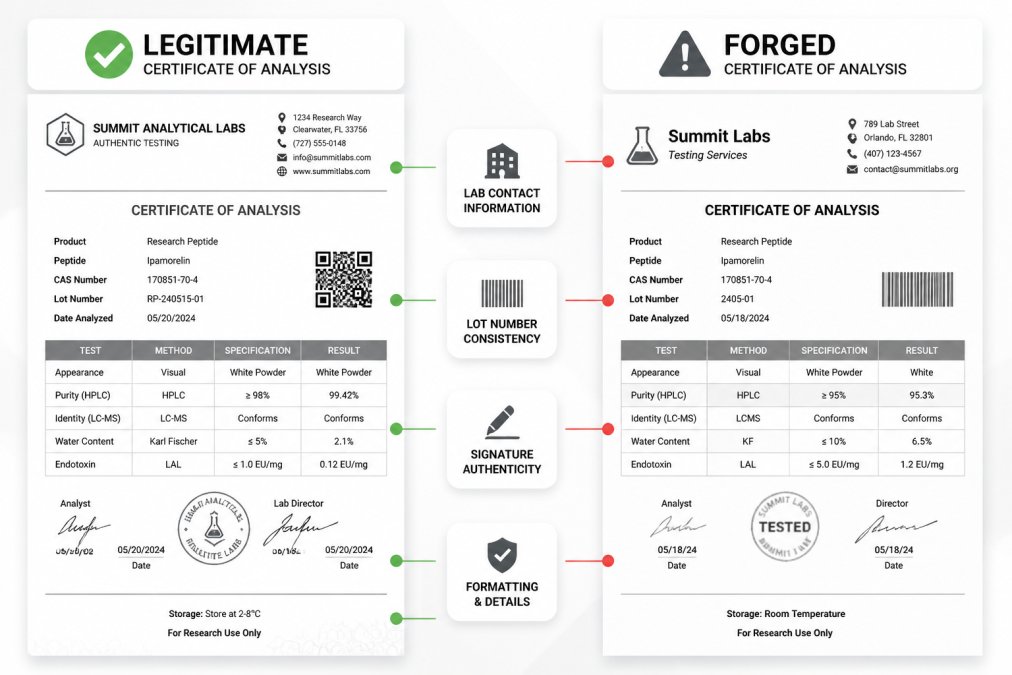
Forged COAs are common in low-quality peptide markets. A vendor can fabricate a professional-looking report in hours. Your job is determining whether the document in front of you is real.
Verify the testing lab independently. This is non-negotiable. The lab’s name, address, phone number, and accreditation information should be listed on the COA. Call the lab directly and ask if they tested the specific lot number on the report. Provide the lot number, peptide name, and testing date. A legitimate lab will have records of this test and can confirm the results. If the lab has no record of testing that lot, the COA is forged. If the phone number on the COA is disconnected or the address doesn’t exist, the lab is fake.
Check the lab’s accreditation status independently. If the COA claims ISO 17025 accreditation, verify it through the International Laboratory Accreditation Cooperation (ILAC) database or your country’s accreditation body. If the lab claims GMP compliance, ask for documentation. Legitimate labs are accredited and can provide proof. Labs that can’t provide accreditation documentation are either not accredited or are lying about it.
Look for dated certifications and signatures. A legitimate COA includes the date the testing was completed, the date the report was issued, and the signature or digital certification of the lab director or authorized signatory. The signature should be consistent across multiple COAs from the same lab. If the signature looks different each time or is missing entirely, that’s suspicious. Some labs use digital signatures with timestamps, these are harder to forge and more trustworthy than printed signatures.
Check for internal consistency. Compare the lot number on the COA to the lot number on the vial you received. They must match exactly. Compare the peptide name on the COA to the label on your vial. If the names don’t match, either the COA is wrong or the vial is mislabeled. Either way, something is wrong. Check the testing date. A COA from six months ago for a reconstituted peptide raises questions about stability. For lyophilized peptides stored properly, older COAs are less concerning, but anything older than 12 months should trigger skepticism about whether the product has degraded.
Verify the lab’s independence from the manufacturer. The testing lab should be a third party, not the manufacturer themselves. Some vendors operate their own in-house labs and claim third-party testing, this is not independent. Ask the vendor directly: "Is this lab owned by or affiliated with your company?" A legitimate vendor will say no and provide documentation of the lab’s independence. If the vendor is vague or defensive, the lab is likely not independent.
Request the full, unredacted COA. Some vendors provide abbreviated versions that hide details. Ask for the complete report including all test parameters, instrument names, method references, and analyst initials. Vendors who refuse to provide the full report are hiding something. Legitimate labs provide complete documentation because they have nothing to hide.
Cross-reference against known fraudulent labs. The peptide research community maintains informal lists of labs known to issue fake COAs. Ask your research network or professional contacts if they’ve heard of the lab. Check online forums and research communities for mentions of the lab. If multiple people report that a lab issues fraudulent COAs, that’s a strong signal to avoid vendors using that lab.
Watch for red flags in COA formatting and language. Legitimate labs use consistent formatting, professional language, and standardized report templates. Forged COAs often contain spelling errors, inconsistent formatting, vague language, or unprofessional presentation. Compare the COA to samples from known legitimate labs. If something looks off, it probably is.
Compare the COA to the vendor’s claims. If they claim 99.5% purity but the COA shows 98.2%, something’s wrong. If they claim pharmaceutical grade but the COA shows microbial contamination or high endotoxin levels, they’re misrepresenting the product. If they claim the peptide was tested within the last 90 days but the COA is dated six months ago, they’re lying about freshness.
Third-party lab testing is the only reliable way to verify what’s actually in a peptide vial. The manufacturer testing their own product creates an obvious conflict of interest. Independent testing provides the credibility your research demands.
A legitimate third-party lab tests for multiple parameters. Purity verification through HPLC or mass spectrometry confirms the peptide matches its specification. Identity testing confirms the molecular structure. Potency testing measures biological activity. Microbial contamination screening identifies bacterial and fungal growth. Endotoxin testing measures pyrogenic substances that trigger immune responses. Heavy metal testing screens for lead, cadmium, mercury, and arsenic.
The lab should be accredited and transparent about its methods. ISO 17025 accreditation indicates the lab meets international standards for competence and impartiality. GMP compliance means the lab follows manufacturing standards that ensure consistent, reliable results. Look for labs that publish their methodology, what instruments they use, what standards they follow, how they validate their results.
Batch testing is essential. Every batch of peptides should be tested independently. If a vendor claims all their peptides meet specifications but only tests occasionally, that’s a problem. Legitimate suppliers test each batch before release. The COA should reference the specific batch number in your vial.
Testing frequency matters. For a stable, lyophilized peptide stored properly, annual retesting is reasonable. For reconstituted peptides or those approaching their shelf-life, more frequent testing is prudent. If you’re running a multi-year study, request fresh testing at key intervals to document stability.
The cost of third-party testing is built into the price of quality peptides. Vendors offering rock-bottom pricing often skip this step entirely. That’s where low quality research peptides originate, from skipped testing and unverified manufacturing. The testing cost is your insurance against corrupted data.
Contamination in low quality research peptides takes multiple forms, each with serious consequences for your research and safety.
Microbial contamination, bacterial or fungal growth, can occur during manufacturing, packaging, or storage. Even tiny amounts can proliferate if the peptide is reconstituted and stored improperly. Contaminated peptides introduce variables you can’t control. They may trigger immune responses in cell cultures or animal models, confounding your results. Some bacteria produce endotoxins that are pyrogenic, they trigger fever and inflammatory responses independent of the peptide’s actual effects.
Chemical degradation happens when peptides break down over time. Lyophilized peptides are more stable than reconstituted ones, but improper storage accelerates breakdown. Heat, light, and humidity all degrade peptides. A peptide stored at room temperature for months may have lost 20-30% of its potency without any visible change. Your dosing calculations become wrong. Your results become unreliable.
Heavy metal contamination can occur if manufacturing uses contaminated water or equipment. Lead, cadmium, and mercury are particularly problematic because they’re toxic at low concentrations and can accumulate in tissues. A peptide with trace heavy metals may not cause acute toxicity, but chronic exposure creates confounding variables in long-term studies.
Adulterants, intentional additions of cheaper substances, are less common but more serious. Some counterfeit peptides contain fillers, other peptides, or completely different compounds. The only way to catch this is through rigorous testing that includes identity confirmation via mass spectrometry.
Endotoxin levels matter tremendously. Bacterial endotoxins trigger immune responses at concentrations as low as 0.5 endotoxin units per kilogram of body weight. A peptide with high endotoxin levels will produce inflammatory responses unrelated to the peptide’s actual pharmacological action. Your study results become meaningless.
Storage conditions directly impact contamination risk. Peptides must be stored at appropriate temperatures, protected from light, and kept in sterile, sealed containers. A vendor shipping peptides in standard packaging without temperature control is risking degradation and contamination. Proper cold chain storage, maintaining consistent low temperature from manufacturing through delivery, is essential.
The FDA’s regulatory framework for peptides is critical to understand because it shapes what’s legal to buy and sell.
Research peptides exist in a regulatory gray area. The FDA does not approve peptides for human consumption or medical use outside of formal clinical trials. When a peptide is labeled "for research purposes only," that label is legally required. It means the product has not undergone FDA approval for any therapeutic application.
This doesn’t mean research peptides are unregulated. Manufacturing facilities must follow current Good Manufacturing Practice (cGMP) standards if they’re producing compounds intended for human use, even research use. The FDA can take action against manufacturers producing substandard material or making illegal claims about therapeutic effects.
The distinction matters for your purchasing decisions. A vendor claiming their peptides are "pharmaceutical grade" or making any therapeutic claims is violating FDA regulations. That vendor is operating outside legal bounds, which suggests their quality controls may be equally lax.
503B compounding pharmacies operate under specific FDA oversight. These facilities can compound medications and research compounds under defined conditions. They must maintain records, follow quality standards, and report adverse events. Working with a 503B compounding pharmacy provides regulatory legitimacy that independent manufacturers may lack.
Understanding the research-only label is essential. It’s not a weakness, it’s a legal requirement that actually protects you. It means the vendor isn’t making false claims about therapeutic effects. It means they’re operating within a defined regulatory framework where the FDA can hold them accountable for quality failures.
Low quality research peptides often come from vendors operating completely outside this framework. They make therapeutic claims, skip quality testing, and operate with no regulatory oversight. The "research only" label from a legitimate vendor is actually a sign of compliance.
Verifying where your peptides actually come from is the final piece of quality assurance. Supply chain transparency separates legitimate vendors from questionable ones. However, simply asking for credentials isn’t enough, you must independently verify them, understand what they actually mean, and distinguish between different types of manufacturing claims.
Not all manufacturing certifications are equal. Understanding the difference between raw material sourcing and finished product manufacturing is critical because vendors often conflate them to appear more legitimate than they are.
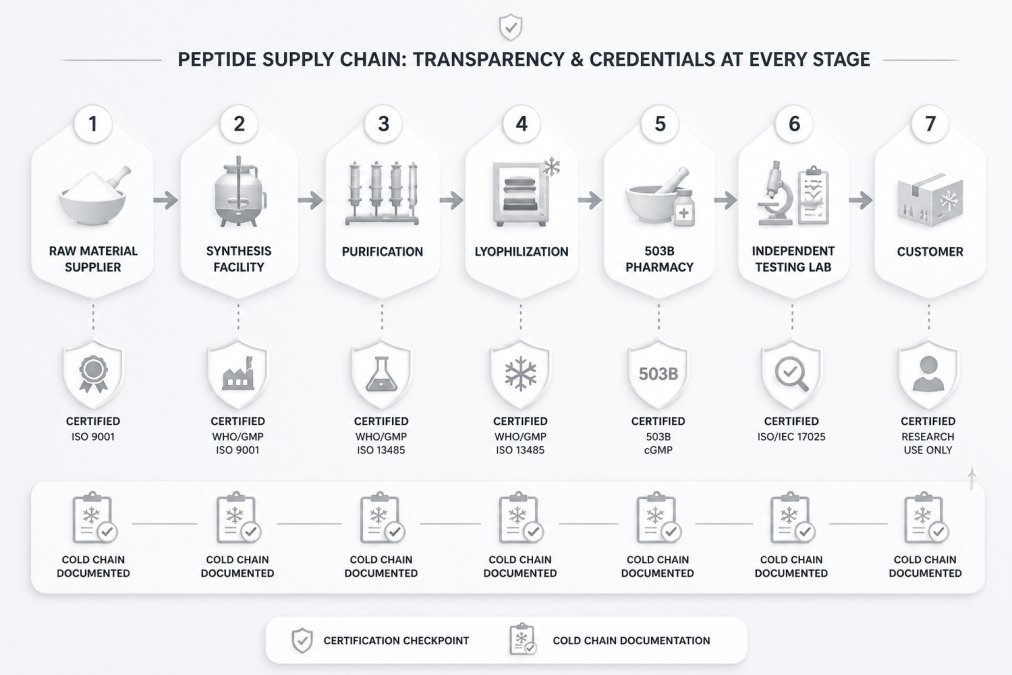
Raw material sourcing refers to where the amino acids and chemical precursors come from. A vendor might claim their raw materials come from WHO/GMP-certified suppliers. This is good, but it’s only the first step. Raw materials are ingredients, not finished products. A vendor with certified raw materials but no certified manufacturing facility is still producing peptides in an uncontrolled environment.
Finished product manufacturing is where the peptide is actually synthesized, purified, and prepared for sale. This is where quality control matters most. A facility manufacturing finished peptides must follow current Good Manufacturing Practice (cGMP) standards if the product is intended for human use, even research use. WHO/GMP certification at the finished product level is significantly more rigorous than certification at the raw material level.
Compounding and reconstitution is a separate step. If a peptide is lyophilized (freeze-dried), it may be manufactured at one facility and then reconstituted (dissolved in solution) at a different facility. A 503B compounding pharmacy handles reconstitution under specific FDA oversight. Understanding which facility did which step is essential for supply chain transparency.
Ask your vendor explicitly: "Which facility synthesized the peptide? Which facility purified it? Which facility lyophilized it? Which facility reconstituted it?" If they can’t answer these questions separately, they don’t understand their own supply chain.
WHO/GMP certification is the gold standard for peptide manufacturing, but vendors frequently misrepresent their certification status. Don’t take their word for it.
The World Health Organization maintains a public list of prequalified manufacturers on their website. Visit the WHO’s prequalification of medicines programme and search for the manufacturer’s name. If the facility is listed, you can see exactly what products they’re certified to manufacture, when their certification was issued, and when it expires. If the manufacturer is not on this list, they are not WHO/GMP prequalified, regardless of what the vendor claims.
If the vendor claims WHO/GMP certification but the facility isn’t on the WHO list, ask for their certification document directly. A legitimate facility will provide a copy of their certification letter from the WHO or from their national regulatory authority. The document should include the facility name, address, certification date, expiration date, and scope of certification (what products they’re certified to make). If the vendor can’t provide this document, they’re lying about their certification status.
Understand the scope of certification. A facility might be certified to manufacture certain peptides but not others. The certification document specifies which products are covered. If your peptide isn’t listed in the scope, the facility isn’t certified to make it, even if they claim to be certified for peptides in general.
ISO certifications (typically ISO 9001 for quality management or ISO 13485 for medical devices) are common claims but easy to fake. Verify them independently.
ISO certifications are issued by accredited certification bodies. The manufacturer should provide the name of the certification body that issued their certificate. Contact that certification body directly and ask if they’ve certified the manufacturer. Provide the manufacturer’s name and the certification number from their certificate. A legitimate certification body will confirm the certification. If they have no record of it, the certificate is forged.
Check the certification body’s own accreditation. Legitimate certification bodies are accredited by national accreditation bodies. In the United States, this is typically ANSI (American National Standards Institute) or another recognized body. Ask the certification body for proof of their accreditation. If they can’t provide it, they’re not a legitimate certification body.
Understand what ISO certification actually means. ISO 9001 certifies that a company has quality management processes in place. It doesn’t certify that their products are high quality, it certifies that they have documented procedures for managing quality. A facility with ISO 9001 certification might still produce low-quality peptides if their procedures are inadequate. ISO 13485 is more specific to medical devices and is more rigorous, but it still certifies processes, not product quality.
If your peptides are reconstituted at a 503B compounding pharmacy, verify the pharmacy’s license independently. Don’t rely on the vendor’s word.
Every 503B compounding pharmacy must be licensed by their state pharmacy board. Contact your state’s pharmacy board directly and ask if the pharmacy is licensed. Provide the pharmacy’s name and address. The pharmacy board will confirm whether the license is active, in good standing, and what their scope of practice is. If the pharmacy isn’t licensed or if their license is inactive, they’re operating illegally.
Ask the vendor for the pharmacy’s DEA registration number and state license number. These should be publicly available. You can verify the DEA registration through the DEA’s website. You can verify the state license through your state pharmacy board’s website. If the vendor can’t provide these numbers or if the numbers don’t check out, the pharmacy isn’t legitimate.
Understand what 503B oversight means. 503B compounding pharmacies are regulated by the FDA and must follow specific quality standards. They maintain records of what they compound, for whom, and when. They report adverse events to the FDA. This creates accountability that independent manufacturers lack. A vendor using a 503B compounding pharmacy is operating within a regulated framework.
Even with certified manufacturers and compounding pharmacies, you need to verify that your specific vial came through the proper supply chain.
Each vial should have a lot number that corresponds to a specific manufacturing batch. Ask the vendor for documentation showing that lot number was manufactured at the certified facility, tested by an independent lab, and released for sale. This documentation should include the manufacturing date, testing date, and release date. If you can’t trace your vial back to a specific batch with documented manufacturing and testing, the supply chain isn’t transparent.
Ask for cold chain documentation. Peptides must be shipped and stored at appropriate temperatures. Legitimate vendors provide temperature logs showing the peptide was kept at the correct temperature from manufacturing through delivery. These logs should include timestamps and temperature readings at key points: when the peptide left the manufacturer, when it arrived at the compounding pharmacy (if applicable), when it was shipped to you, and when it arrived at your facility. If the temperature log shows the peptide was exposed to room temperature for extended periods, it may have degraded.
Verify the shipping method. Peptides should be shipped via expedited methods (overnight or 2-day) in insulated packaging with temperature-controlled packs (dry ice, gel packs, or phase-change materials). Standard ground shipping or uninsulated packaging is a red flag. Ask the vendor how they ship and request documentation of the shipping method used for your order.
Certain claims should immediately trigger skepticism:
"We’re certified but we can’t share the certification document." Legitimate vendors provide certification documents readily. If a vendor refuses, they’re hiding something.
"Our manufacturer is certified but we don’t know the facility name." A vendor should know exactly where their products are made. If they’re vague about the manufacturer, they probably don’t have direct relationships with certified facilities.
"We source from multiple manufacturers." This isn’t inherently bad, but it creates complexity. Ask which manufacturer produced your specific lot. If the vendor can’t tell you, the supply chain isn’t transparent.
"Our lab is certified but we can’t provide contact information." Legitimate labs have public contact information. If the vendor won’t provide it, the lab is probably fake.
"We’re cheaper because we cut out the middleman." Legitimate supply chains have multiple steps: raw material suppliers, synthesis facilities, purification facilities, testing labs, and compounding pharmacies. Cutting out steps means cutting out quality control. Vendors claiming to eliminate steps are eliminating oversight.
Before purchasing from a vendor, complete this verification:
Vendors with nothing to hide will provide all this documentation readily. Vendors with something to hide will make excuses, go silent, or become defensive. That’s your signal to find a different vendor.
Good quality research peptides come with a valid Certificate of Analysis from an independent third-party lab showing purity levels of 99% or higher. Check that the vendor provides this COA before purchase, verify the testing lab is accredited, and confirm the manufacturer holds WHO/GMP or ISO certification. Reputable vendors also store peptides under proper cold chain conditions and provide clear labeling with batch numbers, expiration dates, and reconstitution instructions.
Third-party lab testing verifies the peptide's purity percentage, identifies any adulterants or impurities, and checks for microbial contamination and heavy metals. A Certificate of Analysis from an independent lab, not the manufacturer, shows objective results for the specific batch you're purchasing. This testing confirms the product matches its label claims and meets pharmacological grade standards for research use.
The unregulated online peptide market carries significant risks: counterfeit products, mislabeled vials with incorrect dosing, substandard manufacturing practices, chemical degradation from improper storage, and contamination with endotoxins or heavy metals. Many online vendors lack verifiable credentials, don't provide COAs, and disappear after purchase. Buying from vendors without transparent supply chain information or WHO/GMP certification exposes you to products that may not be what they claim.
Ask the vendor directly for proof of certification and request the certification number. You can verify WHO/GMP status through official databases and contact the certifying body. For 503B compounding pharmacy partnerships, confirm the pharmacy's license with your state's pharmacy board. Legitimate vendors provide this documentation readily and can explain their manufacturing and quality control processes. Be wary of vendors who claim certifications but cannot provide verifiable proof.
This article was written using GrandRanker