
Last Updated: September 15, 2026
Pharmaceutical-grade peptides are manufactured under strict regulatory oversight for human use, unlike research-grade peptides sold for laboratory work only. At Rejuvenation Wellness Solutions LLC, we help researchers understand where that line falls before sourcing.
The difference comes down to three things: who oversees production, what testing is documented, and whether the final product is legally cleared for human use.
A pharmaceutical-grade peptide is produced under Good Manufacturing Practice (GMP) conditions with batch documentation, sterility testing, and a traceable active pharmaceutical ingredient (API) designation. Without that traceability, you may have a chemical that is 95% pure, or 70% pure with an untested contaminant.
GMP certification means a facility follows documented procedures for every step of production: synthesis, purification, lyophilization, and packaging. Under Section 503B of the Federal Food, Drug, and Cosmetic Act, an outsourcing facility can compound sterile products without patient-specific prescriptions, but it must register with the FDA and meet current GMP requirements. The FDA’s guidance on 503B outsourcing facilities spells out those obligations in detail.
A 503B facility is inspected, its batches tested, its equipment calibrated on a schedule. That is what “pharmaceutical grade” buys you.
Research grade peptides are synthesized for laboratory and in-vitro study, not human administration, and typically meet lower documentation standards.
“Research grade” is not a regulated classification, and no federal agency defines a purity floor. One vendor’s “research grade” might be 98% pure with a full Certificate of Analysis; another’s might be 85% pure with no documentation.
When you buy research grade peptides, you are buying the supplier’s word about purity, and that word means different things at different companies.
The “not for human use” or “for laboratory research use only” label exists for a legal reason: the product has not been evaluated for safety, dosing, sterility for injection, or adverse reactions in humans. Selling a chemical for human consumption triggers regulatory requirements research-grade suppliers cannot meet.
Read that label as a factual statement: no clinical trials, no bioavailability data, and no sterility assurance for subcutaneous administration.
A Certificate of Analysis (CoA) for peptides is a document from an analytical laboratory reporting test results for a specific batch, including purity percentage, molecular sequence confirmation, and contaminants, the single most useful document a buyer can request.
A real CoA includes the batch number, testing method (typically HPLC for purity and mass spectrometry for identity), results, and the lab’s identification, and it should match the batch you receive.
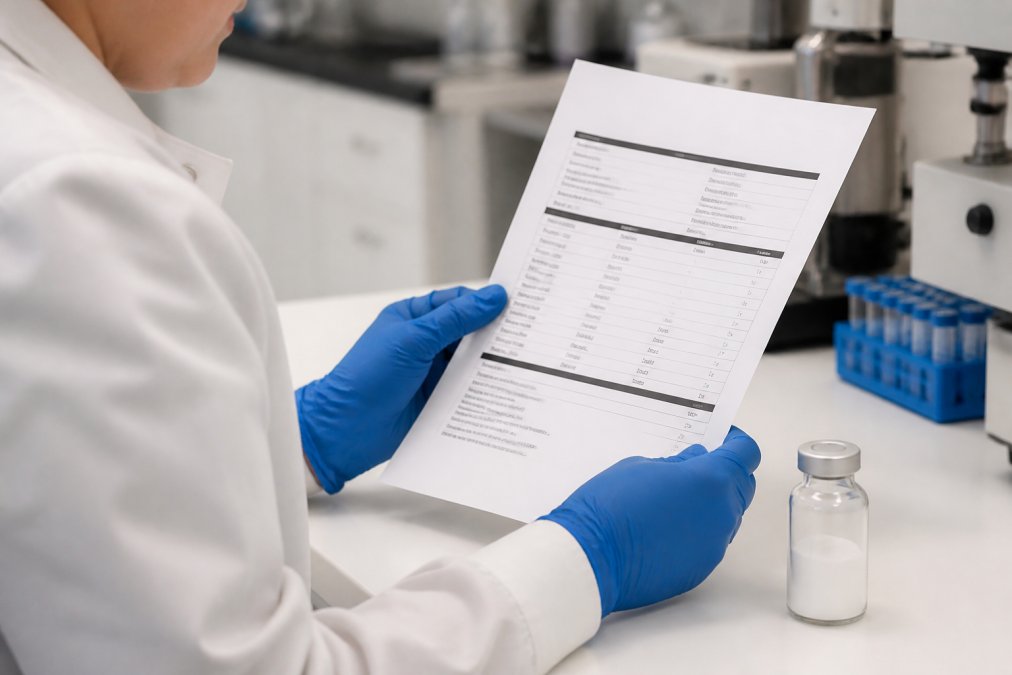
A CoA can be real but irrelevant: if it is from a different batch than the vial in your hand, it proves nothing. Always match the batch number.
Research chemicals, including research-grade peptides, sit in a regulatory gray zone: legal to sell and possess for laboratory use, but not approved for human consumption, and the FDA can act against suppliers who market them for that purpose.
The FDA has issued warning letters to companies selling peptides with claims about human use, weight loss, or healing. Its position is consistent: a product intended for human use needs drug approval or legal compounding under 503A or 503B.
For researchers, the takeaway is simple: buying research grade peptides for legitimate laboratory work is one thing; buying them for personal use puts you outside the intended use and any safety net.
The FDA’s warning letters database is public. Checking whether a supplier has received one takes about two minutes.
The risks of low-purity peptides come from what else is in the vial: synthesis byproducts, residual solvents, heavy metals, and bacterial endotoxins if sterility was never tested. Purity percentage tells you how much target peptide is present, not what the remaining percentage is, two 98% pure peptides can differ chemically depending on what the other 2% contains.
Two failure modes matter most, and both are routinely under-explained in supplier marketing.
Trifluoroacetic acid (TFA) is not an accidental contaminant, it is a deliberate reagent. In solid-phase peptide synthesis, TFA is the standard cleavage cocktail that detaches the finished chain from its resin and strips side-chain protecting groups. It is also used in reverse-phase HPLC purification as an ion-pairing agent to sharpen separation from truncated sequences.
The purified peptide therefore typically elutes as a trifluoroacetate salt, pairing with the TFA anion as its counterion. Without an ion-exchange or salt-conversion step, that TFA stays in the final lyophilized powder, potentially a meaningful fraction of the vial’s mass.
Why this matters depends on the application:
A Certificate of Analysis that reports only HPLC purity and mass confirmation is silent on counterion content. To know what you have, the CoA needs a residual TFA or counterion assay, and the supplier must state which salt form the batch was converted to. Most research-grade listings do not answer that question, and many suppliers cannot.
Endotoxins are lipopolysaccharide fragments from gram-negative bacterial cell walls. They are heat-stable, survive standard filtration, and trigger a pyrogenic immune response at very low concentrations. Any peptide intended for injection must be tested for endotoxins (typically by Limulus amebocyte lysate assay) and sterility (typically USP <71> membrane filtration or direct inoculation).
Research-grade products frequently are not tested for either, because they were never intended for that route. The absence of an endotoxin result on a CoA is not evidence that endotoxin is absent, it is evidence that nobody looked.
Chemical stability matters too. Peptides degrade through backbone hydrolysis, oxidation of methionine and tryptophan, deamidation of asparagine and glutamine, and aggregation during lyophilization or reconstitution. Heat, light, moisture, and repeated freeze-thaw cycles accelerate all of them.
A product that shipped at 98% purity can arrive at a lower purity if it sat in a hot warehouse or crossed a customs hold in summer. Lyophilization (freeze-drying) and cold-chain handling slow that degradation, but they do not stop it, and the shelf-life claim on a research-grade listing is often unsupported by accelerated stability data. USP’s standards for peptide quality cover identity, purity, and impurity profiling for the pharmacopeia side of this, and they are the reference point pharmaceutical manufacturers are held to.
| Risk Factor | What It Means | How to Check |
|---|---|---|
| Low purity | Byproducts and unreacted material remain | HPLC purity result on batch CoA |
| TFA salt residue | Counterion left from synthesis and purification | Residual TFA or counterion data; salt form stated |
| Endotoxins | Bacterial fragments, immune risk | Endotoxin testing result (LAL assay) |
| Sterility failure | Viable microbes present | Sterility test on CoA (USP <71>) |
| Degradation | Sequence breakdown in transit or storage | Cold-chain records, lyophilization data, stability testing |
Supply chain transparency is where most suppliers fall short, and it is the hardest thing to fake.
Research grade peptides carry a ‘not for human use’ label because they are not manufactured under the same FDA oversight as pharmaceutical-grade products. Without GMP certification and 503B compounding standards, these peptides may contain impurities or contaminants that have not been evaluated for human safety. Anyone considering peptide use for health purposes should consult a licensed healthcare provider about pharmaceutical-grade options.
A Certificate of Analysis (COA) documents independent lab testing results for a specific peptide batch. It typically reports purity percentage, molecular weight confirmation, and sometimes endotoxin testing. A COA from a third-party lab provides verification that the product matches its label claims. Buyers should request a batch-specific COA before purchasing, since a generic COA does not guarantee the quality of the vial you receive.
503B compounding pharmacies operate under FDA oversight and must follow current Good Manufacturing Practice (cGMP) standards. They produce medications for human use with a prescription. Research peptide suppliers sell products labeled for laboratory research only, without the same manufacturing requirements or regulatory compliance. This distinction affects purity, sterility, and the legal framework for each product type.
Third-party testing verifies that a peptide’s purity, molecular sequence, and concentration match the supplier’s claims. Without independent verification, researchers cannot confirm whether a product contains the correct compound or harmful impurities. Reputable suppliers like Rejuvenation Wellness Solutions provide batch-specific COAs from independent labs, giving researchers documented evidence of quality before they begin their work.