
Last Updated: September 21, 2026
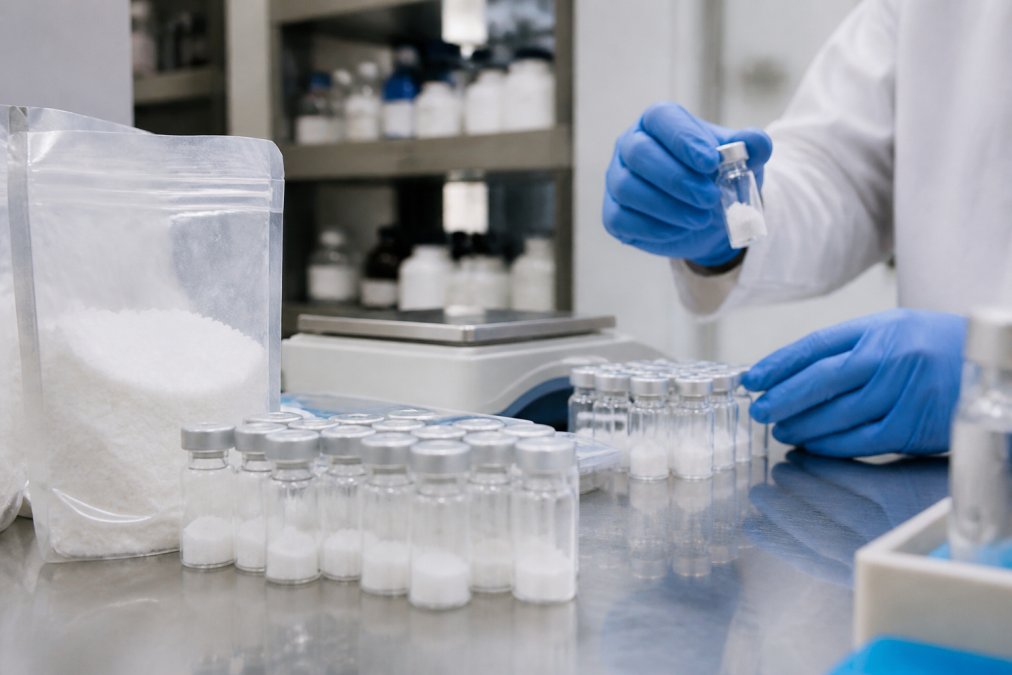
GMP grade peptide bulk pricing reflects the cost of manufacturing peptides under current Good Manufacturing Practice conditions, where every batch is documented, tested, and traceable from raw amino acid reagents to finished vial. At Rejuvenation Wellness Solutions LLC, we source exclusively from WHO/GMP and ISO-certified manufacturers and 503B compounding pharmacies, which is why our pricing sits where it does.
Research-grade peptides are synthesized for laboratory use only and typically ship with a basic purity report. GMP-grade peptides are produced under cGMP controls with full batch records, validated analytical methods, and documentation suitable for clinical or regulatory review.
Several variables move the final number on a cGMP peptide synthesis quote, and understanding them lets you negotiate from a position of knowledge rather than accepting a single lump figure.
Longer sequences require more synthesis cycles and more amino acid reagents, which raises cost per gram. Purity thresholds matter just as much: pushing from standard purity to a higher specification means additional purification passes and lower yield. Scale cuts the other way. Larger batch sizes spread fixed setup costs across more material, so cost per gram typically falls as volume rises.
Every release test adds cost: HPLC-verified purity, mass spectrometry for molecular weight confirmation, and sequence verification. CMC development documentation, stability testing, and lyophilization add further overhead. These are not optional extras on a GMP order; they are the reason the grade exists.
Most suppliers structure bulk peptide pricing on a tier-based model, where cost per unit drops as order quantity increases. The reason is straightforward: a cGMP run carries large fixed costs, facility qualification, equipment changeover, analytical method setup, and release testing, that do not scale linearly with batch size. Spread those fixed costs across more grams and the cost per gram falls.
Rather than publish a fixed price list (which would be misleading, since sequence, purity, and documentation requirements vary too widely per order), here is how to estimate where a quote should land before you ever open a contact form.
| Cost Driver | Lower-Cost End | Higher-Cost End | Why It Moves |
|---|---|---|---|
| Sequence length | Short peptides (under ~10 residues) | Long peptides (30+ residues) | Each residue adds a synthesis cycle, reagent consumption, and cumulative yield loss |
| Purity specification | Standard research purity | High-purity clinical specification | Each additional purification pass (typically preparative HPLC) cuts yield and adds run time |
| Scale | Pilot / evaluation quantity | Commercial-scale run | Fixed setup costs amortize across more material as volume rises |
| Structure | Linear peptide | Cyclic or modified peptide | Cyclization and non-standard residues add synthetic steps and failure risk |
| Documentation | Basic purity report | Full CMC package with stability data | Stability studies, method validation, and batch record review consume lab and QA time |
A tier table is only useful if you know which column actually applies to your order.
| Tier | Typical Order Size | What It Usually Includes | Best For |
|---|---|---|---|
| Sample / pilot | Small evaluation quantity | Basic purity report | Feasibility testing |
| Mid-volume | Moderate research batch | Full CoA, HPLC data | Early-phase studies |
| Bulk / commercial | Large-scale production run | Full CMC package, stability data | Late-phase and commercial |
Before you accept any tier quote, get written answers to these:
A Certificate of Analysis for peptides is the document that proves a specific batch meets its stated specifications, and it is the single most important piece of paper in any bulk order. If a supplier cannot produce one tied to your batch number, walk away.
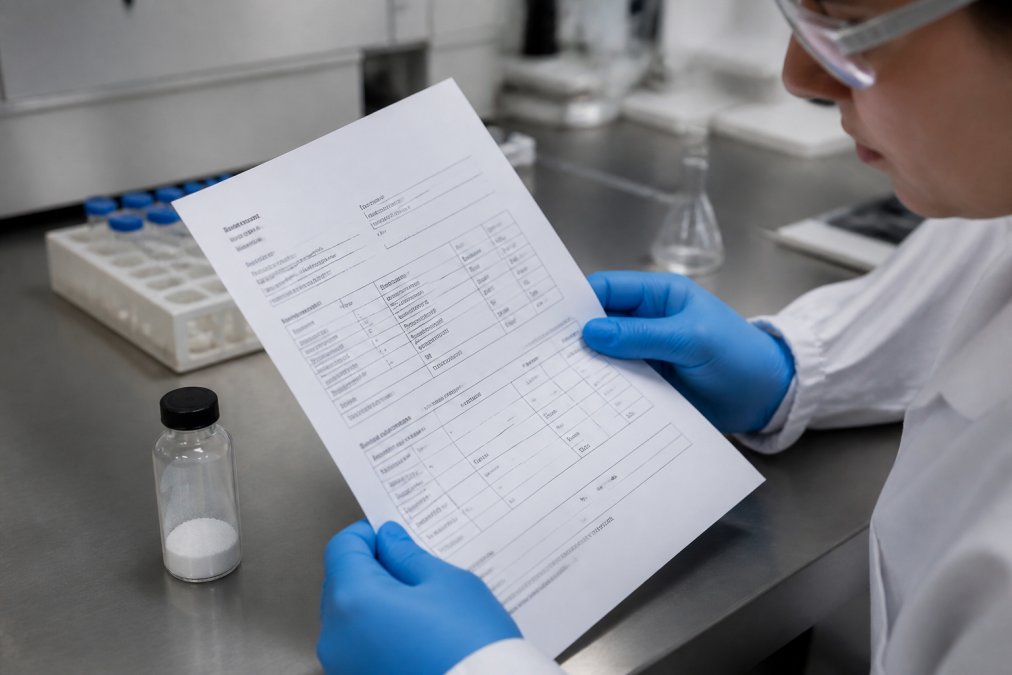
A complete GMP bulk order should ship with the following documents. Treat this as a checklist and confirm each item in writing before you commit.
When you review the CoA, verify these specifics:
HPLC purity. Look for the actual chromatogram, the column and mobile phase used, the detection wavelength, and the integration method. A purity percentage without the trace behind it is a claim, not evidence. Confirm the reported purity meets the specification you ordered, and confirm the specification is stated on the CoA itself.
In-house testing is standard and expected, but independent third-party verification adds a layer of assurance that the supplier’s own lab did not grade its own work. For clinical or regulatory use, confirm whether the CoA reflects in-house results, independent lab results, or both, and whether the independent lab is identified on the document.
Strong bulk peptide procurement best practices come down to planning: knowing your lead time, locking specifications before ordering, and confirming storage and packaging requirements up front.
Lead time scales with order size and complexity. A small pilot batch moves faster than a commercial-scale run, and custom packaging or white-label requirements add time. Build a buffer into your study timeline rather than ordering against a hard deadline.
| Order Scale | Relative Lead Time | Planning Note |
|---|---|---|
| Pilot / sample | Shortest | Confirm specs before ordering |
| Mid-volume | Moderate | Allow time for full testing |
| Commercial-scale | Longest | Factor in packaging and documentation |
Lyophilized peptides generally hold up better in transit and storage than reconstituted material. If your protocol needs custom packaging or specific vial formats, raise it during quoting, not after. Stability testing data should tell you the recommended storage conditions for your batch.
Regulatory compliance and CMC documentation requirements depend on your intended use. Research use, clinical trials, and commercial production each carry different documentation expectations, and the paperwork must match the application.
The documentation package is not paperwork for its own sake. It is what allows your batch to be traced, defended, and reproduced, which is exactly what regulators and reviewers ask for.
Rejuvenation Wellness Solutions LLC supplies high-purity research peptides with independent lab testing and a Certificate of Analysis on every product, backed by same-day fulfillment and UPS 2-day air shipping.
Wholesale pricing for GMP grade peptides depends on sequence length, purity target, order volume, and required documentation. Short peptides at 95% purity cost less per gram than long or cyclic peptides at 98%+ purity. Because suppliers do not publish fixed price lists, request a quote with your exact specifications. Rejuvenation Wellness Solutions provides current pricing on its website and by text, phone, or email.
GMP grade means the peptide is produced under current Good Manufacturing Practices (cGMP), the FDA-enforced quality system for pharmaceuticals. This covers validated synthesis, controlled raw materials, in-process testing, batch records, and full traceability. Every batch is verified by HPLC and mass spectrometry, and a Certificate of Analysis documents the results. Research-grade peptides may be pure, but they lack this documented manufacturing and quality framework.
A complete bulk order should include a Certificate of Analysis per batch with HPLC purity data, mass spectrometry confirmation, and sequence verification. You should also receive safety data sheets, storage and handling instructions, and batch traceability records. For clinical or CMC work, request the full regulatory documentation package. Confirm the supplier’s GMP and ISO certifications before you commit to a purchase order.
Independent lab testing verifies that a peptide matches its label and purity claim. A supplier’s in-house results can be accurate, but third-party HPLC and mass spectrometry results remove doubt. For research use, an inaccurate purity figure can invalidate experimental results. Always ask for the independent Certificate of Analysis and confirm the testing lab is not owned by the supplier. Rejuvenation Wellness Solutions uses independent lab testing for every product.