


Last Updated: September 23, 2026
Small scale gmp peptide production is the manufacture of research-grade peptides in limited batch sizes under current Good Manufacturing Practice conditions. This model serves individual researchers and small labs that need certified purity without commercial-scale volume. The core distinction from standard synthesis is documentation and process control: every step is recorded, every batch is traceable, and every release is backed by analytical data.
Solid-phase peptide synthesis (SPPS) dominates small scale work: the sequence is built stepwise on a resin, making purification straightforward and automation practical. For peptides under roughly 30 residues, SPPS is almost always the right call.
cGMP peptide synthesis requirements do not relax because your batch is small. The same quality management system, documentation, and release testing apply whether you make one vial or one thousand. What changes is how those requirements are scoped, and that scoping separates a smooth IND filing from costly rework.
A common misconception is that small scale means a lighter regulatory burden. The burden is the same; the evidence package shrinks. Here is how the pieces map:
| Requirement | Commercial Scale | Small Scale / Early Phase |
|---|---|---|
| Process validation | Full three-batch prospective validation | May use a documented, science-based justification; concurrent or retrospective approaches are sometimes accepted for Phase 1 |
| Facility qualification | Full IQ/OQ/PQ on all systems | Same expectation, but scope can be limited to systems that touch the batch |
| Batch records | Master batch record plus executed record per lot | Same, though the master record may be less mature at Phase 1 |
| Raw material traceability | Full supplier qualification and audit trail | Same traceability; supplier audits may be phased |
| Release testing | Full panel per 21 CFR 211.165 | Same panel; method validation may be less exhaustive at Phase 1 |
| Stability program | Full ICH Q1A(R2) program | Same design; duration can be shorter with commitment to continue |
Most small scale projects start as research-grade synthesis and cross into cGMP territory when work moves toward a clinical trial. The transition is where timelines slip. A workable sequence:
The FDA guidance on cGMP for Phase 1 investigational drugs is the single most useful document for anyone planning a small scale cGMP campaign, because it tells you exactly where the agency is flexible and where it is not.
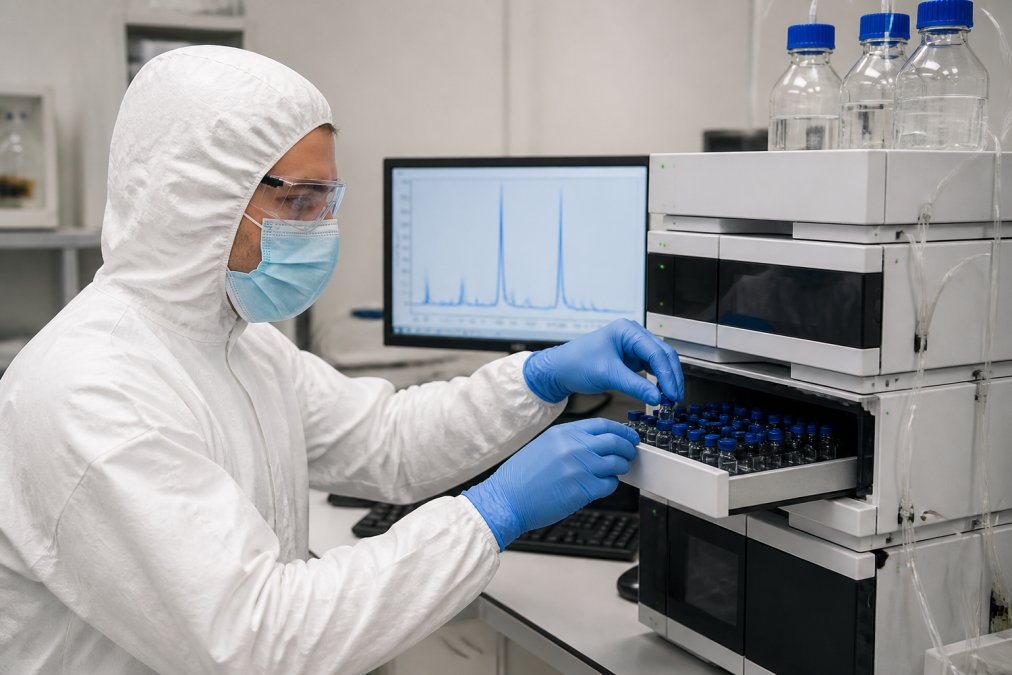
HPLC (high-performance liquid chromatography) is the purity workhorse, separating the target peptide from related impurities and reporting purity as area under the curve. Reverse-phase HPLC on a C18 column with UV detection at 214 nm is standard. The method must resolve the target peak from the closest-eluting impurity; if it cannot, the purity number is meaningless.
The ICH guidelines on impurities in drug substances set the framework that most GMP peptide documentation follows. ICH Q3A covers organic impurities in drug substances, and ICH Q3C covers residual solvents. Knowing this framework helps you read a CoA critically rather than accepting the headline number.
A basic stability program includes:
For researchers who must defend their work, the analytical package is the product. A peptide without a validated method, characterized impurity profile, and stability protocol is a research reagent, not a GMP material.
Peptide impurity profiling is the practice of identifying and quantifying everything in the vial that is not your target peptide. A certificate of analysis that reports only a purity percentage is incomplete.
Small scale GMP peptide production costs more per milligram than commercial-scale work for structural reasons: fixed costs, facility qualification, documentation, release testing, spread across far less output. Timelines follow the same logic: a commercial batch amortizes setup over a large run, while a small batch pays the same setup cost for a fraction of the material.
The per-milligram premium comes from four places:
| Cost Driver | Why It Hits Small Batches Harder |
|---|---|
| Facility and equipment qualification | Same fixed cost, fewer milligrams to absorb it |
| Documentation and batch records | Proportionally larger per unit of output |
| Analytical release testing | Each test has a fixed cost regardless of batch size |
| Process development and validation | Same effort whether the batch is small or large |
The tradeoff is real, but so is the alternative: an unverified peptide with no traceable documentation. For research that must stand up to scrutiny, the premium buys credibility no other way provides.
Ask these questions before committing:
This is where the partner matters more than the peptide. Rejuvenation Wellness Solutions LLC works with WHO/GMP and ISO-certified manufacturers and 503B compounding pharmacies, and every product ships with independent lab testing and a Certificate of Analysis. That documentation is the point.
GMP compliance means every batch is made under a documented quality management system covering raw material sourcing, amino acid sequence verification, in-process controls, analytical validation, and batch release. At small scale, this includes traceability from starting materials to final vial, stability studies, and a certificate of analysis for each lot. The FDA does not certify individual peptide batches; instead, manufacturers operate under cGMP regulations and are inspected periodically. Ask any supplier for their most recent inspection history and lot-specific documentation before committing to a research supply chain.
Early-phase clinical trials typically need grams, not kilograms, of a peptide API. Full commercial-scale manufacturing would waste material and budget before safety and dosing are confirmed. Small scale GMP production gives researchers clinical trial material that meets the same purity, sterility, and documentation standards as commercial supply, without committing to a full-scale run. This matters because the FDA expects investigational new drug applications to include chemistry, manufacturing, and controls data that reflect the actual material used in the trial.
Large scale production optimizes for cost per kilogram, using larger reactors, continuous flow systems, and bulk purification. Small scale GMP peptide production prioritizes flexibility and documentation: smaller batch sizes, more frequent analytical testing per gram, and closer oversight of each synthesis step. Scale-up from pilot to commercial introduces new risks, including changes in impurity profile, so small scale batches often serve as the reference standard for later comparability studies. Researchers should ask how a CDMO handles scale-up and whether the impurity profile stays consistent across batch sizes.
A complete batch record includes the certificate of analysis, HPLC and mass spectrometry data, amino acid analysis, impurity profile, residual solvent and counterion results, and stability data where applicable. For research peptides, independent lab testing adds a layer of verification beyond the manufacturer’s own release testing. Rejuvenation Wellness Solutions provides a certificate of analysis with every product and partners with WHO/GMP and ISO-certified manufacturers and 503B compounding pharmacies, so researchers can review lot-specific documentation before use.








