

Last Updated: September 24, 2026
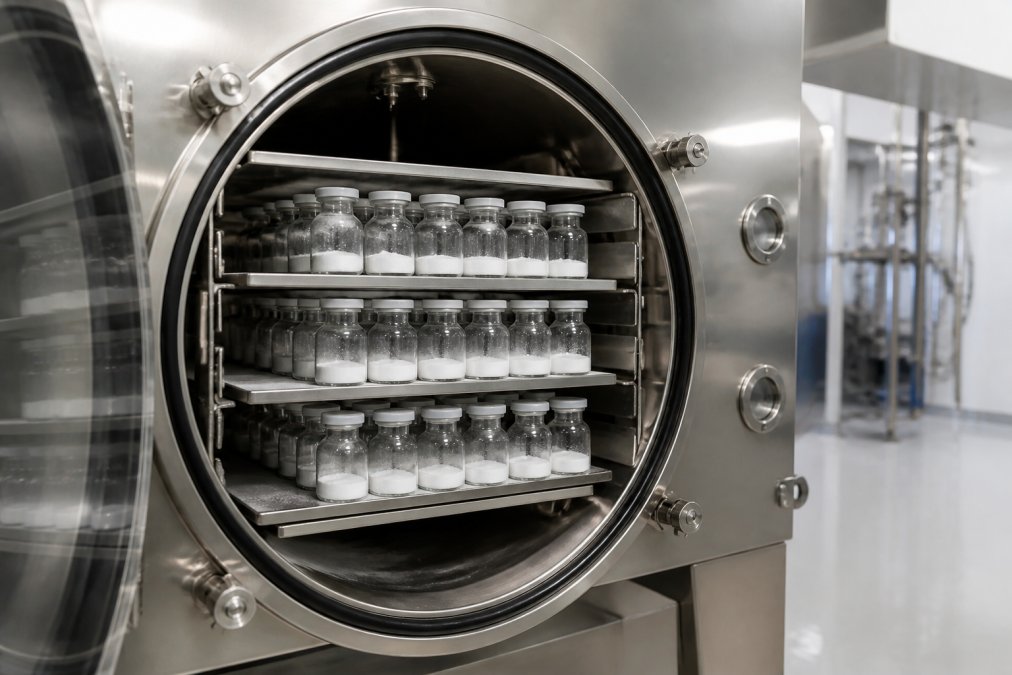
Peptide lyophilization is the controlled removal of water from a frozen peptide formulation under vacuum, converting it into a stable powder that resists the hydrolysis and aggregation that destroy peptides in solution. For any GMP peptide lyophilization best practices program, it is the difference between a product that holds its stability profile for years and one that degrades in months.
Water is the enemy of peptide integrity. In liquid form, peptides are vulnerable to hydrolysis, oxidation, and aggregation, and each pathway accelerates with temperature. Sublimation locks the molecule into a glassy matrix that slows those reactions dramatically.
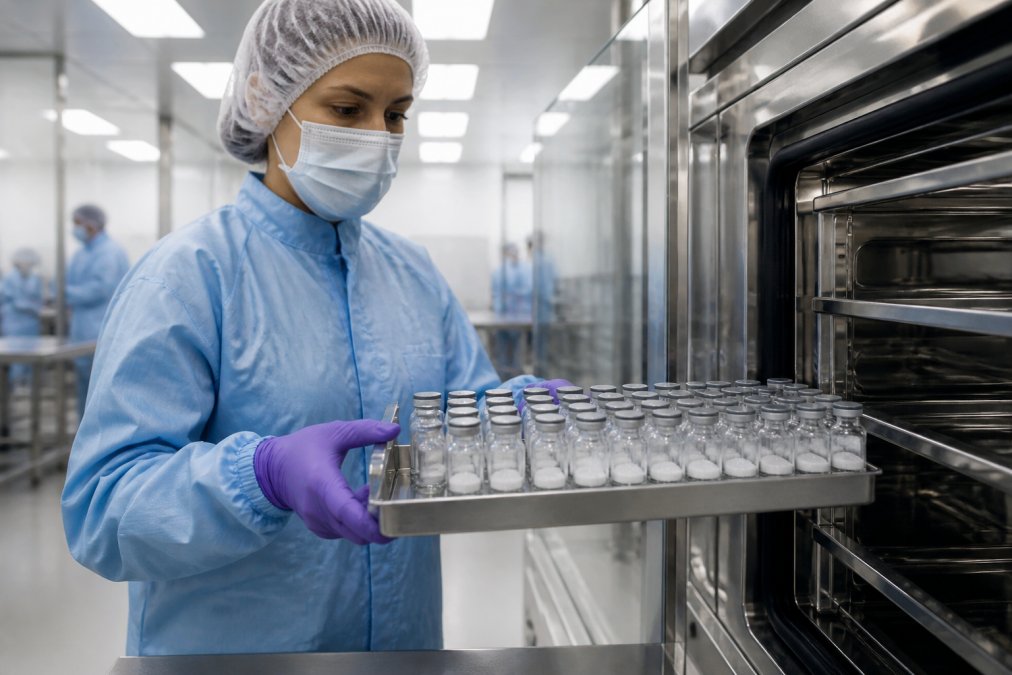
At Rejuvenation Wellness Solutions LLC, every research peptide we supply is 99%+ pure and shipped with a Certificate of Analysis from independent lab testing, purity only means something if the peptide arrives stable and stays that way. Our WHO/GMP and ISO-certified manufacturing partners treat lyophilization as a validated process, not a drying step.
Lyophilization cycle optimization starts with thermal analysis, not trial and error. Before you freeze a single vial, you need the formulation’s critical temperatures, because those values set the ceiling for everything that follows.
Primary drying is where cycles succeed or fail. Shelf temperature must stay below the formulation’s collapse temperature, where the frozen matrix loses structure and the cake caves in, and chamber pressure low enough to drive sublimation without melting the product.
Vial heat transfer determines whether center-shelf vials dry at the same rate as edge vials, which receive more radiant heat and dry faster, creating batch non-uniformity.
| Cycle Phase | Key Parameter | Common Failure | Corrective Action |
|---|---|---|---|
| Freezing | Nucleation temperature | Ice crystal size variation | Controlled nucleation |
| Primary drying | Shelf temp vs. collapse temp | Cake collapse, meltback | Stay below collapse temperature |
| Secondary drying | Ramp rate and endpoint | Elevated residual moisture | Slow ramp, verify endpoint |
| Scale-up | Vial heat transfer (Kv) | Edge-to-center variance | Position mapping, load adjustment |
FDA lyophilization validation guidelines require documented evidence that your process consistently produces a product meeting predetermined specifications. Compliance is a lifecycle: process design, qualification, continued verification.
Residual moisture content analysis is the most scrutinized release test for lyophilized peptides. Karl Fischer titration remains the standard method, and it must be performed on samples drawn from across the batch, not just the center.
Lyophilization excipient selection determines whether your peptide survives freeze-drying with its structure intact. Excipients are not filler, they are the scaffolding that protects the molecule, and the wrong choice or ratio undermines an otherwise well-designed cycle.
Sucrose and trehalose are the workhorses, but not interchangeable. Trehalose generally forms a more stable glass, with a higher Tg’, often -25°C to -30°C for typical formulations, giving more headroom during primary drying. Sucrose sits lower, sometimes -32°C to -35°C, and can hydrolyze to glucose and fructose under acidic conditions, which matters for pH-sensitive peptides.
Mannitol is the most common bulking agent because it crystallizes cleanly and produces a mechanically strong cake. The trade-off: crystalline mannitol does not protect the peptide, so it must be paired with an amorphous lyoprotectant, commonly mannitol at 2-5% with sucrose or trehalose at 1-3%. Glycine works similarly but can crystallize in different polymorphs, complicating cycle reproducibility.
Excipient ratios matter as much as identity, and the ratio interacts with your cycle. Too little lyoprotectant leaves the peptide exposed; too much raises the Tg’ and forces a colder, slower, costlier primary drying step. The answer comes from thermal analysis, differential scanning calorimetry for Tg’, freeze-dry microscopy for collapse temperature, not a default template.
Most lyophilization failures trace back to a parameter that drifted outside its validated range, and the symptom usually points to which one.
Peptide sequence sensitivity means two peptides with similar molecular weight can require completely different cycles. Sequence determines secondary structure, and secondary structure determines how the molecule responds to freezing stress. Most guides treat peptides as a single category; they are not, and the difference shows up in the freeze-dryer.
The most useful distinction is hydrophobic versus hydrophilic character. Hydrophobic peptides, rich in tryptophan, phenylalanine, leucine, isoleucine, and valine, tend to adsorb to ice interfaces during freezing and air-liquid interfaces during filling, driving aggregation. For these, slower freezing rates (often 0.5-1°C/min) produce larger ice crystals and reduce interfacial surface area, and a low concentration of nonionic surfactant such as polysorbate 80 further suppresses interfacial aggregation.
Sequences with high beta-sheet propensity tend to aggregate during freezing because the sheet edge is exposed and can template intermolecular hydrogen bonding. Those formulations often need a stronger lyoprotectant (higher trehalose ratio) and a controlled nucleation step to keep ice crystal size uniform. Sequences with labile residues, methionine, cysteine, tryptophan, may need tighter temperature control during secondary drying and possibly a nitrogen overlay to limit oxidation.
Lyophilization is energy-intensive. A production-scale freeze-dryer can draw hundreds of kilowatts during a multi-day cycle, and primary drying is the longest, most energy-hungry phase. A poorly optimized cycle wastes energy and time, and the waste compounds at scale.
Reconstitution and storage determine whether a stable lyophilized peptide stays stable once back in solution. Lyophilization bought you time; how you handle the vial decides how much.
| Stage | Best Practice | Why It Matters |
|---|---|---|
| Reconstitution | Add diluent slowly down the vial wall | Prevents foaming and shear-induced aggregation |
| Diluent choice | Bacteriostatic water when protocol allows | Supports repeated draws and microbial control |
| Lyophilized storage | Refrigerated or frozen, protected from light | Preserves the glassy matrix |
| Reconstituted storage | Refrigerate, use within protocol window | Solution-state degradation resumes |
The FDA expects a documented validation lifecycle covering process design, qualification, and continued verification. Under 21 CFR Parts 210 and 211, you must establish written procedures for lyophilization, demonstrate that critical process parameters like shelf temperature and chamber pressure are controlled, and maintain batch records. For peptides, validation should also confirm residual moisture limits and stability of the lyo-cycle across production scales. Rejuvenation Wellness Solutions partners with WHO/GMP-certified manufacturers and provides a Certificate of Analysis with every peptide, which supports your own validation documentation.
Excipients act as lyoprotectants and bulking agents that prevent peptide aggregation and collapse during freeze-drying. Common choices include sucrose, trehalose, and mannitol. The right lyophilization excipient selection depends on your peptide’s glass transition temperature and the intended reconstitution volume. Sucrose and trehalose stabilize the amorphous phase, while mannitol provides crystalline structure for cake formation. Getting this wrong leads to collapse, poor solubility, or residual moisture above specification. Rejuvenation Wellness Solutions supplies 99%+ pure peptides that undergo independent lab testing, so your excipient trials start from a consistent baseline.
Research-grade peptides are synthesized for laboratory use and may not follow the same documentation or facility controls as GMP-grade material. GMP-grade peptides are produced in FDA-inspected facilities with validated lyophilization cycles, full batch records, and testing for identity, purity, and residual moisture. Rejuvenation Wellness Solutions works with WHO/GMP and ISO-certified manufacturers and 503B compounding pharmacies to ensure every peptide is 99%+ pure and backed by a Certificate of Analysis. For independent researchers, this means your lyophilization data rests on a verified starting material.
Prevention starts with thermal analysis using differential scanning calorimetry to identify the glass transition and collapse temperatures. Keep primary drying shelf temperature below the collapse temperature, control chamber pressure to support sublimation, and use an annealing step if your formulation is prone to crystallization. Secondary drying should bring residual moisture below the limit that protects against hydrolysis. Rejuvenation Wellness Solutions provides peptides with documented purity and stability profiles, and their comprehensive kits include bacteriostatic dilution water and supplies to support consistent reconstitution after lyophilization.








