

Last Updated: October 18, 2026
Most failed peptide experiments start with a solvent mistake, not a bad peptide.
Peptide dissolution is the process of getting a lyophilized peptide powder fully into solution without clumping, precipitation, or loss of activity. Get it right and your assay works.
Three things go wrong most often:
Below, we walk through solvent selection by sequence, polarity, and charge, then give you a troubleshooting workflow you can run on the bench today.
Standard peptide solubility guidelines start with one question: what is the peptide made of? Short chains behave very differently from long ones. A five-residue fragment often dissolves in plain water. A thirty-residue chain with a cluster of hydrophobic residues may resist water entirely.
The rule of thumb most labs use: count the charged and polar residues, then count the nonpolar ones. Whichever side wins tells you where to start.
Before you weigh a single milligram, pull the sequence and check the isoelectric point. The isoelectric point is the pH at which a peptide carries no net charge. Peptides are least soluble at that pH, so you want your solvent on either side of it.
Quick read:
This one step saves more failed vials than any other habit in the lab.
Water is the default first try for most hydrophilic peptides, and for good reason. It is cheap, compatible with nearly every assay, and easy to handle.
The three grades you will see:
Bacteriostatic water is not a one-size-fits-all choice. Benzyl alcohol can interfere with some cell-based assays and certain analytical methods. If your peptide is headed for HPLC or a live-cell study, check compatibility before you commit.
Hydrophobic peptides resist dissolution in water, so you start organic. The Sigma-Aldrich solubility guidelines name acetonitrile, DMSO, and DMF as common starting points.
How they compare:
| Solvent | Best For | Watch Out For |
|---|---|---|
| Acetonitrile | HPLC-compatible work | Poor solvent for very nonpolar chains alone |
| DMSO | Stubborn hydrophobic peptides | Freezes near room temp; hard to pipette cold |
| DMF | Broad hydrophobic coverage | Toxic; requires careful handling |
| Methanol | Polar uncharged peptides | Can denature some structures |
A common mistake is going straight to pure DMSO. It dissolves almost anything, which is exactly the problem: the peptide may crash out the moment you dilute it into your aqueous buffer. Pre-dissolve in a small volume of organic solvent, then add it dropwise into buffer while swirling.
Basic peptides with a pI above 7 often need an acidic push. The AmbioPharm peptide dissolution FAQ notes that a dilute acetic acid solution can help these peptides into solution.
What this looks like in practice:
The trap here is overshooting. More acid is not better. Once the peptide is dissolved, extra acid can push you out of the pH range your assay needs, and you will spend the next hour dialing it back.
What to dissolve peptide for HPLC depends on your mobile phase, not just on what dissolves the powder fastest.
Match your solvent to the method, and understand why each choice matters:
The GenScript peptide dissolution guide makes a related point: for peptides with an overall charge of zero, an organic solvent is often the right starting point.
A second, often-overlooked issue is sample recovery. Peptides adsorb to plastic and to certain filter membranes, and hydrophobic peptides are the worst offenders.
Finally, distinguish research solvents from reconstitution diluents.
The best reconstitution solution for peptides is the one that dissolves your specific sequence at your target concentration, stays clear after dilution, and does not interfere with your assay. There is no universal answer, but there is a reliable workflow.
Note charged residues, hydrophobic clusters, and the isoelectric point. Peptides are least soluble at their pI, so plan to keep your solvent on either side of it. A short hydrophilic fragment and a long hydrophobic chain need different starting points, and the sequence tells you which you have.
Try a tiny aliquot in distilled water with gentle vortexing. If it clears fully, you have your answer and you have avoided unnecessary organic solvent. If it clouds or leaves film on the glass, move on, do not keep adding water to a peptide that is telling you it is hydrophobic.
Stop as soon as the solution clears. More acid or base is not better; overshooting pushes you out of your assay’s pH range and creates a new problem.
For stubborn hydrophobic peptides, use the smallest volume of organic solvent that clears the powder, often DMSO, DMF, or acetonitrile. The goal is a concentrated stock, not a dilute working solution, because a concentrated organic stock is easier to dilute cleanly into buffer.
This is where most failures happen. When an organic stock meets an aqueous buffer, the peptide can crash out if the local organic fraction drops too fast or the buffer pH sits near the pI. Add the aqueous phase slowly, with mixing, and watch for cloudiness. If it clouds:
Concentration limits are real. A peptide that dissolves at 5 mg/mL may precipitate at 20 mg/mL, and a stock that is clear in organic solvent may not survive a 1:100 dilution into aqueous buffer. Decide your target working concentration first, then work backward to a stock concentration that stays clear through the dilution. When in doubt, keep the stock more concentrated and the working solution more dilute.
Check for aggregation over time and avoid repeated freeze-thaw cycles. Solvent, pH, temperature, light, and storage duration all affect degradation and aggregation after dissolution. Aliquot before freezing so you thaw once, not ten times, and protect light-sensitive peptides from unnecessary exposure.
Run a small pilot before committing the full batch. Confirm the solvent does not interfere with your detection method, does not suppress signal, and does not bind to your labware.
Two habits prevent most failures. First, keep stock solutions concentrated enough to be useful but dilute enough to stay clear. Second, label every aliquot with solvent, concentration, and date, six months later, that label is the difference between a usable stock and a mystery vial.
Distinguish research solvents from reconstitution diluents. DMSO, DMF, and acetonitrile are laboratory solvents; they are not interchangeable with sterile water or bacteriostatic water and are not suitable for injection. Match the solvent to the intended use, not just to what dissolves the powder.
This is also where sourcing matters. A Certificate of Analysis tells you purity and counter-ion content, both of which affect how a peptide dissolves. Our comprehensive product kits include peptides, bacteriostatic dilution water, syringes, and alcohol swabs so you are not hunting for supplies mid-protocol.
Solvent selection is not guesswork, but it does take discipline. Read the sequence, match the solvent to charge and polarity, and confirm compatibility with your downstream method before you commit a vial.
If inconsistent peptide quality is what keeps derailing your dissolution work, that is a supply problem, not a technique problem. Rejuvenation Wellness Solutions LLC sources 99%+ pure research peptides from WHO/GMP and ISO-certified manufacturers and 503B compounding pharmacies, ensuring products are 99%+ pure and undergo independent lab testing with a Certificate of Analysis for safety and purity.
Start with the peptide’s sequence: count charged residues and estimate the isoelectric point. Hydrophilic, charged peptides usually dissolve in distilled or sterile water. Neutral or hydrophobic peptides often need an organic solvent such as acetonitrile, DMSO, or DMF, sometimes as a small fraction of the final volume. Basic peptides may need a small amount of acetic acid. Always run a small test aliquot first, and confirm compatibility with your downstream assay before committing the full vial.
Sterile water contains no preservative and is suited to single-use reconstitution and analytical work where an additive could interfere with HPLC or assays. Bacteriostatic water contains benzyl alcohol, which slows microbial growth across repeated withdrawals from a multi-dose vial. For cell culture or sensitive analytical methods, the benzyl alcohol can affect results, so sterile water is usually the safer choice. Match the diluent to the application, not to habit.
Work in steps. First try water with a brief vortex and short sonication. If particles remain, add a small percentage of a water-miscible organic solvent such as acetonitrile, then try DMSO if needed. For basic peptides, a small amount of acetic acid can help; for acidic peptides, a mild base is sometimes used. Keep the organic fraction as low as possible, avoid prolonged sonication that can degrade the peptide, and check for precipitation after each dilution.
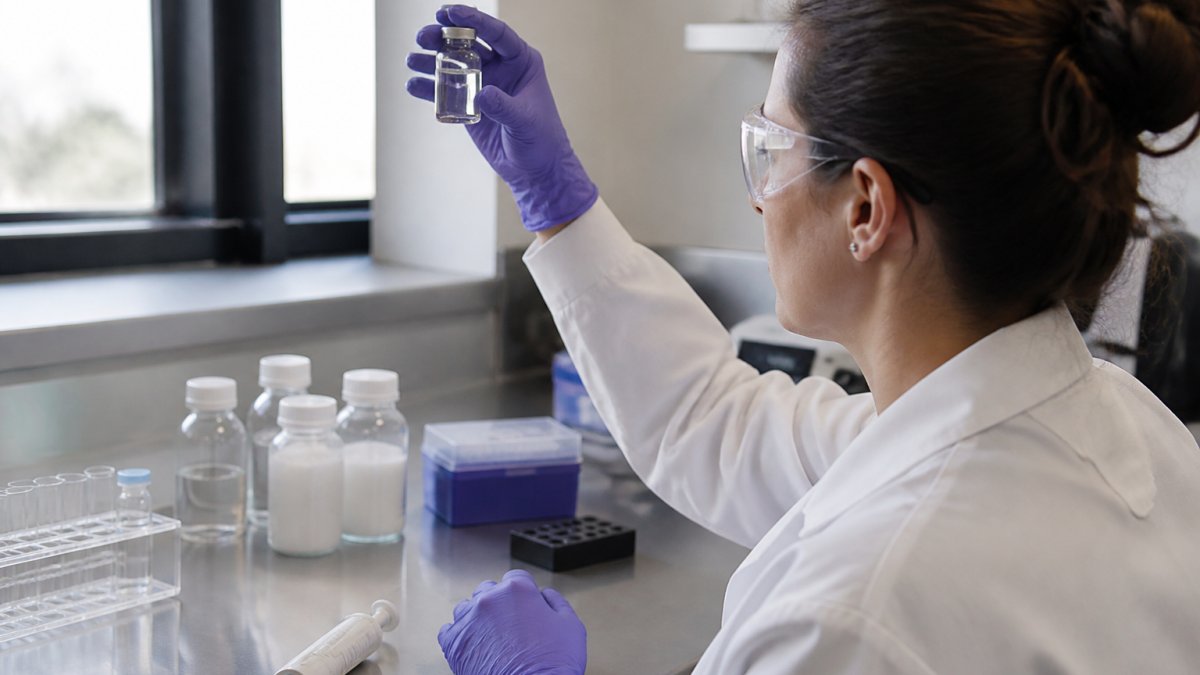
Hold the vial against a light source and look for haze, floating particles, or film on the glass. A fully dissolved solution is clear and free of visible particulate. Confirm with absorbance at 280 nm if aromatic residues are present, or run a quick HPLC injection to check for a single main peak. If the solution turns cloudy after standing or after dilution, the peptide has likely precipitated and needs a different solvent ratio.








