

Last Updated: October 17, 2026
When you store research peptides, you’re working with sensitive molecules. They break down quickly when exposed to heat, light, moisture, or repeated temperature changes. How you store research peptides properly determines whether your work succeeds or fails.
Improper storage degrades peptide quality. You lose purity, potency, and research validity. A peptide that was 99% pure when it arrived can drop to 80% pure within weeks if stored incorrectly.
At Rejuvenation Wellness Solutions LLC, we include detailed storage guidance with every order because our customers’ research depends on it.
You’re investing time, money, and scientific rigor into your work. Proper peptide storage protects that investment.
Temperature control is the foundation of peptide preservation, and the right temperature depends on how long you need to keep peptides viable.
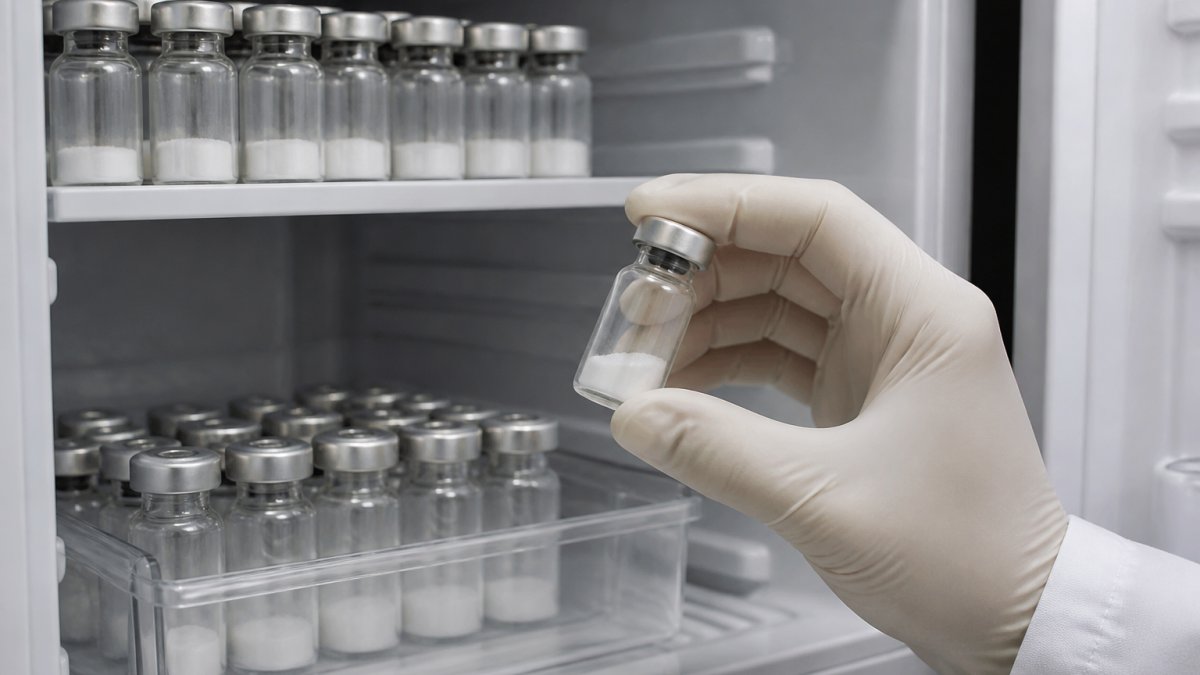
Short-term storage at 2-8°C (refrigeration) works for peptides you’ll use within weeks, slowing degradation without the stress of freezing.
Keep lyophilized peptides in the refrigerator when:
Reconstituted peptides absolutely belong at 2-8°C. Once diluted, peptides become more vulnerable. Refrigeration extends their usable window significantly compared to room temperature storage.
Store vials on a shelf inside the refrigerator, not on the door. Door storage experiences temperature fluctuations every time someone opens it. Interior shelves maintain more stable conditions.
Long-term storage requires freezer temperatures. Choose between -20°C (standard freezer) or -80°C (ultra-low freezer) based on your storage duration.
-20°C freezers preserve lyophilized peptides for 6-12 months or longer. Most standard laboratory or home freezers reach this temperature. This is the most accessible option for individual researchers.
-80°C freezers are the gold standard for extended storage, keeping peptides stable for years.
Never store reconstituted peptides at -20°C for extended periods. Freeze-thaw cycles during repeated use damage peptide bonds. For reconstituted solutions you’ll access multiple times, keep them at 2-8°C instead.
Lyophilized peptides are freeze-dried powders that are remarkably stable when protected from moisture and light.
Start with the right container. Use amber or opaque glass vials with rubber septa and aluminum seals.
Place desiccant packets inside the vial before sealing. Desiccant absorbs any residual moisture. Even trace water accelerates peptide hydrolysis.
Seal the vial tightly. Press the aluminum cap down firmly. A loose seal lets humidity creep in over time.
Store in a secondary container for additional protection. Use an opaque foil pouch, amber bottle, or sealed plastic container.
Label everything clearly:
Keep the vial upright in the freezer. Horizontal storage can stress the seal over time.
Reconstituted peptides are dissolved in solution, making them less stable than dry powder because water accelerates degradation. The handling workflow around reconstitution matters as much as the temperature you choose.
A consistent, written workflow prevents the two most common failures: contamination and unnecessary freeze-thaw cycles. A practical sequence:
Use sterile syringes and alcohol swabs for every withdrawal: swab the septum, let it dry, and use a new needle each time. Keep the vial sealed between uses and minimize air exposure, oxygen contributes to oxidative degradation. Rejuvenation Wellness Solutions LLC includes syringes and alcohol swabs in our kits.
If you must freeze reconstituted solution, aliquot it first: divide the batch into small labeled vials, freeze them, and thaw only what you need. Discard unused thawed solution rather than refreezing it, keep a small working stock at 2-8°C, and leave reserve aliquots untouched in the freezer. This single practice does more to protect stability than any other handling step.
General rules are a starting point, not a guarantee. The right diluent, concentration, and storage temperature depend on the peptide sequence, formulation, supplier’s stability data, and your assay. If the Certificate of Analysis or supplier instructions conflict with general guidance, follow the peptide-specific instructions and document why.
Reconstituted peptides stored at 2-8°C typically remain stable for 2-4 weeks. After 4 weeks, degradation accelerates noticeably.
The exact timeline depends on the specific peptide sequence. Some peptides are more strong. Others are fragile. Conservative estimates assume 2-3 weeks of reliable use.
Do not rely on visual inspection: a solution can look clear while degradation proceeds invisibly at the molecular level. Follow the timeline, and when in doubt, prepare fresh solution.
Frozen reconstituted peptides at -20°C last longer, but freeze-thaw cycles cause damage. Every freeze and thaw stresses peptide bonds. Ice crystal formation disrupts molecular structure.
Freeze-thaw cycles are one of the biggest threats to reconstituted peptide stability, and each cycle compounds the damage to peptide molecules.
Avoid freeze-thaw cycles entirely when possible, the single best protection for reconstituted peptides.
If you must freeze reconstituted solution, aliquot it first. Divide the batch into small portions in separate vials. Use one aliquot at a time.
Keep working stock at 2-8°C. Maintain a small refrigerated batch for active use. Store reserve batches in the freezer untouched.
Document every freeze-thaw event. Track how many times each vial has been frozen and thawed. After 3-4 cycles, quality degrades significantly. Replace with fresh solution.
Moisture and light are the two primary enemies of peptide stability, accelerating chemical degradation through different mechanisms.
Moisture causes hydrolysis. Water molecules break peptide bonds. Humid air gradually infiltrates even sealed containers.
Light causes photodegradation. Ultraviolet and visible light energy breaks chemical bonds.
Store all peptides in opaque containers. Amber glass is ideal.
Keep peptides away from direct sunlight. Store in a dark cabinet or opaque box inside the freezer.
Minimize bench exposure. Do not leave vials sitting out while you prepare experiments. Work quickly.
Control humidity in your storage area.
Avoid temperature fluctuations. Unstable temperatures stress peptide molecules and introduce moisture through condensation.
The right container determines whether peptides remain stable or degrade prematurely.

Vial selection matters. Use borosilicate glass vials, not plastic. Glass doesn’t interact with peptides.
Vial size should match your usage pattern.
Sealing is critical. Rubber septa must be intact and properly seated.
Label clearly and completely. Include:
Labeling prevents mistakes. It also helps you rotate stock properly. Oldest peptides should be used first.
Store vials upright. Horizontal storage stresses seals over time. Upright vials maintain seal integrity longer.
Keep peptides in their original packaging when possible. Manufacturers design packaging specifically for peptide protection.
Documentation protects your research. Storage logs create accountability, support reproducibility, and help you identify problems before they invalidate a batch.
Record the following for every peptide batch. A simple spreadsheet with one row per vial or lot works well:
| Field | What to record |
|---|---|
| Receipt date | Date and time the shipment arrived |
| Peptide and lot | Name, sequence, and lot or batch number |
| Initial purity | Purity from the Certificate of Analysis |
| Storage location | Freezer or refrigerator ID and shelf position |
| Assigned temperature | Target temperature (e.g., -20°C, 2-8°C) |
| Reconstitution | Date, time, diluent, and concentration |
| Freeze-thaw count | Running tally per vial |
| Temperature excursions | Date, duration, peak temperature, and action taken |
| Withdrawals | Date and amount removed |
| Discard decision | Date and reason |
This log becomes part of your research record. It demonstrates that you handled materials properly, and if results look off, it helps you determine whether storage contributed.
Use a thermometer or a temperature logger in each freezer and refrigerator. Check readings on a fixed schedule, weekly is a common minimum, and document them. A logger with a min/max memory is more useful than a spot-check thermometer because it captures overnight drift. If temperature drifts above the target range, investigate immediately; a freezer malfunction can ruin an entire batch.
Excursions happen: a power outage, a door left open, a failing compressor. When one occurs, collect the information you need before deciding anything:
Lyophilized powder is generally more tolerant of brief warming than reconstituted solution, but tolerance depends on the peptide and formulation. Do not assume a sample remains usable just because it looks unchanged, degradation can proceed invisibly. When in doubt, consult the supplier with the excursion details and replace questionable material. Research integrity depends on knowing your materials are reliable.
Rejuvenation Wellness Solutions LLC provides Certificates of Analysis with every order. These documents establish baseline purity. Keep them with your storage logs, together they show what you started with and help you evaluate whether storage affected quality. Maintain consistent storage practices as well: don’t rotate between different freezers or change temperatures without documenting why, because consistency keeps your results interpretable.
Research peptides require cold storage to slow degradation. Lyophilized peptides in dry powder form should be stored at 2-8°C for short-term use (weeks to months) or -20°C to -80°C for long-term storage (months to years). All peptides must be kept in airtight containers protected from moisture and light. Reconstituted peptides have shorter shelf lives and should be stored at 2-8°C and used within days unless otherwise specified by your supplier’s Certificate of Analysis.
Reconstituted peptides typically remain stable for 3-7 days when stored at 2-8°C in airtight vials, though this depends on the specific peptide sequence and your reconstitution method. Some peptides may degrade faster due to hydrolysis or bacterial growth. Always check your product’s Certificate of Analysis for stability data specific to your batch. Freezing reconstituted peptides at -20°C can extend shelf life to weeks, but repeated freeze-thaw cycles increase the risk of peptide bond degradation and loss of potency.
Yes. Each freeze-thaw cycle introduces stress that can break peptide bonds and reduce stability. Ice crystal formation during freezing can physically damage peptide structures, while thawing creates osmotic stress. To minimize damage, divide reconstituted peptides into smaller aliquots before freezing so you use one vial at a time without repeated thawing. Lyophilized peptides are more resistant to freeze-thaw stress than liquid solutions, making them ideal for long-term storage.
Temperature excursions can accelerate degradation, especially for reconstituted peptides. If your peptides were exposed to temperatures outside their recommended range, document the incident with date, time, and temperature readings. Contact your supplier immediately with this information, they can review your Certificate of Analysis and advise whether the batch remains suitable for research. For future shipments, request insulated packaging with temperature monitoring devices and confirm receipt within hours of delivery to catch excursions early.








