
Last Updated: October 21, 2026
Troubleshooting peptide solubility issues in research starts with one fact: a peptide that won’t dissolve is usually telling you something about its sequence, not its purity. Peptide solubility is the ability of a peptide powder to fully dissolve into a clear solution at a given concentration and solvent.
Peptides are built from amino acids with wildly different water preferences, so a sequence loaded with water-repelling residues will fight you at every step.
Hydrophobic peptides carry a high share of residues like leucine, isoleucine, valine, phenylalanine, and tryptophan.
Charged residues do the opposite: lysine, arginine, aspartate, and glutamate help the peptide interact with water.
So the first diagnostic question is simple: count the charged residues against the hydrophobic ones. That ratio predicts most dissolution problems before you open a vial.
Non-natural amino acids change the picture: modified residues can boost stability or binding but often reduce water solubility by adding hydrophobic bulk or removing charge.
Solubility indices rank each residue by its tendency to dissolve in water; summing them across a sequence gives a rough calculated solubility figure. A low score flags a peptide that will likely need an organic solvent or a pH adjustment.
Learning how to dissolve peptides for research comes down to a repeatable order of operations that removes most guesswork.
Total time: 30 to 60 minutes
Difficulty: Beginner to intermediate
What you’ll need:
The certificate of analysis is your first and best data source: it gives identity, purity, counter-ion, and handling notes. Check the counter-ion especially, acetate salts dissolve differently than trifluoroacetate salts.
Read it first; it often names the recommended solvent outright.
Start with the mildest solvent that will work: add liquid dropwise, swirl gently between additions, and aim for a clear stock solution before you dilute.
Peptide solvent selection is where most failed attempts go wrong. The right solvent depends on the peptide’s charge profile and hydrophobicity, not habit, and that choice follows the sample into every downstream experiment.
Work top to bottom and stop at the first branch that fits.
This order moves from the mildest, most downstream-friendly solvent toward stronger interventions, so you only escalate when the peptide forces you to.
| Peptide Type | Net Charge | Best First Solvent | Backup Option | Downstream Caution |
|---|---|---|---|---|
| Basic | Positive | Dilute acetic acid | Water with gentle vortexing | Acetate carryover can shift assay pH; volatile, so removable by lyophilization |
| Acidic | Negative | Dilute ammonium hydroxide | Physiological buffer | Residual ammonia can raise assay pH; keep additions minimal |
| Hydrophobic | Neutral | DMSO or acetonitrile (5%-20% v/v) | Small organic fraction in water | DMSO carryover can inhibit cells and interfere with some assays |
| Mixed | Balanced | Sterile water or buffer | Dropwise acid or base | Re-check pH after any adjustment |
Basic peptides dissolve more readily in slightly acidic solution. Add dilute acetic acid dropwise until clear; it is volatile, so it leaves the sample during lyophilization, a real advantage for a clean final product. Check clarity after each addition, since overshooting can push the pH below the peptide’s stable range.
Acidic peptides respond to basic conditions. Ammonium hydroxide raises the pH and helps the peptide enter solution; add it dropwise and stop as soon as the solution clears, since over-addition can push the pH too high and harm the peptide.
When water and pH adjustment fail, a co-solvent is the next step. DMSO dissolves many difficult hydrophobic sequences and is miscible with water, but even a few percent can affect cell viability and some enzymatic assays. Acetonitrile suits reverse-phase chromatography but is less forgiving for cell-based work. Introduce either in 5% v/v increments and record the minimum fraction that produces a clear solution, that number becomes your standard for the batch.
The solvent you choose does not disappear when the peptide dissolves. Plan for carryover before you commit:
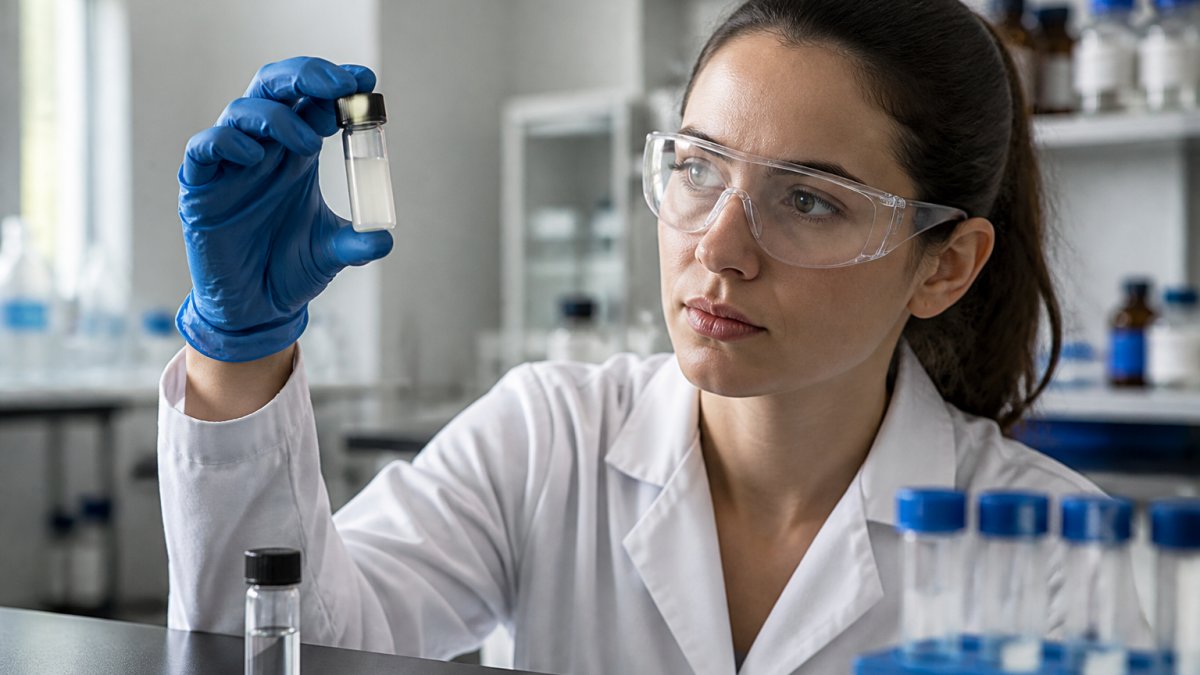
Peptide aggregation troubleshooting begins the moment a solution turns cloudy, but “cloudy” is not one problem. Classify what you see first, because incomplete dissolution, colloidal aggregation, and true precipitation each call for a different response.
Hold the vial against a light source and look for three distinct presentations:
Each pattern points to a different root cause. Treating a settling precipitate as haze by adding more solvent usually makes it worse by diluting past your working concentration.
Work down the matrix in order. Stop as soon as the symptom resolves.
| Symptom | Most Likely Cause | First Action | If It Persists |
|---|---|---|---|
| Uniform haze, no settling | Incomplete dissolution; peptide still hydrating | Vortex gently 30-60 s, then rest 5 min; re-check | Add co-solvent dropwise (DMSO or acetonitrile) at 5-10% v/v |
| Haze that clears on warming | Temperature-dependent solubility | Warm to room temperature; avoid exceeding ~40 °C | Hold at room temperature longer before adding solvent |
| Particles that settle | Concentration above solubility limit | Dilute 2-fold and re-check clarity | Reduce target stock concentration; switch solvent system |
| Cloudy after pH adjustment | pH past the peptide’s stable range; isoelectric precipitation | Back-titrate one drop at a time toward neutral | Re-dissolve in the original solvent and adjust more slowly |
| Clear then cloudy over days | Self-association or adsorption | Check vial material; move to low-binding tubes | Aliquot fresh; avoid repeated freeze-thaw |
| Cloudy only after dilution into buffer | Buffer incompatibility or salting-out | Dilute into buffer dropwise with mixing | Match buffer ionic strength to the stock; consider a different buffer |
This step changes your next move:
If vortexing makes the sample cloudier rather than clearer, stop. Switch to gentle end-over-end mixing or brief bath sonication, and consider whether the peptide needs a different solvent system entirely rather than more mechanical energy.
Once the solution clears, confirm you recovered the peptide rather than merely hiding the haze: check clarity against a light source, confirm concentration against your intended stock, and note the final pH. If it only cleared after a large solvent addition, record that, the peptide sits near its solubility ceiling and should be handled at a lower working concentration.
Peptide solubility prediction saves time before you waste material. Calculated tools estimate solubility from the amino-acid sequence and flag problem peptides early.
These tools are guides, not guarantees. Experimental solubility still depends on concentration, temperature, and buffer. Use predictions to set expectations, then confirm in the lab.
A practical approach:
Set acceptance criteria before you start so you know when a solution is good enough. Define what “dissolved” means for your experiment.
A simple rubric:
Record the solvent, pH, concentration, and time to clarity for every batch. That log turns a frustrating one-off into a repeatable method and gives you data to compare when a batch fails.
Handle every peptide as a research chemical. Wear gloves and eye protection, work in a ventilated space, and follow your institution’s chemical safety rules. Review the OSHA laboratory safety guidance for handling and labeling standards.
Storage rules that protect your work:
At Rejuvenation Wellness Solutions LLC, every product ships with a certificate of analysis from independent lab testing, so you can confirm identity and purity before you dissolve a single milligram.
Peptide solubility problems rarely come from bad material. When you need research peptides you can trust, Rejuvenation Wellness Solutions LLC supplies 99%+ pure products with independent lab testing and a certificate of analysis in every order.
A peptide that will not dissolve usually has a high proportion of hydrophobic residues, a strong tendency to aggregate, or a pH that leaves it without a net charge. Check the Certificate of Analysis for purity and counterion content, then try a small test batch in an organic solvent such as DMSO or in acidified water. If the solution stays cloudy, sonicate briefly and inspect against a light source. For peptides with known aggregation motifs, consider adding a low percentage of acetic acid or using a physiological buffer that matches your downstream assay.
Start with the amino-acid sequence: count basic residues (lysine, arginine) and acidic residues (glutamate, aspartate). Basic peptides often dissolve in acidic conditions, while acidic peptides may need basic conditions. If the peptide is largely hydrophobic, try DMSO or a small amount of acetic acid. Always test a small aliquot first and add solvent dropwise with gentle vortexing. Keep the final volume minimal to reach your target stock concentration, and note the solvent composition so you can match it to your downstream experiment.
Yes. Adjusting pH changes the charge on ionizable side chains, which can increase repulsion between peptide molecules and reduce aggregation. For basic peptides, lowering pH with acetic acid or dilute hydrochloric acid often helps. For acidic peptides, raising pH with ammonium hydroxide can work. Add acid or base dropwise while monitoring with a pH meter or indicator paper, and stay within a range compatible with your assay. Extreme pH can hydrolyze some peptides, so use the mildest adjustment that clears the solution.
Aggregation typically shows as cloudiness, visible particles, or a drop in signal in functional assays, while degradation often appears as a new peak on analytical HPLC or mass spectrometry. Run a small sample on HPLC and compare the retention time and peak shape with the Certificate of Analysis. For aggregation, try sonication or a different solvent; for degradation, check storage temperature and avoid repeated freeze-thaw cycles. Keep records of solvent, pH, and time so you can distinguish the two causes.