

Last Updated: August 20, 2026
Proper peptide storage is essential for maintaining sample integrity and ensuring reliable research outcomes. At Rejuvenation Wellness Solutions LLC, we understand that the difference between successful experiments and failed batches often comes down to storage conditions. Whether you’re working with lyophilized peptides or reconstituted solutions, the storage environment directly impacts stability, potency, and usability.
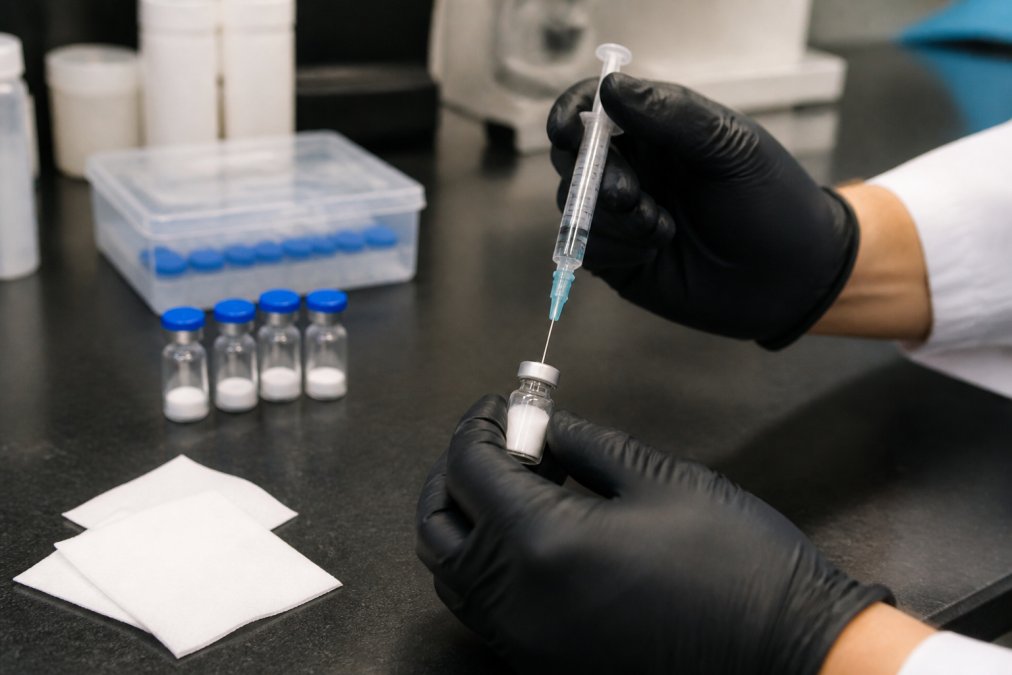
A degraded peptide sample means wasted time, failed experiments, and repeated costs. Understanding the fundamentals means knowing the difference between lyophilized and reconstituted forms, why temperature matters at a molecular level, and how environmental factors like moisture and oxidation drive degradation.
Lyophilized peptides are freeze-dried powders with water removed through a controlled process that preserves molecular structure. This form is remarkably stable, a lyophilized peptide stored properly can remain viable for years. Reconstituted peptides are dissolved in solution (typically bacteriostatic water) and face environmental stressors: water molecules drive hydrolysis, oxygen triggers oxidation, and bacteria can contaminate the solution.
A lyophilized peptide in a sealed vial at -20°C faces minimal degradation. The same peptide, once reconstituted, degrades faster depending on the specific sequence and storage conditions. For researchers, this distinction shapes your entire storage strategy: lyophilized peptides are your long-term storage solution, while reconstituted peptides are working solutions you prepare when needed and plan for shorter shelf life.
Temperature, moisture, light, and oxygen are the four enemies of peptide stability. Temperature accelerates chemical reactions; higher temperatures mean faster degradation. Moisture enables hydrolysis, breaking peptide bonds. Light triggers photochemical degradation, especially for peptides with aromatic amino acids. Oxygen drives oxidation, modifying amino acid side chains.
Proper storage minimizes all four: cold temperatures slow chemical reactions dramatically, sealed vials exclude moisture and oxygen, and opaque containers block light. Together, these measures preserve peptide integrity across weeks, months, or years depending on the form and storage temperature.
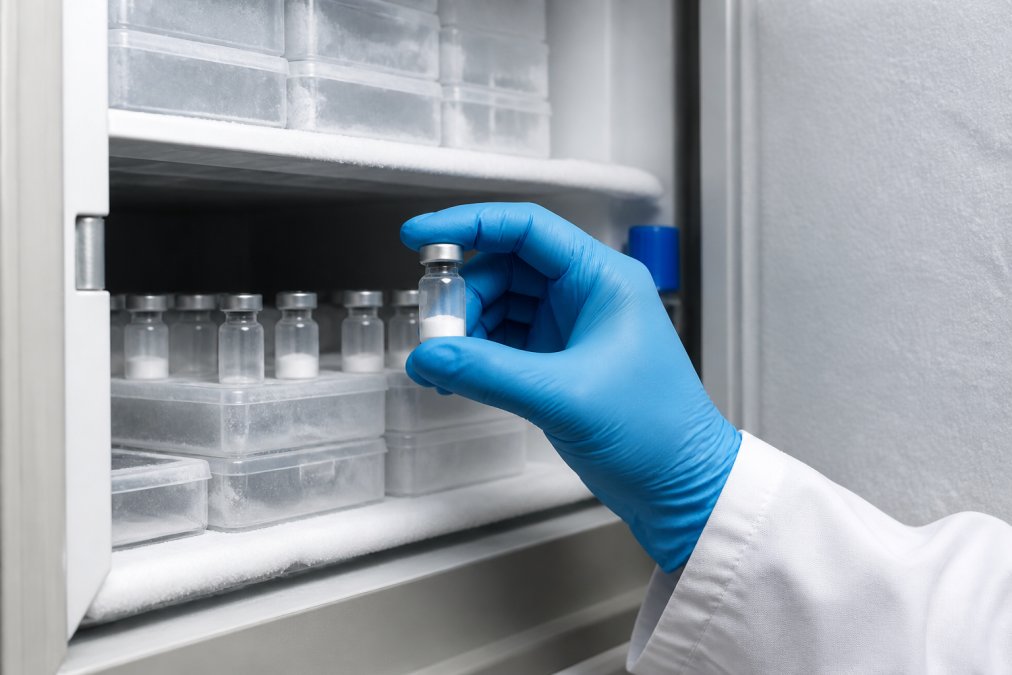
Lyophilized peptides have straightforward temperature requirements. The choice between -20°C and -80°C storage determines how long your peptides remain stable and what equipment investment you need.
At -20°C, chemical reaction rates slow considerably. At -80°C, they slow even further. For most lyophilized peptides, -20°C storage provides stability measured in years, while -80°C extends that to many years, sometimes indefinitely.
Use -20°C storage if you plan to use the peptide within 1-3 years. Use -80°C if you need longer-term preservation or are building a reference library. A standard laboratory freezer reaches -20°C and costs less to purchase and operate. An ultralow freezer reaching -80°C is more expensive upfront and consumes more electricity, but is the right choice for extended storage.
Temperature stability matters as much as absolute temperature. A freezer that fluctuates between -15°C and -25°C is worse than one holding steady at -25°C. Freeze-thaw cycles accelerate degradation. Look for equipment with tight temperature control and low fluctuation rates. Many modern freezers include data logging, use it to monitor storage temperatures consistently.
Glass vials with rubber-lined septa (caps) are the standard for peptide storage. The rubber creates an airtight seal and the glass is inert. For long-term storage, use amber or opaque vials to block light. The vial size should match your peptide quantity to minimize excess headspace filled with air, which increases oxidation risk.
Before storing peptides, inspect each vial for cracks, chips, or defects. Check seals, they should feel tight when opening and closing. Store vials upright in a freezer box designed for vial storage. PETG plastic storage boxes designed for laboratory use are durable across temperature ranges and won’t warp at -20°C or -80°C.
Reconstitution transforms a lyophilized powder into a usable solution. Done correctly, you create a stable working solution. Done carelessly, you compromise your peptide before you’ve even started your experiment.
Work in a clean, organized area, preferably a biosafety cabinet or laminar flow hood if available. Gather all materials before starting: your lyophilized peptide vial, bacteriostatic water, sterile syringes (typically 1 mL or 3 mL), sterile needles (25-27 gauge), alcohol swabs, and your target container for the reconstituted peptide.
At Rejuvenation Wellness Solutions LLC, we provide comprehensive kits that include peptides, bacteriostatic water, syringes, and alcohol swabs, everything you need for proper reconstitution. Cleanliness is critical: wipe down your workspace with 70% isopropyl alcohol, wear clean gloves, and change them if they touch any non-sterile surface.
Before opening anything, calculate exactly how much bacteriostatic water you need. Example: if you have a 10 mg lyophilized peptide and want a final concentration of 10 mg/mL, you need 1 mL of bacteriostatic water. Write down your calculation and measure using a sterile syringe and needle, drawing slightly more than needed to account for loss in the needle and syringe.
Bacteriostatic water is the standard diluent because it contains benzyl alcohol as a preservative, which inhibits microbial growth in your reconstituted solution. This is important for peptides you’ll store for weeks or months.
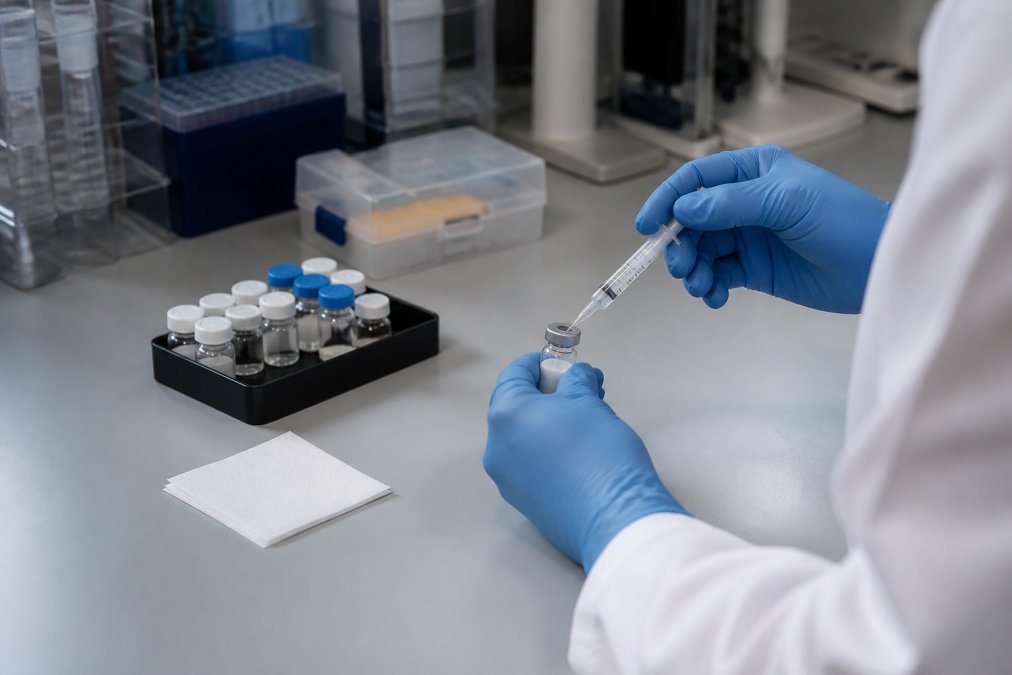
Wipe the rubber septum of your peptide vial with an alcohol swab and let it dry completely. Insert your needle through the septum at a slight angle and inject the bacteriostatic water slowly and steadily. As you inject, the powder will begin to dissolve. If it doesn’t dissolve immediately, remove the syringe and let the vial sit for 5-10 minutes.
After the initial rest period, gently swirl the vial. If the peptide still hasn’t fully dissolved, let it sit another 5-10 minutes. Most peptides dissolve within 15-20 minutes. The solution should be clear or slightly cloudy, never grainy. If you see particles that won’t dissolve, you may have a contamination issue, don’t use it for critical experiments.
Aliquoting means dividing your reconstituted peptide into smaller portions. This is critical for long-term storage because every time you open a vial, you expose it to air and contamination risk. Divide your reconstituted peptide into the smallest practical portions to minimize freeze-thaw cycles.
Use sterile syringes and needles for aliquoting. Transfer each portion to a labeled vial with: peptide name, concentration, reconstitution date, and expiration date. Use a permanent marker or printed labels that won’t smudge in the freezer. Store aliquots at -20°C for short-term use (weeks to a few months) or -80°C for longer storage.
Reconstituted peptides stored in a standard refrigerator at 4°C typically remain stable for 1-2 weeks, sometimes up to 4 weeks depending on the specific peptide sequence and bacteriostatic water quality. This is far shorter than lyophilized storage because hydrolysis, oxidation, and microbial growth still occur at this temperature.
For longer-term storage of reconstituted peptides, use -20°C freezer storage. At this temperature, reconstituted peptides typically remain stable for 3-6 months. If you need storage beyond 6 months, -80°C is preferable, extending stability to 1-2 years or longer.
The practical implication: if you reconstitute a peptide and plan to use it within 1-2 weeks, refrigerator storage is acceptable. If you need it longer, freeze it immediately after reconstitution.
Bacteriostatic water contains benzyl alcohol, which inhibits bacterial growth, but inhibition isn’t prevention. Over time, especially at warmer temperatures, bacteria can still grow. Fungal contamination is also possible, particularly in humid environments.
Signs of contamination include cloudiness, discoloration, or visible particles. If you notice any of these, don’t use the peptide. Prevention is simpler: use sterile technique during reconstitution, don’t touch needles or syringe tips to non-sterile surfaces, and store vials in clean, dry freezers. Keep your freezer organized so you can quickly locate vials without extended door-opening times that warm the interior.
How you handle peptides during storage determines whether they degrade gradually or rapidly.
Every time you freeze and thaw a peptide solution, you stress the molecules. Ice crystal formation during freezing can damage peptides, and thawing allows temporary exposure to warmer temperatures where degradation accelerates. Repeated cycles multiply this damage.
The solution is aliquoting. By dividing reconstituted peptides into small portions, you use each aliquot only once, thaw it, use it, and don’t refreeze. If you must store large quantities, minimize thawing frequency by planning experiments to use each vial efficiently. Work quickly during thawing and don’t leave vials sitting on the bench at room temperature longer than necessary.
Many peptides, particularly those containing aromatic amino acids like tryptophan and tyrosine, are light-sensitive. Exposure to ultraviolet and visible light can trigger photochemical degradation. Even ambient laboratory lighting, over weeks and months, can cause measurable degradation.
Use amber or opaque vials when possible. If you use clear vials, store them in opaque freezer boxes or wrapped in foil. Keep your freezer in a dark location. When retrieving vials, minimize exposure time, don’t leave peptide vials sitting on the bench under bright lights while you prepare your experiment.
Oxidation occurs when peptide amino acids react with dissolved oxygen. Methionine and cysteine are particularly vulnerable. Hydrolysis occurs when water molecules break peptide bonds, shortening the peptide chain and destroying its activity.
Sealed vials prevent both by excluding oxygen and controlling moisture. Inspect vials regularly for signs of leakage, peptide residue on the outside, or visible moisture. Hydrolysis accelerates at higher pH and warmer temperatures. Bacteriostatic water is typically pH-neutral, and slightly acidic conditions slow hydrolysis.
Label every vial immediately after reconstitution with: peptide name, concentration, reconstitution date, and expiration date. Use permanent marker or printed labels. Organize your freezer systematically by grouping peptides by type or project. Use a freezer inventory spreadsheet to track what you have, where it’s stored, and when it expires. Store vials in labeled boxes to quickly locate what you need without opening multiple boxes and warming the freezer.
Monitor your freezer temperature regularly. Most modern freezers have built-in thermometers or data logging capabilities, check them weekly for patterns and fluctuations. Service your freezer according to the manufacturer’s schedule, clean condenser coils regularly, and replace seals if they show wear.
Consider installing a wireless temperature monitoring system, which provides continuous temperature tracking and alerts if temperatures deviate from your set range.
If you notice the reconstituted solution has changed color, developed cloudiness, or shows visible particles, determine if the issue is degradation or contamination. Contamination shows as visible changes; if contamination is suspected, discard the vial. If you suspect degradation without visible signs, run a control experiment with a fresh peptide from a different batch.
Review your storage conditions: did the freezer temperature fluctuate? Were vials exposed to light? Did you repeatedly thaw and refreeze? Were vials stored longer than recommended? For expensive or irreplaceable peptides, consider running a stability test before committing to long-term storage.
Proper peptide storage isn’t complicated, but it requires attention to detail and consistency.
At Rejuvenation Wellness Solutions LLC, we support your peptide research with high-purity products that arrive ready for immediate use. Our comprehensive kits include everything needed for proper reconstitution and storage, and our team is available by text, phone, or email to answer questions within hours. When you start with 99%+ pure peptides backed by independent lab testing and a Certificate of Analysis, proper storage ensures those peptides remain effective throughout your research timeline. [Learn more about best practices(/best-practices-peptide-handling/) from industry standards | iso.org] and connect with our team to discuss your specific storage needs.
Store lyophilized peptides in their original sealed vials at -20°C for short-term use (up to 2 years) or -80°C for long-term storage (3+ years). Keep vials in a freezer with stable temperature control, away from light. Use airtight containers with desiccant packs to minimize moisture exposure. Ensure vials remain sealed until you're ready to reconstitute. Every time you open a vial, you introduce moisture and oxygen, both of which accelerate degradation. For maximum stability, store vials in a desiccator under vacuum conditions when possible.
Reconstituted peptides typically remain stable for 2-4 weeks when stored at 2-8°C (refrigerator temperature) in sterile vials. Stability depends on the specific peptide sequence, the purity of your bacteriostatic water, and how carefully you minimize freeze-thaw cycles. Most researchers use aliquoting to divide reconstituted peptides into smaller portions, using one aliquot at a time while keeping others frozen. If you need longer stability, store reconstituted peptides at -20°C, where they can last 3-6 months. Always label vials with the reconstitution date and expiration date.
At minimum, you need a -20°C laboratory freezer for short-term storage or an ultralow freezer (-80°C) for long-term preservation. Complement this with a wireless temperature monitoring system to track fluctuations and receive alerts. Use PETG plastic vial storage boxes to organize and protect vials from physical damage. Include desiccant packs (silica gel) inside storage containers to control moisture. For maximum protection, add a vacuum desiccator for moisture-sensitive peptides and consider a refrigerated centrifuge if you perform sample processing. Proper labeling systems and a cold chain protocol ensure nothing degrades due to human error.
Freeze-thaw cycles cause ice crystals to form and reform, physically damaging peptide molecules and exposing them to oxidation and hydrolysis. Each cycle reduces peptide stability and purity. To prevent damage, aliquot reconstituted peptides into single-use or small-batch portions immediately after reconstitution. Store each aliquot separately so you only thaw what you need for one experiment. Never refreeze a thawed aliquot. Keep your freezer at a stable temperature without frequent door openings. If your freezer experiences temperature swings, the peptides will degrade faster. Use a temperature monitoring system to catch and prevent these fluctuations before they damage your samples.
This article was written using GrandRanker








