

Last Updated: September 25, 2026
Research peptides degrade through predictable chemical pathways, and most loss happens before an experiment begins. Good GMP peptide storage and handling guidelines exist to interrupt those pathways: moisture, heat, light, oxygen, and repeated temperature swings. This guide from Rejuvenation Wellness Solutions LLC walks through the practical standards that protect purity from the loading dock to the bench.
The core principle is simple: peptide storage is a control problem, not a convenience problem. Every time a vial warms up, absorbs water, or gets left on a bench under fluorescent light, you lose material you cannot get back. Lyophilized peptides are stable when kept dry, cold, and sealed. Once reconstituted, they become far more fragile.
Below, we cover temperature requirements, dissolution technique, shelf life, documentation, cold-chain logistics, and how to recognize a batch that has already gone bad.
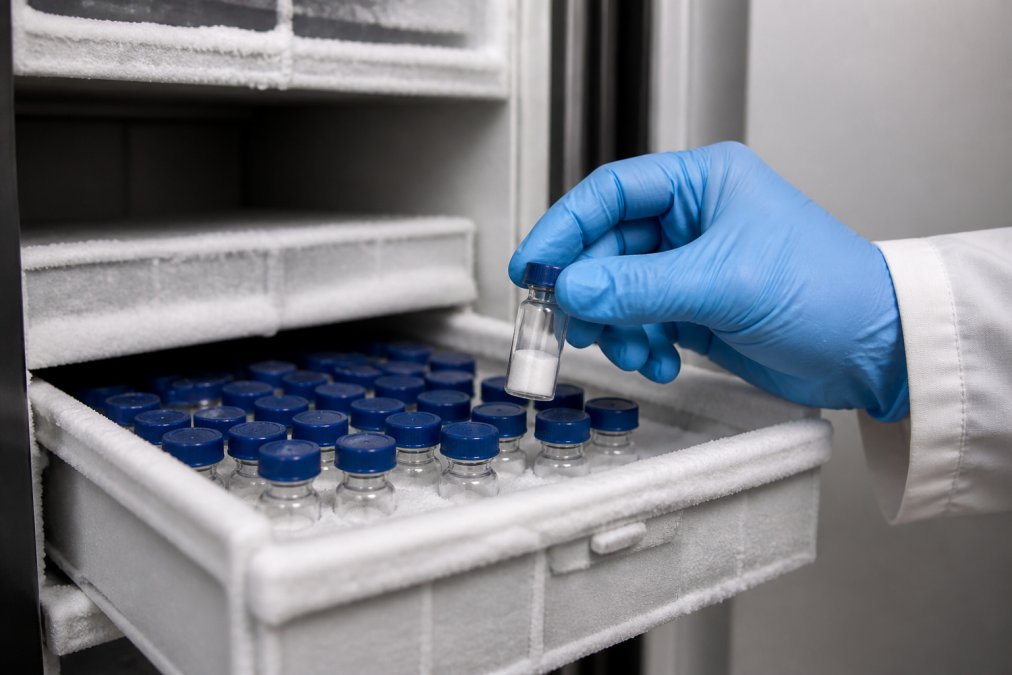
Lyophilized peptides should be stored frozen, desiccated, and protected from light, typically at -20°C for routine work and -80°C for long-term archival storage. The freeze-dried powder is the most stable form a peptide will ever be in, and the goal is to keep it that way.
A -20°C freezer handles most short-to-medium term storage. For peptides you plan to keep for extended periods, or sequences known to be oxidation-prone, -80°C is the safer default. The trade-off is real: ultra-low freezers cost more to run and lose temperature faster during a power event.
| Storage Form | Temperature | Typical Use |
|---|---|---|
| Lyophilized powder | -20°C | Routine, short-to-medium term |
| Lyophilized powder | -80°C | Long-term archival, labile sequences |
| Reconstituted solution | 2-8°C | Working use, days to weeks |
| Reconstituted solution | -20°C or below | Aliquoted, longer intervals |
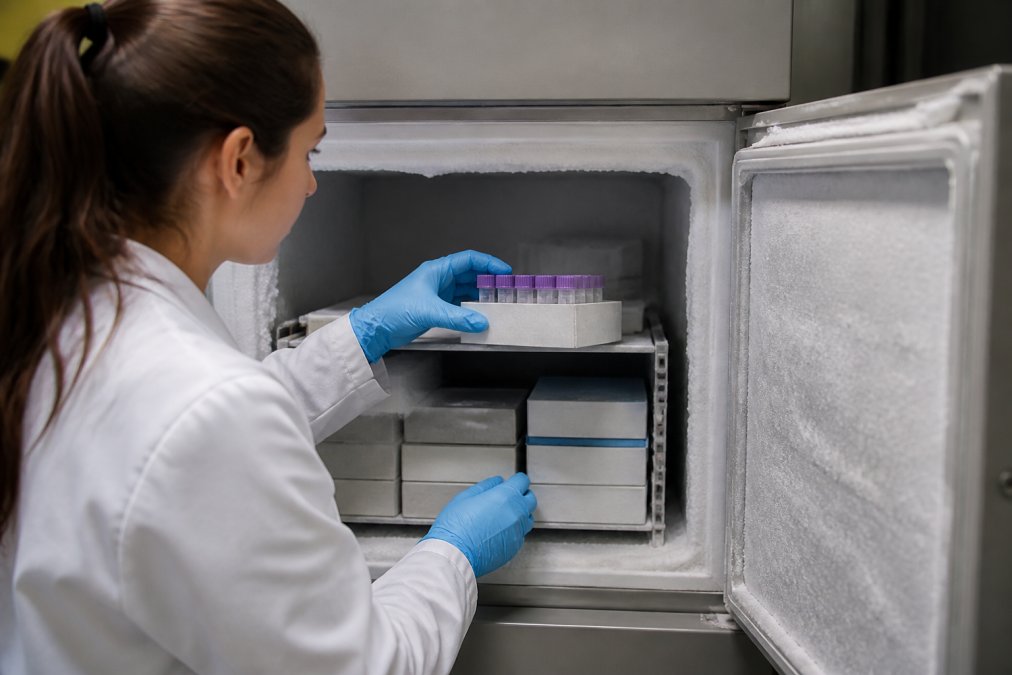
The single most common mistake is opening a cold vial at room temperature. Condensation forms instantly on the cold glass and wicks moisture into the powder, where hydrolysis begins breaking peptide bonds.
Let vials equilibrate to room temperature before opening. This takes 20-30 minutes for a small vial and is the cheapest protection you will ever buy.
Dissolution should be done slowly, with the correct solvent, and with the vial swirled rather than shaken. Rapid reconstitution and vortexing shear the peptide and introduce foam that denatures material at the air-liquid interface.
A standard approach:
Buffer compatibility decides whether your peptide survives in solution. Most peptides are most stable near neutral pH, but sequences with acidic or basic residues can shift that window. Phosphate buffers are common; avoid buffers that react with your specific sequence. Always check the certificate of analysis for the recommended solvent.
Reconstituted peptides are a microbial growth medium. Work in a clean environment, use sterile technique, and swab vial septa with alcohol before every draw. This is where contamination creeps in.
Reconstituted peptide shelf life is short: generally days to a few weeks at 2-8°C, depending on sequence and buffer. If you need it longer, aliquot and freeze at -20°C or below.
Storage duration depends on three things: the peptide sequence, the solvent, and how often the vial is opened. A vial drawn from ten times degrades faster than one split into ten single-use aliquots. Freeze-thaw cycles are the quiet killer here.
Many labs find that labeling each aliquot with the reconstitution date and solvent is the difference between a reproducible study and a confusing one.
GMP compliance for peptide storage is fundamentally a documentation exercise. The vial itself does not know whether it was handled correctly, the record does. Under current good manufacturing practice, a storage record has to be complete enough that an auditor who was never in the room can reconstruct what happened to that material, when, and by whom.
The FDA guidance on current good manufacturing practice sets the framework compliant labs build their storage records around.
A record that survives an audit typically carries, at minimum:
GMP storage is not just about keeping things cold, it is about being able to justify the assigned shelf life. A defensible program documents the stability data behind each storage claim: the conditions tested, the time points, the analytical method, and the acceptance criteria. Where a lab relies on a supplier’s stability data rather than generating its own, that data should be on file and traceable to the lot in use.
Rejuvenation Wellness Solutions LLC ships every product with an independent Certificate of Analysis and partners with WHO/GMP and ISO-certified manufacturers and 503B compounding pharmacies, so the documentation trail starts before the vial reaches your bench.
Cold-chain integrity is where most peptide quality is quietly lost. A vial that leaves a supplier at -20°C and arrives warm has already begun degrading, no matter how good the certificate of analysis was. The certificate proves what left the facility; the transit record proves what arrived.
The first hour after delivery matters more than most labs treat it. A workable receiving protocol:
A shipment without a temperature record is an unverified shipment. Data loggers that capture the full transit profile, not just a single endpoint reading, let you see whether the material ever left its acceptable range and for how long. Where an excursion occurred, the decision to accept or reject should follow a pre-defined criterion rather than an ad hoc judgment.
Rejuvenation Wellness Solutions LLC offers same-day order fulfillment and UPS 2-day air shipping to limit time in transit, with customer service reachable by text, phone, and email within hours.
Degraded peptides announce themselves in a few predictable ways. Cloudiness, visible precipitate, a color shift, or a powder that no longer dissolves cleanly are all red flags.
Common warning signs:
The gap between a reproducible study and a failed one usually comes down to storage discipline: correct temperature, dry conditions, minimal freeze-thaw cycles, and honest documentation. Get those right and your peptides arrive at the assay as pure as they left the facility.
Lyophilized peptides stored at -20°C typically remain stable for 12 to 24 months, while -80°C storage can extend stability beyond 24 months. Storage duration depends on the specific peptide sequence, purity level, and whether the vial remains sealed under an inert atmosphere such as argon or nitrogen. Always check the Certificate of Analysis for the manufacturer’s recommended shelf life. Once you break the seal or expose the powder to moisture, stability drops sharply.
Lyophilized peptides are freeze-dried powders that remain stable at -20°C or -80°C for months to years. Reconstituted peptides are dissolved in solvent and must be stored at 2°C to 8°C, typically usable for days to a few weeks depending on the peptide. Reconstituted solutions are more vulnerable to hydrolysis, oxidation, and microbial contamination. Aliquoting reconstituted peptide into single-use portions before freezing reduces freeze-thaw damage and extends usable shelf life.
Handle peptides with aseptic technique in a desiccated environment. Warm vials to room temperature before opening to prevent condensation. Use analytical grade solvent, avoid vortexing vigorously, and centrifuge briefly to collect powder at the vial bottom. Aliquot into sterile storage vessels, purge with argon or nitrogen, and avoid repeated freeze-thaw cycles. Protect from light and store at the temperature specified on the Certificate of Analysis.
Yes. Ultraviolet and visible light can trigger oxidation of sensitive residues such as methionine, tryptophan, and tyrosine, and can break disulfide bonds. Store lyophilized and reconstituted peptides in amber vials or wrap clear vials in foil. Keep working solutions away from direct bench lighting and UV sources. Light protection matters most for peptides with aromatic or sulfur-containing residues, but the guideline applies to all peptides as a default precaution.








