
Last Updated: October 10, 2026
Before you submit peptide samples for analysis, understand your sample’s quantity, condition, and stability needs. Most labs require a minimum of 5-10 mg of peptide material for a complete quality control panel. Getting this wrong wastes time and money.
Most laboratories need at least 5-10 mg of peptide material for a complete quality control panel. If you’re running identity testing, purity analysis, and molecular weight confirmation, expect to use 15-20 mg total.
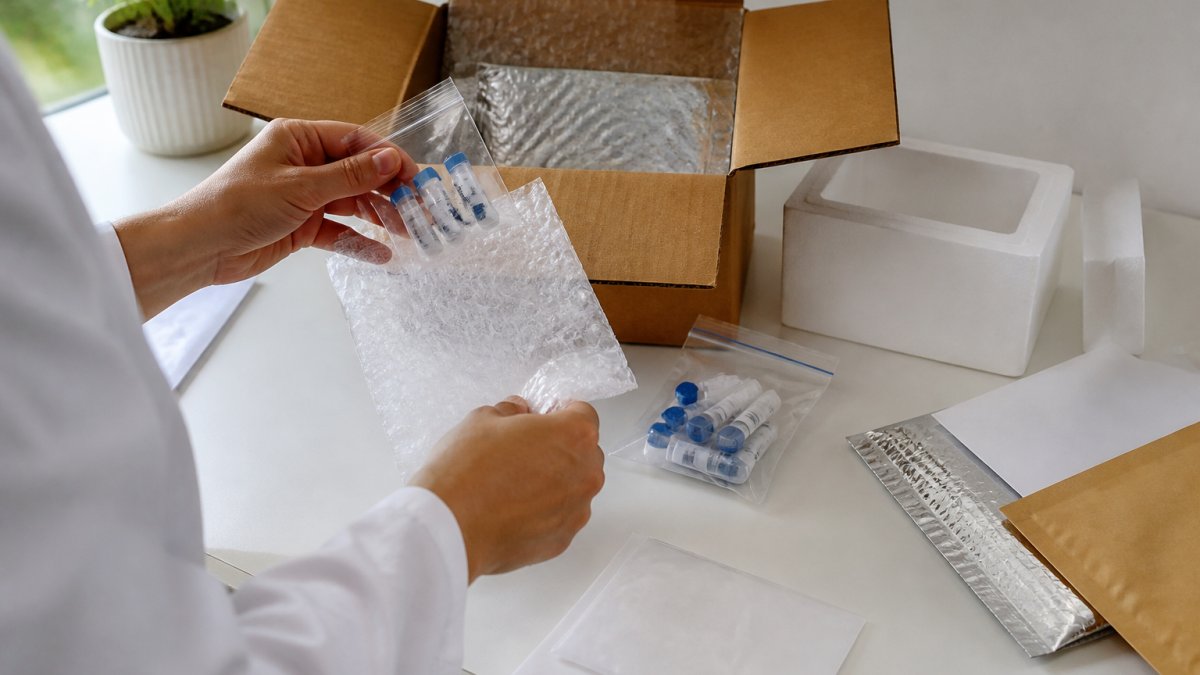
Use sterile glass vials with inert caps. Amber glass vials protect light-sensitive peptides; clear glass works for stable compounds. Avoid plastic vials unless your lab specifically approves. Use 2 mL or 4 mL vials with PTFE-lined caps to prevent peptide adhesion. Send 20-30% more material than the minimum required.
Peptide stability directly affects your results. Peptides degrade over time, especially if exposed to heat, light, or moisture. Store your peptide sample at -20°C if possible (Recommendations for the generation, quantification, storage and handling of peptides used…). If you only have room-temperature storage, keep samples in a cool, dark place and submit them quickly. Frozen samples stay stable for months; room-temperature samples degrade within weeks.
Document the storage temperature and duration before submission. If your peptide has been at room temperature for more than two weeks, mention this on your analysis request form. The laboratory needs this context to interpret your purity results accurately.
Proper preparation prevents contamination and ensures reliable results. Contamination ruins analysis accuracy, and improper sample state leads to misinterpretation of results.
Lyophilized (freeze-dried) peptides are stable at room temperature for months and require minimal special handling during shipment. Dissolved peptides in solution are more prone to degradation and require temperature control.
If your peptide is lyophilized, keep it in a sealed vial with a desiccant packet. Do not open the vial until you’re ready to submit it. Exposure to air introduces moisture, which degrades peptides over time.
If your peptide is in solution, document the solvent clearly on your submission form. Common solvents include water, phosphate-buffered saline (PBS), dimethyl sulfoxide (DMSO), or acetonitrile. Include the concentration (mg/mL) if known.
Moisture is the primary enemy of peptide stability. Before shipment, store your sample in a sealed container with a desiccant packet. Replace the desiccant if it becomes saturated (color change indicates saturation).
Wear nitrile gloves when handling vials. Never touch the cap threads or the interior of the vial. Fingerprints leave oils and salts that interfere with mass spectrometry analysis and can catalyze peptide degradation.
If storing samples longer than a few days before shipment, place vials in a freezer bag with a fresh desiccant packet and store at -20°C.
Label each vial clearly with a unique identifier using a waterproof marker or pre-printed labels. Include sample ID (e.g., PEP-001), date prepared, your initials, approximate concentration if known, and solvent if dissolved. Write the label on both the vial cap and body.
Create a spreadsheet listing each sample ID, peptide type, concentration, solvent, and special handling notes. This document goes with your submission. If you don’t know the exact concentration, estimate it (e.g., “~5 mg/mL” or “approximately 20 mg total”).
Document how long your sample has been stored and at what temperature before submission. On your submission form, include storage temperature, duration stored, any temperature fluctuations, and humidity conditions if room-temperature storage. If your peptide has been at room temperature for more than two weeks, mention this explicitly. Proper disclosure prevents misunderstanding and helps the laboratory advise whether the purity is acceptable for your research.
Different analytical methods answer different questions. Your research goal determines which methods you need.
High-performance liquid chromatography (HPLC) is the standard for peptide purity testing. It separates peptide components by size and polarity, showing you exactly what’s in your sample. The largest peak is your target peptide; smaller peaks represent impurities or degradation products. The laboratory calculates purity as a percentage based on peak area.
Use HPLC when you need purity percentage for regulatory or research documentation, identification of degradation products, batch consistency verification, or quality control before experiments. HPLC costs less than mass spectrometry and provides results within 3-5 business days.
Mass spectrometry (MS) confirms your peptide’s molecular weight by ionizing peptide molecules and measuring their mass-to-charge ratio. LC-MS combines liquid chromatography with mass spectrometry, separating peptides by HPLC and identifying each peak by molecular weight. Amino acid analysis breaks down your peptide into individual amino acids and quantifies each one.
Choose your analysis based on your research stage: early research requires HPLC purity testing only; regulatory submission requires HPLC + mass spectrometry; detailed characterization requires HPLC + LC-MS + amino acid analysis; stability studies require repeat HPLC at different time points.
Your analysis request form is your contract with the laboratory. Missing information delays processing by days. Incorrect information produces useless results.
Your institution or organization: State your affiliation clearly. If you’re an independent researcher, write “Independent Researcher” or your company name.
Sample ID matching your vial labels: This must match exactly what you wrote on your vials.
Peptide name or sequence: If your peptide has a published name, include it.
Expected molecular weight: Provide the theoretical molecular weight of your target peptide in Daltons (Da).
Desired analysis methods: Check all methods you want.
Turnaround time preference: Most laboratories offer standard turnaround (5-10 business days) and expedited options (2-3 business days).
Special handling instructions: Use this field for anything the laboratory needs to know that doesn’t fit elsewhere.
Before you submit your form and ship samples, verify:
Mismatched sample IDs: Use identical IDs on vials and forms. Missing expected molecular weight: Always provide this so the laboratory can identify contamination. Vague storage history: State the exact temperature and duration. Requesting undefined analyses: Specify “HPLC purity analysis and mass spectrometry molecular weight confirmation” rather than “test for purity and quality.” Incomplete contact information: Provide a phone number and email, and monitor both during the turnaround period.
After you submit your form and ship samples, the laboratory will send a confirmation email within 24 hours of receiving your package. This email includes confirmation of sample receipt, your project number or tracking ID, expected turnaround date, total cost and payment instructions, and a link to check status online. Save this email and use the project number to inquire about your results. If you don’t receive a confirmation within 24 hours of shipping, contact the laboratory to verify receipt.
Choosing the right laboratory matters. Not all labs are equipped for research peptides. Some specialize in pharmaceutical quality control; others focus on academic research.
Look for laboratories that offer independent testing with a Certificate of Analysis.
When evaluating a laboratory, ask: Do they offer HPLC and mass spectrometry? What’s their typical turnaround time? Do they provide a Certificate of Analysis? Can they handle your sample size? What’s their pricing structure? Request a quote before submitting samples.
Improper packaging ruins samples during transit. Temperature fluctuations, moisture, and physical damage all compromise peptide integrity.
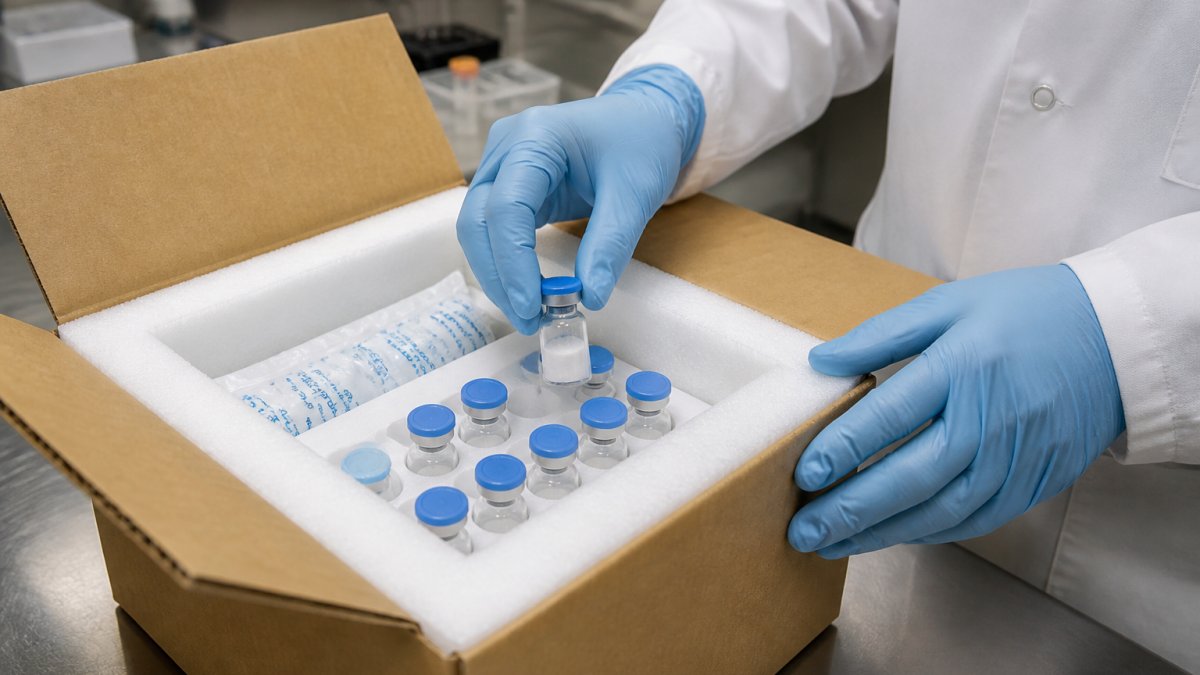
Use an insulated shipping box designed for biological samples. Line the bottom with 2-3 inches of foam. Place vials upright in the center, surrounded by foam padding. Add ice packs or dry ice on top, depending on required temperature. For frozen samples, use dry ice in a certified dry ice shipping container. Check your laboratory’s requirements.
Seal the box securely with strong tape. Label the exterior clearly with “FRAGILE” and “BIOLOGICAL MATERIAL.” Include your return address and the laboratory’s receiving address.
Use overnight or two-day shipping. Slower shipping increases degradation risk.
Include a packing slip inside the box listing all samples in a plastic bag attached to the inside of the lid. Include your name and contact information, sample IDs and quantities, analysis request form, and special handling instructions.
Request signature confirmation on delivery. Track your shipment and confirm delivery before the laboratory processes samples. If samples don’t arrive within the expected timeframe, contact the laboratory immediately.
Your Certificate of Analysis is the official record of your peptide’s quality. This document proves purity, identity, and composition.
Purity percentage tells you what fraction of your sample is the target peptide. A 99% pure sample contains 99 mg of target peptide per 100 mg of material. For most research, 95-98% purity is sufficient. For regulatory submissions or sensitive assays, 99%+ purity is standard. Extremely high purity (99.5%+) costs significantly more and isn’t necessary for most applications.
The Certificate lists purity percentage (usually by HPLC), molecular weight confirmation (if MS was run), amino acid composition (if requested), testing date, and laboratory name and accreditation.
Your chromatogram shows peaks representing different components. The largest peak is your target peptide. Smaller peaks are impurities. If purity is lower than expected, check the storage history. Room-temperature storage for weeks causes degradation. If storage was proper, contact the supplier.
For mass spectrometry results, confirm the molecular weight matches your expected peptide. A significant difference indicates contamination or incorrect peptide. Amino acid composition should match your peptide sequence.
Submitting peptide samples correctly ensures you get reliable results that support your research. Start with proper sample preparation, choose the right analysis methods for your research stage, and use secure shipping to protect your material in transit.
Start by preparing your sample according to laboratory requirements, complete the submission form with detailed information about your peptide, and package it securely in a vial with appropriate labeling. Contact your chosen peptide testing laboratory to confirm submission procedures, then ship via a tracked courier service. Most laboratories provide step-by-step submission instructions on their websites and can answer specific questions about your sample type and analysis needs.
Your submission form should include the peptide name or identifier, molecular weight, expected purity level, sample quantity, storage conditions before shipment, and your specific analysis requirements. Include your contact information, institutional affiliation if applicable, desired turnaround time, and any special handling instructions. If your sample has known contaminants or degradation concerns, note those details. This information helps the laboratory select the appropriate analytical methods and set proper acceptance criteria for your results.
A Certificate of Analysis documents your sample’s purity percentage, identity confirmation through analytical testing methods like HPLC, molecular weight verification, and any detected contaminants or degradation products. It includes the testing date, laboratory identification, and specific analytical methods used. The certificate serves as verification that your peptide meets quality standards for research use and provides the data needed to validate your experimental results and support regulatory submissions like IND applications.
Turnaround time varies depending on the complexity of your analysis and laboratory workload. Standard purity testing through HPLC usually takes 5-10 business days, while more comprehensive analyses including mass spectrometry and amino acid composition may require 2-3 weeks. Rush services are often available for an additional fee. Contact your laboratory directly about current turnaround times and whether expedited options suit your research timeline.