


Last Updated: September 2, 2026
ISO certified peptide manufacturing is the production of research-grade peptides in facilities that meet internationally recognized quality management standards. These certifications, primarily ISO 9001, ISO 17025, and ISO 13485, ensure that every peptide batch undergoes rigorous quality control, documentation, and testing protocols before reaching researchers.
When you order peptides for clinical research or laboratory work, you’re investing in a product manufactured under systems designed to catch errors, track every step of production, and verify purity through independent analysis. At Rejuvenation Wellness Solutions LLC, we partner exclusively with WHO/GMP and ISO-certified manufacturers and 503B compounding pharmacies to ensure that every peptide meets these exacting standards. ISO certification creates a documented chain of evidence proving that your peptide is what the label claims it is.

GMP stands for Good Manufacturing Practice, a set of quality standards enforced by regulatory bodies to ensure products are consistently produced and controlled to quality standards (the FDA). ISO standards are voluntary frameworks that organizations adopt to demonstrate systematic quality management.
The key distinction: GMP is regulatory (mandatory for certain product categories), while ISO is voluntary certification demonstrating commitment to quality systems. GMP-certified facilities must maintain sterile environments, validate equipment, and document everything with FDA-level rigor. ISO certification, particularly ISO 9001, focuses on organizational quality management systems.
For research-grade peptides, the combination of both GMP and ISO standards creates the strongest assurance. A facility holding both certifications has proven it can maintain pharmaceutical-grade manufacturing practices while demonstrating systematic quality across its entire operation. This is why Rejuvenation Wellness Solutions LLC partners with manufacturers holding both certifications: quality isn’t just a checkbox, it’s embedded in every workflow.
Three ISO standards dominate peptide manufacturing.
ISO 9001:2015 is the foundation of quality management systems. It requires organizations to establish documented processes, define responsibilities, and continuously improve operations. For peptide manufacturing, this means written standard operating procedures for synthesis, purification, and testing that are actually followed.
ISO 17025 is the standard for testing and calibration laboratories. If a peptide supplier claims independent lab testing, that testing facility should hold ISO 17025 accreditation. This certification verifies that the laboratory’s equipment is calibrated, its methods are validated, and its results are reproducible.
ISO 13485 is specific to medical device manufacturing. It incorporates quality management principles tailored to the medical device industry, including risk management, design controls, and traceability. Facilities holding this certification have demonstrated they understand regulatory requirements for products used in human studies.
A peptide supplier holding all three certifications has layered quality assurance, each certification addressing a different dimension of reliability.
A Certificate of Analysis (CoA) is a document issued by a testing laboratory confirming the identity, purity, and specifications of a peptide batch. It’s the primary evidence that your peptide is what you paid for.
A legitimate CoA includes the batch number (tying analysis to a specific production run), the purity percentage (typically stated as a percentage by HPLC or mass spectrometry), molecular weight confirmation, and analytical methods used. The difference between a real CoA and marketing copy is specificity: a real CoA lists the exact method, analysis date, laboratory’s accreditation number, and often the analyst’s signature.
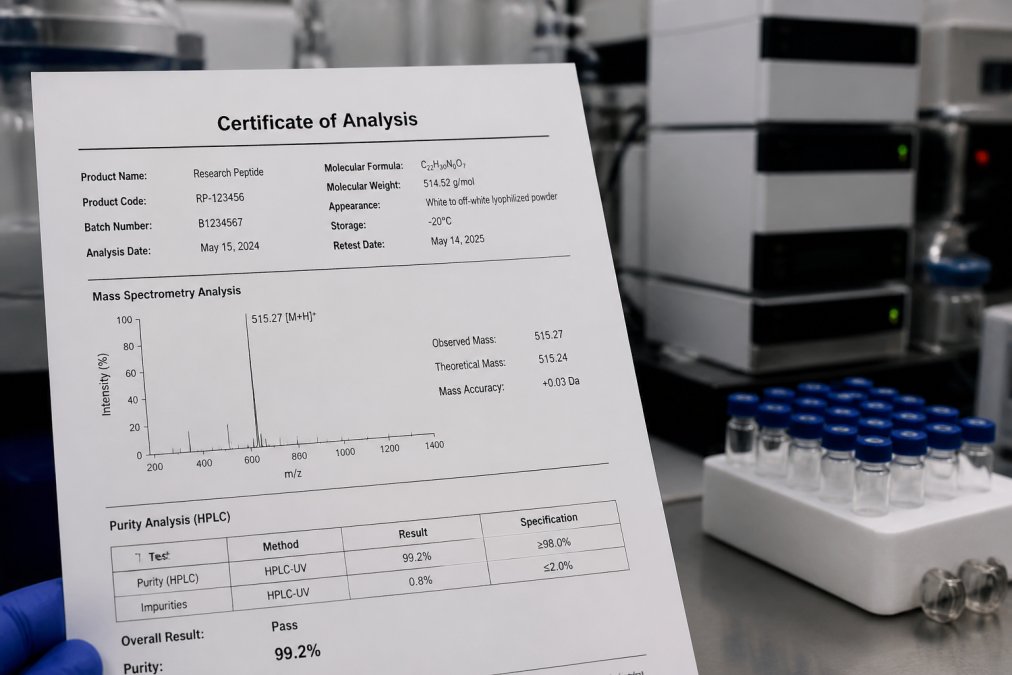
When evaluating a peptide supplier, request the CoA before purchasing. A reputable supplier like Rejuvenation Wellness Solutions LLC provides independent lab testing results with every order, so you have third-party verification that the peptide meets stated purity standards. The CoA should come from an ISO 17025-accredited laboratory, meaning the lab’s methods are validated and its equipment is calibrated to traceable standards (iso.org). Without a CoA, you have no recourse if a batch doesn’t perform as expected.
Verifying a supplier’s certifications requires more than checking a website claim. Start by requesting the supplier’s certificate documents directly. Legitimate ISO and GMP certifications come with certificate numbers, issuance dates, and expiration dates. Ask for the certificate number and verify it through the accrediting body’s database.
Second, verify that the supplier’s testing laboratory holds ISO 17025 accreditation. Request the testing lab’s accreditation number and confirm it independently.
Third, ask for documentation of third-party audits. ISO certifications require regular audits by external auditors. A supplier holding current certification should be able to provide audit reports or confirm the audit schedule.
Fourth, request a sample CoA before committing to a bulk order. Examine it for specificity: does it list the analytical method, date, batch number, and laboratory accreditation number? Does it show actual numerical results or just a statement that “purity was verified”?
Finally, check whether the supplier offers same-day fulfillment and rapid shipping. This indicates the supplier maintains stock of quality-controlled peptides rather than synthesizing on demand, which reduces quality consistency. Rejuvenation Wellness Solutions LLC offers same-day order fulfillment and UPS 2-day air shipping.
A quality management system is the organizational backbone that prevents errors, documents decisions, and enables continuous improvement. Without documented processes, manufacturing becomes ad hoc, and batches vary. Your research suffers because the peptide you use in month one differs subtly from the peptide in month three.
ISO 9001 requires organizations to document standard operating procedures, assign responsibility for each process, and measure whether the process is performing as intended (iso.org). For peptide synthesis, this means written protocols for every step: chemical reactions, purification methods, testing criteria, and storage conditions.
Quality management systems also create traceability. Every batch is tagged with a batch number that connects it to specific raw materials, equipment, and dates. If a problem emerges, the system allows the manufacturer to trace backward and identify the source. This documentation also protects you: if you discover peptides don’t perform as expected, the batch number allows you to contact the supplier with specific documentation.
Risk management is another function of quality systems. ISO standards require organizations to identify potential failure points and implement controls to prevent them. For peptide manufacturing, this might mean validating that HPLC equipment is calibrated monthly or that raw materials are tested before use.
The first red flag is vague or missing CoA documentation. If a supplier provides a CoA that doesn’t specify the analytical method, laboratory’s accreditation, or exact purity percentage, that’s a warning.
The second red flag is claims of certification without supporting documentation. A supplier that displays ISO logos but can’t provide certificate numbers, issuance dates, or expiration dates is likely misrepresenting its status.
The third red flag is extremely low pricing. Peptide synthesis is expensive. Quality testing is expensive. A supplier offering peptides at a fraction of the market rate is cutting corners on quality. Rejuvenation Wellness Solutions LLC offers competitive pricing without compromising documented quality.
The fourth red flag is unavailable customer support. If you can’t reach a supplier by phone, email, or text within hours, they don’t prioritize customer relationships. Rejuvenation Wellness Solutions LLC provides support by text message, phone, and email within hours.
The fifth red flag is lack of transparency about sourcing. A legitimate supplier can explain where its raw materials come from, which manufacturers produce its peptides, and which labs test them.
The sixth red flag is no mention of GMP or ISO standards. If a supplier’s website doesn’t mention certifications, quality standards, or testing procedures, quality assurance isn’t a priority.
Selecting a peptide supplier is ultimately a decision about research reliability. The certifications and documentation you verify upfront determine whether your research data will be trustworthy months later. When you choose a supplier like Rejuvenation Wellness Solutions LLC that partners with WHO/GMP and ISO-certified manufacturers and 503B compounding pharmacies, you’re choosing a partner invested in your research success. Every peptide undergoes independent lab testing with a Certificate of Analysis, every batch is traceable, and support is available when you need it. Your research deserves peptides manufactured with the rigor that ISO certification ensures.
ISO certification, particularly ISO 17025 for testing laboratories and ISO 9001 for manufacturing, establishes that a peptide supplier follows standardized quality management systems. ISO 17025 ensures analytical testing, including mass spectrometry and high-performance liquid chromatography, is performed by accredited laboratories with documented procedures. This means purity claims are backed by rigorous, reproducible testing methods rather than unverified assertions. When a supplier provides a Certificate of Analysis from an ISO 17025-accredited lab, you’re seeing results from a third-party audit process that validates the methodology itself.
Request the manufacturer’s certificate directly and verify it through the accreditation body that issued it. In the United States, look for accreditation from ANSI (American National Standards Institute) or other recognized bodies. Check the certificate’s expiration date, certifications require renewal and ongoing audits. Ask for documentation of their third-party audit reports, which show compliance with standard operating procedures and quality control measures. Legitimate manufacturers are transparent about their certification status and can provide evidence of continuous compliance. Avoid suppliers who claim certification but cannot produce official documentation.
No, they serve different purposes. GMP (Good Manufacturing Practice) is a regulatory framework focused on manufacturing processes, cleanliness, equipment validation, and batch consistency. ISO standards address quality management systems more broadly, ISO 9001 covers organizational processes, ISO 17025 covers laboratory testing accuracy, and ISO 13485 applies to medical device manufacturing. A manufacturer can be both GMP-compliant and ISO-certified; in fact, many use ISO standards to demonstrate GMP compliance. For research peptides, ISO 17025 accreditation for testing is particularly important because it guarantees the analytical testing methods are validated and reproducible.
A complete Certificate of Analysis should include the peptide’s sequence verification, purity percentage (typically 95% or higher for research-grade), impurity profile showing what contaminants are present, the analytical methods used (mass spectrometry, HPLC), batch number, manufacturing date, and the testing laboratory’s accreditation status. Verify that the testing was performed by an ISO 17025-accredited laboratory, not just the manufacturer’s internal lab. The document should show specific measurements, not vague claims. Cross-reference the batch number with your order to ensure you received the tested batch. Legitimate suppliers provide this documentation before purchase or immediately upon request.
This article was written using GrandRanker