

Last Updated: July 23, 2026
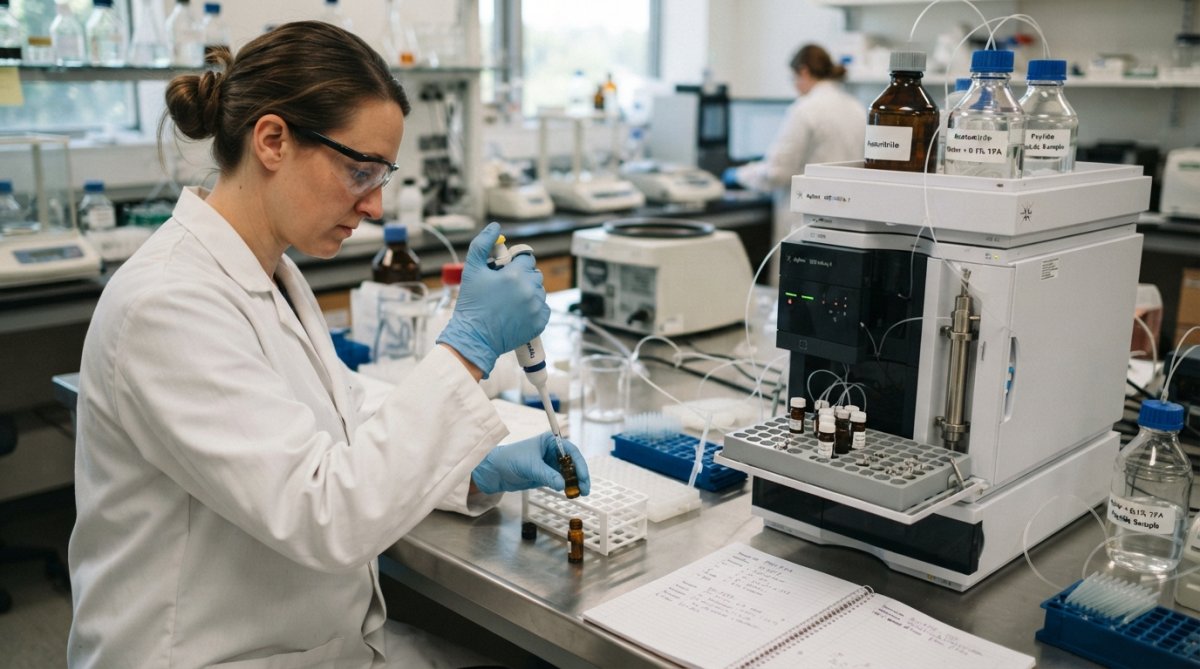
High-Performance Liquid Chromatography (HPLC) is the gold standard analytical technique for peptide testing, separating peptide components based on their chemical properties to identify contaminants, degradation products, and verify purity with precision. At Rejuvenation Wellness Solutions LLC, we understand that researchers need reliable analytical methods to verify peptide products meet specifications before use in critical applications.
When conducting research with peptides, the purity of your starting material directly affects your results. A peptide sample may contain impurities invisible without analytical testing. HPLC detects these impurities with sensitivity that other methods cannot match, making it indispensable for quality assurance in peptide research.
HPLC testing relies on a simple principle: different peptides and their impurities have different chemical affinities for the stationary phase and mobile phase. A liquid sample containing your peptide mixture is injected onto a column containing a stationary phase, typically silica particles bonded with specific chemical groups. A mobile phase (solvent) is pumped through the column at high pressure, carrying the sample through. Peptides interact differently with the stationary phase based on their molecular structure, charge, and polarity. Peptides that bind weakly elute first; those that bind strongly elute later. This separation allows the HPLC instrument to detect and quantify each component individually.
In reversed-phase HPLC, the most common method for peptide analysis, the stationary phase is hydrophobic (water-repelling). Peptides interact with this surface based on their hydrophobic amino acid content. More hydrophobic peptides bind strongly and elute later; more hydrophilic peptides elute earlier. The mobile phase typically consists of water and organic solvents like acetonitrile or methanol, sometimes with additives like trifluoroacetic acid (TFA) to improve separation.
During analysis, the mobile phase composition changes in what’s called gradient elution. The analysis begins with a mobile phase that’s mostly aqueous, which promotes binding of peptides to the hydrophobic column. Gradually, the proportion of organic solvent increases, weakening peptide-column interactions and causing peptides to elute in order of increasing hydrophobicity. This gradient approach allows a single HPLC run to separate peptides with varying hydrophobicities.
As peptides elute from the HPLC column, they pass through a detector. The most common detector for peptide analysis is a UV absorbance detector, which measures light absorption at specific wavelengths (typically 214 nm or 280 nm, where peptide bonds and aromatic amino acids absorb strongly). When a peptide elutes, the detector records an increase in absorbance, producing a peak on the chromatogram.
The retention time, the time from injection until a peak appears, is characteristic for each peptide under specific HPLC conditions. A pure peptide produces a single, well-defined peak at a specific retention time. If your sample contains impurities, you’ll see additional peaks at different retention times, each representing a different chemical component. The area under each peak is proportional to the amount of that component, allowing you to calculate what percentage of your sample is the desired peptide versus impurities.
Peptide purity analysis is where HPLC testing delivers its most practical value. Purity refers to the percentage of your sample that is the desired peptide, with the remainder being impurities. Calculating purity from an HPLC chromatogram requires identifying which peak corresponds to your target peptide, then dividing its peak area by the total area of all peaks.
You’ll compare your sample’s chromatogram to a reference standard, a known pure sample of your target peptide. The reference standard produces a single peak at a specific retention time. Your sample should produce a peak at the same retention time. If it does, you can reasonably assume that peak is your target peptide. Any additional peaks represent impurities.
Sources of impurities in peptide samples include incomplete synthesis (truncated peptides), oxidized peptides from sensitive amino acids like methionine, diastereomers and isomers from unintended structural variations, and residual salts and reagents from synthesis. HPLC detects all of these, making it essential for understanding what you’re actually working with in your research.
Rejuvenation Wellness Solutions LLC partners with WHO/GMP and ISO-certified manufacturers that conduct HPLC testing on every batch of peptides. Every product comes with a Certificate of Analysis showing the HPLC purity result, typically 99% or higher, ensuring you know exactly what purity you’re receiving before starting your research.
A chromatogram is the graphical output of an HPLC analysis, a plot of detector signal (absorbance) versus time. Learning to read chromatograms is essential for evaluating peptide purity yourself.
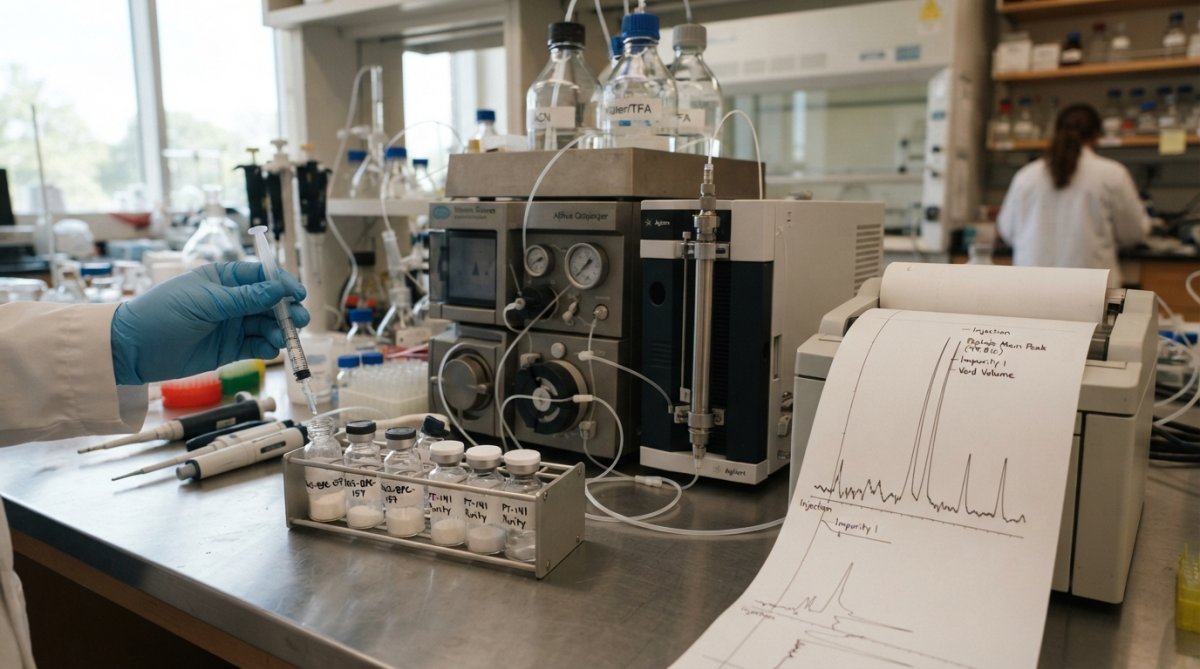
The x-axis represents time (in minutes), and the y-axis represents detector signal intensity (absorbance units). A baseline runs along the bottom when no peptide is present. When a peptide elutes, the signal rises above baseline, forming a peak. The peak’s position on the x-axis is the retention time. The peak’s height and area contain the quantitative information.
A clean, pure peptide produces a single, symmetrical peak with a sharp rise and fall. If your chromatogram shows a single dominant peak with perhaps a few tiny peaks totaling less than 1% of the main peak’s area, your peptide is very pure. If you see multiple significant peaks, your sample contains substantial impurities that may affect your research results.
Peak integration is the process of calculating the area under a peak. The HPLC software does this automatically. The software identifies where the peak begins and ends, then calculates the area enclosed. This area is proportional to the amount of that component in your sample.
If you have two peaks, one at 12 minutes (area = 980 units) and one at 15 minutes (area = 20 units), the purity of the first peak is 980/(980+20) = 97.0%. Whether 3% impurity is acceptable depends on your research requirements. Clinical-grade peptides often require >99% purity. Research-grade peptides may be acceptable at 95-98% purity.
Baseline noise, random fluctuations in the detector signal, can complicate interpretation. If the baseline is very noisy, small impurity peaks may be hard to distinguish from noise. Professional HPLC systems minimize baseline noise through careful equipment maintenance and high-quality mobile phases.
Not every peak in an HPLC chromatogram represents a real impurity in your sample. Solvent peaks occur when the mobile phase itself absorbs at the detector wavelength and are expected and ignored when calculating purity. Ghost peaks are instrumental artifacts that appear at the same retention time in every run, resulting from contamination in the column or system. Tailing peaks have an asymmetrical shape, usually indicating interaction between the peptide and residual active sites on the column, an instrumental issue, not a sample purity problem.
Real impurity peaks are reproducible, appear at the same retention time across multiple runs, and change in size if you prepare fresh samples or dilute your sample.
These terms measure different things. Peptide purity refers to the percentage of your sample that is the desired peptide, as measured by HPLC. A 99% pure sample contains 99% of your target peptide and 1% other compounds.
Peptide content (or assay) refers to the absolute amount of active peptide in your sample, typically expressed as a percentage by weight. This accounts for the fact that your peptide may be in a salt form or may contain residual water. A peptide product might be listed as "Peptide (free base): 95%" and "Peptide (acetate salt): 100%". The acetate salt form is heavier because it includes the acetate counter-ion.
When you order peptides from Rejuvenation Wellness Solutions LLC, the Certificate of Analysis includes both the HPLC purity result and the peptide content assay, ensuring you can calculate the exact amount of active peptide in your vial for accurate research preparation.
While HPLC provides purity and separation information, mass spectrometry (MS) provides molecular weight and structural confirmation. Many advanced peptide analyses combine HPLC with MS, creating HPLC-MS or LC-MS methods.
In HPLC-MS, the liquid coming out of the HPLC column flows directly into a mass spectrometer instead of (or in addition to) a UV detector. The mass spectrometer ionizes the peptide molecules and measures their mass-to-charge ratio, providing confirmation that each peak is actually a peptide and verification of the peptide’s identity by comparing the measured mass to the theoretical mass of your target sequence.
For a peptide with a known sequence, you can calculate the theoretical molecular weight. If your HPLC-MS analysis shows a peak at the expected retention time with the expected mass, you have strong confirmation that the peak is your target peptide. HPLC-MS is particularly valuable for detecting impurities with similar retention times but different masses.
However, HPLC-MS is more expensive and complex than HPLC alone. For routine quality control, standard HPLC with UV detection is often sufficient. HPLC-MS is typically used for detailed characterization when needed or for research applications requiring the highest confidence in peptide identity.
HPLC testing is central to regulatory compliance in peptide manufacturing and research. The FDA, USP (United States Pharmacopeia), and other regulatory bodies recognize HPLC as the standard method for peptide purity analysis.
For research peptides, regulatory requirements depend on the intended use. Peptides intended for clinical trials must meet stringent purity and identity standards, typically >99% purity and confirmed identity by multiple analytical methods. Peptides for basic laboratory research may have less stringent requirements but should still be characterized by HPLC.
An HPLC method is validated when you’ve documented that it reliably and consistently produces accurate results. Validation includes demonstrating specificity, linearity, accuracy, precision, and robustness. Manufacturers like the WHO/GMP and ISO-certified partners that Rejuvenation Wellness Solutions LLC works with maintain validated HPLC methods for every peptide they produce.
Traceability is another key compliance concept. Every HPLC result should be traceable to reference standards, known pure samples of your peptide used to confirm peak identity. These reference standards themselves should be traceable to official standards or characterized by multiple independent methods.
The practical impact of HPLC testing on your research is significant. Peptides are expensive to synthesize, and research projects are time-consuming and costly. Starting with a peptide of unknown purity is a recipe for wasted time and resources.
If you receive a peptide without HPLC testing and prepare it according to the supplier’s stated concentration, weeks of experiments may yield inconsistent results. If you had run HPLC on the peptide before starting, you would have discovered impurity immediately and either obtained a purer sample or adjusted your calculations accordingly.
Peptides can also degrade during storage, especially at room temperature or in humid conditions. HPLC testing at the start of your research and periodically during long-term studies ensures you know whether your peptide remains pure or has degraded. For research involving animal studies or clinical trials, HPLC testing is often a regulatory requirement.
Every peptide from Rejuvenation Wellness Solutions LLC comes with independent lab testing and a Certificate of Analysis showing HPLC purity results. This means you can begin your research with confidence, knowing your peptide meets specifications. The company’s partnership with WHO/GMP and ISO-certified manufacturers ensures that HPLC testing is performed using validated methods and proper quality control. Combined with same-day order fulfillment and UPS 2-day air shipping, this approach gets you high-purity peptides quickly, so you can focus on your research rather than worrying about sample quality.
Understanding what is HPLC testing for peptides is understanding a fundamental tool for research quality. Whether you’re conducting basic laboratory research, preparing for clinical trials, or developing new peptide-based therapies, HPLC provides the analytical rigor your work demands. The technique separates peptide mixtures, identifies impurities, and quantifies purity with precision that no other readily available method matches. When you work with Rejuvenation Wellness Solutions LLC, every peptide includes HPLC analysis and a Certificate of Analysis, giving you the data you need to begin your research with confidence. Get started with Rejuvenation Wellness Solutions LLC and access high-purity research peptides tested to 99%+ standards with complete analytical documentation.
HPLC testing for peptides measures peptide purity, identity, and content by separating peptide components based on their chemical properties. The technique uses a stationary phase and mobile phase to isolate individual peptides, producing a chromatogram that shows peak heights and retention times. This data reveals the percentage of desired peptide versus impurities, degradation products, and other contaminants. UV absorbance detectors typically measure peptide concentration at specific wavelengths, providing quantitative analysis for quality control.
Peptide purity analysis identifies what percentage of your sample is the target peptide versus contaminants, while peptide content measures the absolute amount of active peptide present. Purity focuses on composition and quality, answering 'Is this pure?', while content answers 'How much of it do I have?' Both metrics appear in an HPLC chromatogram: purity is calculated from peak integration percentages, and content is derived from peak area and detector sensitivity. For research applications, both are essential for reproducible results.
Mass spectrometry complements HPLC by confirming peptide identity and detecting structural variants that HPLC alone cannot distinguish. While HPLC separates peptides by retention time and provides purity data, mass spectrometry measures exact molecular weight and identifies amino acid sequence integrity. Together, they provide comprehensive peptide characterization: HPLC shows 'what's there,' and mass spectrometry confirms 'exactly what it is.' This dual-method approach is standard for validating research-grade peptides and ensuring batch-to-batch consistency.
In an HPLC chromatogram, the largest peak typically represents your target peptide, while smaller peaks indicate impurities or degradation products. Real impurities appear as distinct peaks with defined retention times and measurable peak integration values above baseline noise. Common artifacts, spikes or noise, lack consistent retention times and disappear with repeated runs. To distinguish real impurities from artifacts, examine peak symmetry, baseline stability, and whether the peak appears in multiple chromatograms. Degradation products often show retention times close to the main peptide peak due to similar chemical structure.
[EXTERNAL_LINK: USP Monographs for Peptide Standards | usp.org]
[EXTERNAL_LINK: FDA Guidance on Analytical Procedures and Methods Validation | fda.gov]
[EXTERNAL_LINK: International Organization for Standardization (ISO) 17034 Accreditation for Testing Laboratories | iso.org]
This article was written using GrandRanker








