

Last Updated: July 26, 2026
Understanding what is certificate of analysis is essential for anyone working in research, pharmaceuticals, food safety, or chemical manufacturing. A certificate of analysis is an official document issued by a testing laboratory that verifies the composition, purity, and safety of a product or raw material. At Rejuvenation Wellness Solutions LLC, we recognize that COAs represent far more than paperwork, they’re the foundation of product integrity and regulatory compliance that protects both researchers and end users.
The importance of this document extends across industries. When a manufacturer produces a batch of peptides, chemicals, or food ingredients, that batch must undergo rigorous laboratory testing. The certificate of analysis documents those test results, confirming that the product meets specified standards for purity, potency, and safety. Without it, there’s no verifiable proof that what you’re receiving is actually what the supplier claims it is.
This guide covers everything you need to know about certificates of analysis: what they contain, who issues them, how to read them correctly, and why they matter for your research or business. Whether you’re evaluating a new supplier or trying to understand the documentation you’ve already received, the information below will give you the confidence to assess product quality and verify compliance with regulatory standards.
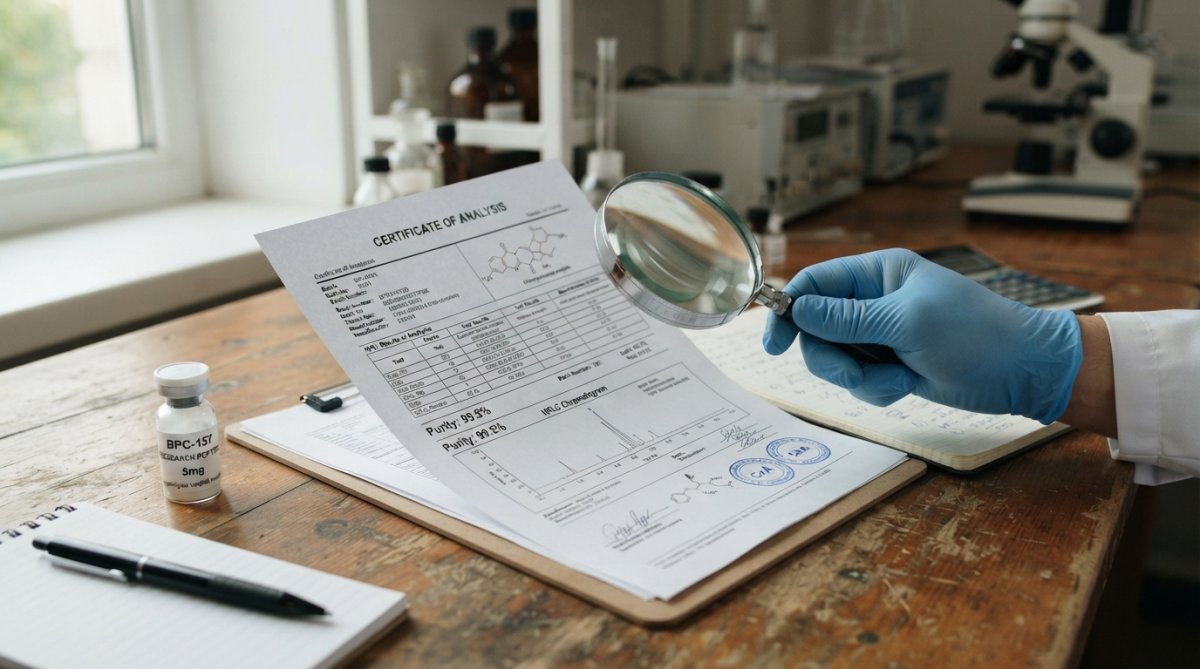
A certificate of analysis is a formal laboratory report that documents the results of testing performed on a product batch or raw material lot. The document serves as proof that the tested material meets specific quality standards for composition, purity, safety, and other defined parameters.
The core purpose of a COA is straightforward: it provides third-party verification that a product is what the manufacturer claims it is. Rather than relying on a supplier’s word alone, you have independent laboratory data backing up quality assertions. This is especially critical in regulated industries where compliance violations can result in product recalls, legal liability, or loss of operating licenses.
Rejuvenation Wellness Solutions LLC partners with WHO/GMP and ISO-certified manufacturers and 503B compounding pharmacies to ensure every research peptide product undergoes independent lab testing with a certificate of analysis. This approach ensures that customers receive products with verified purity levels of 99% or higher, with complete documentation of test results and specifications.
Quality control depends on verifiable data, not assumptions. A certificate of analysis provides the documented evidence that quality standards have been met. For pharmaceutical manufacturers, food producers, and chemical suppliers, a COA is not optional, it’s a regulatory requirement.
Regulatory bodies like the FDA expect companies to maintain detailed records of product testing and quality assurance. When an inspector audits your facility or a customer questions product integrity, a properly issued and documented certificate of analysis demonstrates due diligence. It shows that you’ve taken steps to verify what you’re selling and that you’re maintaining traceability throughout your supply chain.
From a liability perspective, having certificates of analysis for every product batch protects both manufacturers and distributors. If a product causes harm or fails to perform as intended, the COA provides documentation of what testing was performed and what the results were at the time of manufacture. This creates a clear audit trail and reduces legal exposure.
Every certificate of analysis begins with clear product identification. This section includes the product name, the manufacturer’s name and contact information, the batch or lot number, and the manufacturing date. The batch number is crucial because it links the document to a specific production run. If quality issues arise later, the batch number allows you to identify exactly which units are affected.
The certificate also includes the date the testing was performed and the date the report was issued. These dates matter because some test results have validity windows. A stability test performed six months ago may no longer be relevant if the product has been stored improperly in the interim.
The heart of any certificate of analysis is the test results section. This is where the laboratory documents what was actually measured and what the findings were. The results typically include quantitative data, specific numbers and percentages, that describe the product’s composition.
Equally important is the analytical method used to obtain those results. Different testing techniques can yield different outcomes, so the COA specifies which method was used. Common analytical methods include High-Performance Liquid Chromatography (HPLC), Gas Chromatography (GC), Mass Spectrometry (MS), and various spectroscopy techniques. The method name and any relevant standards it follows (such as USP, EP, or ISO methods) are documented so that the testing can be repeated or verified by other laboratories if needed.
The specifications section of a certificate of analysis lists the acceptable ranges or limits for each tested parameter. For example, a peptide product might specify that purity should be 99% or higher, moisture content should not exceed 2%, and heavy metals should be below 10 parts per million.
The COA then shows whether the actual test results fall within those specified ranges. A simple "Pass" or "Fail" notation makes it clear at a glance whether the batch meets requirements. Standards compliance is documented by reference to the standards used, whether FDA regulations, ISO standards, USP monographs, or industry-specific guidelines. This tells you exactly what criteria the product was tested against.
The pharmaceutical industry has the strictest COA requirements. Every active pharmaceutical ingredient, excipient, and finished drug product must be tested and documented. The FDA requires pharmaceutical manufacturers to maintain certificates of analysis as part of their quality assurance systems. For compounded medications prepared by 503B compounding pharmacies, certificates of analysis verify that each ingredient meets pharmaceutical-grade purity standards.
Food safety regulations similarly demand certificates of analysis for many ingredients and finished products. The FDA Food Safety Modernization Act (FSMA) emphasizes supplier verification and traceability, which relies heavily on documentation like certificates of analysis. Food manufacturers use COAs to verify that suppliers’ raw materials, whether spices, additives, or proteins, meet safety and quality standards before they enter production.
Chemical suppliers routinely issue certificates of analysis for reagents, solvents, and specialty chemicals used in research and manufacturing. Research laboratories depend on these documents to confirm that they’re using materials of the correct purity and composition for their experiments. A researcher working with high-purity peptides, for instance, needs documented proof of purity to ensure experimental validity.
Many research institutions have policies requiring certificates of analysis for all purchased materials. This ensures consistency across experiments and provides documentation for grant compliance and publication purposes. Academic and commercial research labs also use COAs to maintain traceability in their supply chain, which is increasingly important for reproducibility and regulatory compliance.
Start by identifying who issued the certificate. Look for the laboratory’s name, address, and contact information. Then verify that the laboratory is actually qualified to perform the testing claimed. Check whether the lab holds relevant certifications such as ISO/IEC 17025, which is the international standard for testing and calibration laboratories.
Many laboratories display their accreditations prominently on their certificates. Look for statements like "ISO/IEC 17025 Accredited" or references to specific certifying bodies. If you’re uncertain about a laboratory’s credentials, contact them directly or check their website. A legitimate testing facility will have transparent information about its qualifications and accreditations readily available.
Red flags include certificates from labs with no verifiable credentials, no contact information, or vague accreditation claims. If a supplier can’t provide a certificate from a reputable, accredited laboratory, that’s a significant concern about product quality and supplier reliability.
Locate the batch or lot number on the certificate. This number is your link to the specific production run that was tested. Write down this number and match it against the batch number on the product packaging you receive. If they don’t match, you’ve received a different batch than the one tested, a serious problem.
Also note the manufacturing date and the testing date. Products can degrade over time, so a certificate from 18 months ago may not accurately reflect the current state of an older product. For temperature-sensitive materials like peptides, the storage conditions between manufacture and testing, and between testing and your receipt of the product, matter significantly.
Check whether the certificate includes information about the sample size tested and how the sample was selected from the batch. Proper sampling procedures ensure that the tested sample is truly representative of the entire batch. If the certificate doesn’t describe sampling methodology, that’s worth asking the supplier about.
This is where you verify that the product actually meets the quality claims made. Look at the test results section and find the parameter you care most about, usually purity for research peptides and chemicals. The result should be expressed as a percentage or concentration, with a specific numerical value.
Compare the result against the specification listed on the same certificate. The specification is the acceptable range or minimum standard. If the result is within the specification range, the product passes. If it’s outside the range, the product fails that test parameter.
For products like research peptides, purity is typically expressed as a percentage (e.g., 99.2% purity). Some certificates also include related data such as the percentage of water content, residual solvent levels, or impurity profiles. These supporting data points give you a more complete picture of product quality than purity percentage alone.
Cross-reference the test results against the product specifications you agreed upon with your supplier. If you ordered peptides specified as 99% pure minimum, verify that the COA shows results at or above 99%. If specifications include limits on moisture, heavy metals, or microbial contamination, check that all those parameters are documented and within acceptable ranges.
Pay attention to the units of measurement. A specification might state "not more than 5 mg/kg" for a contaminant, while the test result is expressed as "4.2 mg/kg", these match. But if you misread units and think one is in percentage while the other is in parts per million, you could reach an incorrect conclusion about compliance.
If any test result falls outside its specification, that’s a failed batch. A reputable supplier will not ship material that fails specification testing. If you receive a product with a COA showing failed results, contact the supplier immediately and refuse the shipment.
A typical certificate of analysis follows a consistent format that includes these sections:
| Section | Contents |
|---|---|
| Header | Laboratory name, address, accreditation info |
| Product Info | Product name, batch/lot number, manufacturer |
| Dates | Manufacturing date, testing date, report date |
| Sample Details | Sample size, sampling method, storage conditions |
| Analytical Methods | Testing techniques used (HPLC, GC, etc.) |
| Test Results | Quantitative data for each parameter tested |
| Specifications | Acceptable ranges for each parameter |
| Pass/Fail Status | Overall compliance determination |
| Signatures | Authorized lab personnel signature and date |
| Notes | Any qualifications or additional information |
This structure ensures consistency and makes it easy to locate specific information. When you receive a COA that deviates significantly from this format, missing sections, vague language, unsigned, that’s a warning sign about the document’s reliability.
Imagine you’ve ordered a research peptide and received a certificate of analysis. The document shows:
Product: Synthetic Research Peptide XYZ-001
Batch Number: 2026-0847
Manufacturing Date: June 15, 2026
Testing Date: June 18, 2026
Test Results:
Specifications:
In this example, every parameter passes. The purity of 99.4% exceeds the 99.0% minimum. Water content at 1.2% is below the 2.0% limit. Residual solvent is well below the limit, and microbial contamination is minimal. This batch is suitable for research use.
The HPLC method used for purity testing is a standard, widely accepted technique. The testing was performed just three days after manufacturing, so the results reflect the product’s condition at the time of production. The three-day turnaround is reasonable and suggests the laboratory has good efficiency.
One frequent error is confusing the specification with the result. The specification is the target range; the result is what was actually measured. If you see "Purity: ≥99%" and then separately "99.2%," the 99.2% is the actual result, and it passes the ≥99% specification.
Another mistake is ignoring the units. A specification might state "Heavy Metals: <10 ppm" while the result shows "8.5 mg/kg." These are different units, ppm (parts per million) and mg/kg are not equivalent in all contexts. Always verify that units match or that you understand the conversion.
People sometimes assume that a document labeled "Certificate of Analysis" is automatically legitimate. However, a COA is only as credible as the laboratory that issued it. A certificate from an unknown, unaccredited laboratory carries little weight. Always verify the issuer’s credentials before trusting the results.
Finally, don’t ignore the date. A certificate of analysis from two years ago may not reflect the current state of a product, especially if storage conditions are unknown. Request recent test results, particularly for temperature-sensitive materials or products with limited shelf life.
The FDA expects pharmaceutical manufacturers and food producers to maintain certificates of analysis as part of their quality assurance documentation. For pharmaceutical products, 21 CFR Part 211 (Current Good Manufacturing Practice) requires that manufacturers have test data demonstrating that each batch meets specifications.
For food manufacturers, the FDA Food Safety Modernization Act emphasizes supplier verification and hazard analysis. Certificates of analysis serve as key documentation in this verification process. When a food manufacturer receives a shipment of an ingredient, the COA helps verify that the supplier has tested the material and that it meets food safety standards.
Chemical manufacturers selling to regulated industries must provide certificates of analysis as a standard practice. Regulatory agencies expect to see these documents during inspections and audits. The absence of proper COAs can result in regulatory findings, warning letters, or enforcement actions.
ISO/IEC 17025 is the international standard for testing and calibration laboratories. Laboratories that hold this accreditation have demonstrated competence in performing specific tests and maintaining quality systems. When a certificate of analysis comes from an ISO/IEC 17025 accredited laboratory, you have reasonable assurance that the testing was performed correctly and the results are reliable.
Many industries reference specific ISO standards for testing methods. For example, ISO 527 covers tensile testing of plastics, while ISO 11357 covers differential scanning calorimetry for thermal analysis. When a COA references these standards, it means the laboratory followed established, internationally recognized procedures.
Third-party testing, where an independent laboratory tests a supplier’s product, is more credible than in-house testing alone. An independent laboratory has no financial incentive to falsify results, whereas a manufacturer might be tempted to overlook minor specification failures. The gold standard is a certificate of analysis from a reputable, accredited, independent laboratory.
Many people confuse a Certificate of Analysis with a Safety Data Sheet (SDS), but they serve different purposes. An SDS is a document that describes the hazards of a chemical substance and provides information about safe handling, storage, and emergency procedures. It focuses on health and safety information.
A certificate of analysis, by contrast, documents the actual test results that verify product composition and purity. It answers the question "What is actually in this product and does it meet specifications?" An SDS answers the question "What hazards does this substance present and how should it be handled safely?"
You need both documents. The SDS tells you how to work safely with a material. The COA tells you that the material you received actually matches what was ordered. A complete supplier relationship includes both documents, along with other supporting documentation like technical specifications, stability data, and regulatory compliance information.
The SDS is typically provided by the manufacturer and may be the same for all batches of a product. The certificate of analysis, however, is unique to each batch because it documents the specific test results for that particular production run. If you order the same product twice, you’ll receive the same SDS both times but different certificates of analysis (because different batches were tested).
Quality assurance in research and manufacturing depends on verifiable documentation. A certificate of analysis is the most direct way to confirm that a product meets the standards you’ve agreed upon with your supplier. When you work with Rejuvenation Wellness Solutions LLC, every research peptide product undergoes independent laboratory testing with a comprehensive certificate of analysis documenting purity, composition, and safety parameters. This commitment to third-party verification ensures you’re working with materials that have been rigorously tested and documented. Shop with confidence, knowing that your peptides have been verified by accredited laboratories and come with complete traceability documentation.
A certificate of analysis serves as official documentation that a product has undergone laboratory testing and meets specified quality standards. It verifies product purity, chemical composition, and compliance with regulatory requirements. For research peptides and pharmaceutical products, a COA confirms that batch testing results align with safety standards and quality assurance protocols, providing traceability and accountability throughout the supply chain.
Verify COA authenticity by checking the issuing laboratory's ISO certification credentials and accreditation status. Confirm the laboratory's contact information and cross-reference it independently. Look for batch number traceability, digital signatures, and official letterhead. Request direct verification from the third-party testing facility. For high-value purchases, contact the lab directly to confirm the document's validity. Legitimate providers, like those partnering with WHO/GMP certified manufacturers, maintain transparent verification processes.
A complete COA includes product name and batch number for traceability, manufacturer and testing lab details, test results with specific analytical methods used, purity percentages and chemical composition data, specifications and pass/fail criteria, testing dates, and issuer certification. It should also list any quality assurance standards met (ISO, FDA compliance) and provide contact information for the testing facility. This comprehensive documentation ensures product integrity and regulatory compliance.
The pharmaceutical industry requires COAs for all drug products and active pharmaceutical ingredients to ensure safety and efficacy. Food and beverage manufacturers use COAs for ingredient verification and contamination testing. Chemical manufacturers provide COAs for purity and composition validation. Research institutions, including those conducting clinical trials and laboratory research, depend on COAs to verify product quality. Compounding pharmacies and suppliers of research compounds also mandate COAs as part of quality control and regulatory compliance protocols.
This article was written using GrandRanker








