
Last Updated: August 6, 2026
High purity peptides are synthetic amino acid chains manufactured to exacting standards for laboratory experiments, clinical trials, and biomedical research. The quality and consistency of your peptide materials directly determine the reliability of your research outcomes. Contaminants, impurities, or inconsistent composition make it impossible to distinguish genuine biological effects from artifacts caused by contamination.
A peptide that’s 95% pure might seem acceptable, but that 5% of unknown material can skew your data and force you to repeat studies from scratch. Research-grade peptides typically meet or exceed 99% purity standards verified through independent laboratory testing, ensuring you know exactly what you’re working with.
Contamination introduces uncontrollable variables. Heavy metals, endotoxin levels, microbial growth, or residual synthesis byproducts can trigger unexpected cellular responses, interfere with binding assays, or compromise your findings. For clinical trials or published work, regulatory bodies and peer reviewers expect documented purity verification. A Certificate of Analysis from third-party testing is essential evidence that your research meets scientific standards.
Peptide purity standards define acceptable levels of the desired peptide sequence versus contaminants, varying significantly by research application and regulatory requirements.
Research-grade peptides typically meet 95-99% purity standards and are suitable for in-vitro studies and exploratory experiments. Pharmaceutical-grade peptides must meet FDA or international regulatory standards with GMP certification, achieving 99%+ purity with rigorous documentation and traceability.
Early-stage exploratory work can proceed with research-grade materials at lower cost. However, if your findings will inform clinical decisions, regulatory submissions, or high-impact publications, pharmaceutical-grade peptides with GMP certification provide the necessary quality foundation. Rejuvenation Wellness Solutions partners with WHO/GMP and ISO-certified manufacturers and 503B compounding pharmacies to ensure every product meets 99%+ purity standards with independent lab testing and a Certificate of Analysis.
High-Performance Liquid Chromatography coupled with Mass Spectrometry (HPLC-MS) is the gold standard for verifying peptide purity, confirming molecular weight, and validating amino acid sequence. This method separates peptide components by chemical properties and measures their mass with extreme precision.
HPLC-MS verification confirms the correct amino acid sequence, identifies synthesis byproducts or truncated peptides, and provides molecular weight confirmation. A clean chromatogram with a single dominant peak at the expected retention time and molecular weight matching your specification indicates pure, correctly synthesized peptide. The key metric is the percentage of total peak area represented by your target peptide, 99% purity means your peptide accounts for 99% of the total material by area under the curve.
Third-party peptide testing sends your peptides to an independent laboratory for verification of purity, identity, and safety. This independent verification creates an objective quality check that protects your research. Unlike manufacturers with financial incentives to report favorable results, independent laboratories have no such incentive and deliver accurate data regardless of outcome.
A Certificate of Analysis (CoA) reports purity percentages, molecular weight confirmation, amino acid sequence verification, and detected contaminants. The CoA identifies your peptide by name, sequence, and lot number, reports purity as a percentage (e.g., "99.2% purity by HPLC"), and confirms molecular weight measured by mass spectrometry against theoretical values.
Many CoAs list identified impurities like trifluoroacetate (TFA) or acetate salt residues as percentages or concentrations. Understanding these impurities helps assess whether they might interfere with your application. The CoA should include testing dates, the performing laboratory, and methods used (HPLC, mass spectrometry, etc.), creating a documentation chain critical for regulatory compliance.
Endotoxin testing and microbial growth assessment are important if peptides will be used in cell culture, animal studies, or applications where biological systems might react to contaminants. Endotoxin levels are measured in endotoxin units per milliliter (EU/mL) using the Limulus Amebocyte Lysate (LAL) test. For research-grade peptides in in-vitro cell culture, endotoxin levels below 1 EU/mL are generally acceptable. For animal administration or therapeutic development, pharmaceutical-grade peptides require endotoxin levels below 0.25 EU/mL or lower.
Microbial contamination testing checks for bacteria, fungi, or other microorganisms. The CoA should report results as either "sterile" or list any organisms detected. If microbial growth is detected, reject the batch unless contamination is negligible and your application doesn’t require sterility.
How you store peptides directly determines their stability and suitability for research. Poor storage conditions degrade peptides, reduce purity, and introduce contamination, compromising experimental outcomes.
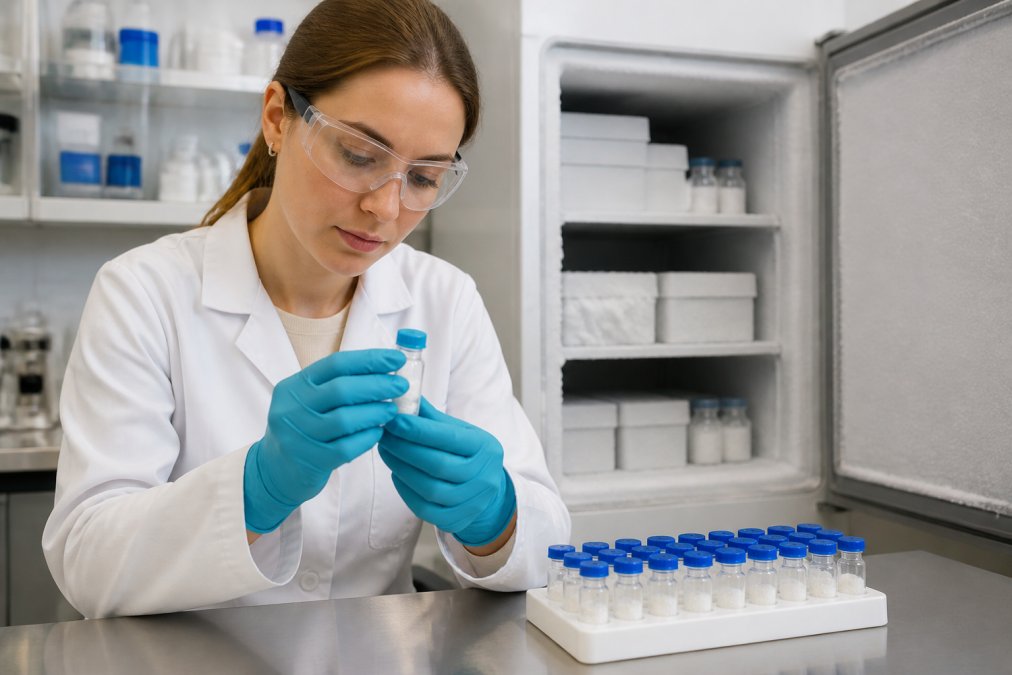
Lyophilized peptides are freeze-dried powders with water removed, creating a stable, shelf-stable form that preserves peptide structure and allows long-term storage at room temperature or in a refrigerator. Lyophilized peptides are the standard for research because they’re stable, easy to ship, and can be reconstituted with your choice of solvent when needed.
Reconstituted peptides are already dissolved in solution and have a much shorter shelf life, measured in weeks or months rather than years. They require refrigeration or freezing to prevent degradation and are more susceptible to bacterial growth if not handled aseptically.
For most research applications, lyophilized peptides are preferable. They offer flexibility in reconstitution, greater long-term stability, and lower cost. Store lyophilized peptides in the original sealed vial in a cool, dry place. Room temperature storage works for short-term use, but refrigeration at 2-8°C or freezing at -20°C extends shelf life significantly.
Once reconstituted, peptide solutions face degradation through hydrolysis, oxidation (particularly for peptides containing methionine or cysteine), and microbial growth. The buffer you choose affects peptide stability, most peptides are most stable in slightly acidic to neutral pH ranges (pH 4-7).
Bacteriostatic water (sterile water containing 0.9% benzyl alcohol as a preservative) is often used for reconstitution because benzyl alcohol inhibits bacterial growth without affecting peptide function in most applications. This extends usable lifespan from days to weeks or months depending on storage temperature.
Temperature control is your primary preservation tool. At room temperature, most peptide solutions remain usable for days to a few weeks. Refrigeration at 2-8°C extends this to weeks or months. Freezing at -20°C can preserve reconstituted peptides for many months, though repeated freeze-thaw cycles can damage peptides. If you need multiple freeze-thaw cycles, add glycerol (10-50%) as a cryoprotectant.
Choosing between custom peptide synthesis and pre-made peptides depends on your research timeline, budget, and sequence availability. Custom synthesis allows you to order any amino acid sequence with specific modifications like phosphorylation, PEGylation, or fluorescent labeling. Services offer turnaround times from days to weeks, but custom synthesis is more expensive and slower than pre-made options.
Pre-made peptides from inventory offer immediate availability and lower cost. Rejuvenation Wellness Solutions maintains stock of commonly used research peptides, all verified to 99%+ purity with independent lab testing and Certificates of Analysis. Same-day order fulfillment and fast shipping enable quick receipt without custom synthesis lead times.
The limitation of pre-made options is availability. If your research requires a sequence not in inventory, you’ll need custom synthesis. A hybrid approach works well: use pre-made peptides for standard experiments and validation, then commission custom synthesis for novel sequences or modified variants.
| Approach | Timeline | Cost | Best For | Customization |
|---|---|---|---|---|
| Pre-made peptides | Same-day to 2 days | Lower per unit | Standard sequences, quick studies | None, catalog only |
| Custom synthesis | 5-21 days | Higher per unit | Novel sequences, modifications | Full customization |
| Hybrid strategy | Mixed | Balanced | Validation + exploration | Selective |
Selecting a peptide supplier directly determines the quality, reliability, and documentation you receive. Rejuvenation Wellness Solutions combines affordable, high-purity research peptides with the certifications and independent testing that serious researchers require.

Rejuvenation Wellness Solutions provides affordable, high-purity research peptides to individual researchers aged 21 and over. They partner with WHO/GMP and ISO-certified manufacturers and 503B compounding pharmacies, ensuring every product meets 99%+ purity standards and undergoes independent lab testing with a Certificate of Analysis. This commitment to independent verification distinguishes them from suppliers who test their own products.
The company’s mission is to help the scientific community with reliable, safe, and high-quality peptide solutions for clinical trials, laboratory research, and scientific innovation. They’re expanding beyond injectable forms to topical and oral options, recognizing that researchers need peptides in multiple delivery formats. For individual researchers aged 21 and over conducting independent scientific studies, this accessibility is critical.
WHO/GMP certification means the manufacturer follows internationally recognized standards for quality control, documentation, and manufacturing processes. This certification requires rigorous auditing and ongoing compliance monitoring. When your peptide supplier partners with WHO/GMP-certified manufacturers, you’re working with facilities meeting global pharmaceutical standards.
503B compounding pharmacy certification indicates the facility is licensed to compound medications and research materials under strict pharmaceutical regulations. A 503B compounding pharmacy must maintain sterile environments, follow precise formulation protocols, and maintain detailed batch records. This certification provides regulatory assurance that your peptides are manufactured under conditions appropriate for research that may eventually inform clinical applications.
These certifications create accountability. Certified manufacturers are subject to regulatory inspection and audit. This is fundamentally different from unregulated suppliers operating without oversight.
Rejuvenation Wellness Solutions offers same-day order fulfillment with UPS 2-day air shipping, delivering peptides to your lab within 48 hours. This speed is a competitive advantage for researchers on tight timelines. Customer service is reachable by text, phone, and email with responses within hours, providing invaluable support when you have questions about orders, need technical guidance on reconstitution, or encounter unexpected results.
Assuming all 99% purity claims are equivalent. A supplier claiming 99% purity without independent verification is making a claim they have every financial incentive to exaggerate. Always verify purity claims come from third-party testing with a Certificate of Analysis you can review.
Choosing price over quality documentation. The cheapest peptide source often cuts corners on testing, documentation, or manufacturing standards. When experiments fail due to poor material quality, you’ve wasted far more than you saved on material costs. Investing in suppliers with transparent quality documentation and independent testing is always better economics.
Not understanding your storage requirements before peptides arrive. Confirm you have the storage conditions your peptides require before ordering. If you’re reconstituting peptides, ensure you have the correct buffer solutions and aseptic technique to prevent contamination.
Reconstituting more peptide than you’ll use in a reasonable timeframe. Reconstituted peptides degrade over time, even under ideal storage conditions. Reconstitute only what you’ll use within a few weeks to minimize waste and ensure fresh material.
Skipping validation steps when switching suppliers. If you switch peptide sources, validate that the new supplier’s material performs identically in your assays. Run a side-by-side comparison with your previous material before committing to critical experiments.
Ignoring Certificate of Analysis details. Review the full CoA: check molecular weight confirmation, look for detected impurities, verify testing methods used, and confirm the lot number matches your vial.
Selecting high purity peptides for your research is fundamentally about controlling variables. Your experimental results are only as reliable as the materials you’re working with. When you choose Rejuvenation Wellness Solutions, you’re gaining access to 99%+ pure materials verified through independent lab testing, same-day fulfillment, and responsive customer support that understands research timelines. Get started with Rejuvenation Wellness Solutions and access the high-quality peptide solutions that enable your research to succeed.
High purity peptides typically contain 99% or greater of the target peptide molecule, with the remainder being byproducts from synthesis or minor contaminants. For research applications, this level of purity is critical because impurities can interfere with experimental outcomes, skew data, and compromise the validity of your findings. High purity peptides undergo rigorous HPLC and mass spectrometry analysis to verify the exact composition before reaching your lab.
Research-grade peptides are typically 95-99% pure and designed for experimental use in laboratories. Pharmaceutical-grade peptides meet stricter regulatory standards, often exceeding 99% purity, and follow GMP (Good Manufacturing Practice) protocols for clinical applications. For independent scientific research, high-purity research-grade peptides from WHO/GMP-certified manufacturers provide the quality needed for reliable results without the premium cost of full pharmaceutical-grade materials.
Third-party testing provides independent verification of purity, molecular weight, and safety, eliminating bias in quality claims. When a supplier conducts their own testing, conflicts of interest can arise. Independent labs verify that HPLC-MS results are accurate, endotoxin levels are safe, and microbial contamination is absent. This independent validation protects your research integrity and ensures your experimental outcomes are based on materials you can trust.
This article was written using GrandRanker