

Last Updated: September 16, 2026
Every vial of lyophilized powder that arrives compromised means lost time, wasted budget, and invalidated data. Shipping and handling requirements for research peptides exist because these compounds degrade when exposed to heat, moisture, vibration, and mishandling in transit. At Rejuvenation Wellness Solutions LLC, we ship every order the same day via UPS 2-day air. (Source: guidance on the transport of dangerous goods)
The stakes are straightforward: a peptide that degrades in transit may still look normal in the vial, and you will not know it failed until your assay produces anomalous results weeks later, after burning through reagents, instrument time, and possibly an entire experimental cohort.
This guide covers the full lifecycle: pre-shipment storage, transit temperature control, packaging, regulatory compliance, and on-arrival protocols.
Peptide storage temperature guidelines differ by form (lyophilized or reconstituted) and by stage (transit or freezer).
Lyophilized peptides are generally stable at ambient temperature for short periods, but long-term storage should be at -20°C or below.
| Peptide State | Pre-Transit Storage | Transit Target | Post-Arrival Storage |
|---|---|---|---|
| Lyophilized powder | -20°C | 2-8°C | -20°C or below |
| Reconstituted | 2-8°C, use within days | Not recommended | 2-8°C, short-term |
Lyophilized peptide stability during transit depends on matching the cooling method to shipping duration and destination climate. Dry ice and gel packs are not interchangeable.
Dry ice maintains -78.5°C and is appropriate for extended transit times, international shipments, or reconstituted peptides that demand strict frozen conditions. It requires vented packaging because sublimation produces carbon dioxide gas. The International Air Transport Association dangerous goods guidance classifies dry ice as a hazardous substance for air transport, meaning shipments must include proper documentation and quantity declarations.
Gel packs maintain 2-8°C and suit lyophilized peptides traveling domestically within 48 hours. They are lighter, need no hazardous materials paperwork, and are easier to handle on arrival. For most domestic research peptide shipments, gel packs with insulated liners provide adequate thermal stabilization.
Protecting vial integrity requires more than a box and a cold pack. Vials are glass and break under impact, so packaging must address three threats: thermal excursion, physical shock, and moisture ingress.
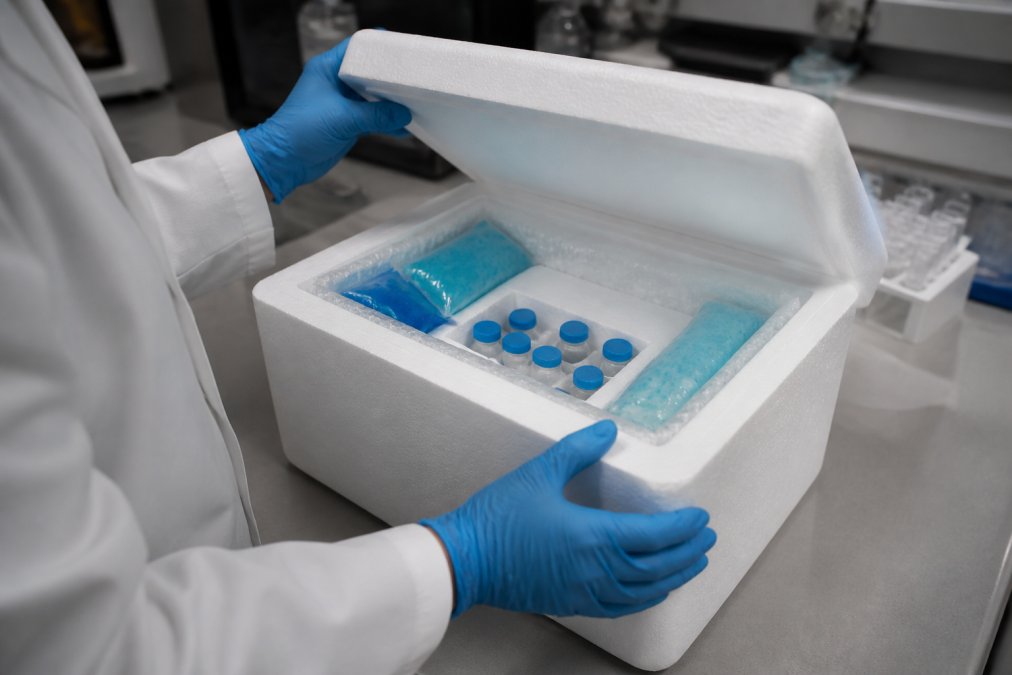
A complete protective packaging setup includes:
Domestic shipments move under carrier-specific and general transport rules. International shipments add customs clearance, import permits, and destination-specific standards. Documentation is where most research peptide shipments fail, not because the material is prohibited, but because the paperwork is incomplete or inconsistent.
For domestic movement, the main compliance concerns are carrier restrictions on dry ice and proper labeling. Dry ice is a hazardous material under U.S. Department of Transportation rules when shipped by air, and carriers like UPS and FedEx require specific markings: net dry ice weight in kilograms, the shipper’s name and address, and a Class 9 miscellaneous hazardous materials label.
For international orders, the documentation package must be internally consistent. A single mismatch between the commercial invoice, packing list, and air waybill can trigger a customs hold lasting days, long enough to compromise the cold chain even with dry ice.
The core documents include:
Most guides treat customs paperwork and cold chain logistics as separate concerns. They are not. Every hour in customs review depletes the thermal buffer. Dry ice sublimates at roughly 5 to 10 pounds per 24 hours depending on insulation, and a customs delay can exhaust the buffer entirely.
Both domestic and international shipments should be traceable from supplier to laboratory. Keep all shipping documents, the COA, and the temperature indicator readout filed together. If a shipment is seized or delayed, this record is your evidence for insurance claims, reshipment requests, or regulatory inquiries, and it supports your experimental records if a reviewer questions a reagent’s provenance.
Certificate of Analysis importance for research peptides comes down to verification. A COA documents the identity, purity, and testing methodology for a specific lot; without it, you cannot confirm the vial in your hand matches the specifications you ordered.
Inspect every shipment before signing for it or discarding packaging. Damage is not always obvious from the outside, and the visual cues inside the vial tell you more about peptide integrity than the box condition. Use this checklist, then interpret what you see.
A failed checklist item is not just a reason to contact the supplier, it is diagnostic information about transit conditions.
Once a shipment clears inspection, transfer vials to storage the same day. Log the arrival date, lot number, storage location, and temperature indicator reading. Store lyophilized powder at -20°C or below; store reconstituted material at 2-8°C and use within your protocol’s timeframe.
Reconstituted peptides are far less stable than lyophilized powder. Once you add bacteriostatic dilution water, stability declines, and the clock runs faster after shipping has already stressed the material. Shipping stress, even within acceptable temperature ranges, can leave the peptide more susceptible to hydrolysis and aggregation in solution.
Shipping and handling requirements for research peptides do not end at delivery. The first 24 hours after arrival determine whether your cold chain investment translates into usable material. Inspect with a diagnostic eye, not just a checklist.
Lyophilized research peptides in a sealed vial are generally more tolerant of short ambient exposure than reconstituted peptides, but the delivery window still matters. Most suppliers ship with dry ice or gel packs to keep the package cold for the stated transit time. Once the package arrives, move vials to cold storage promptly and check the Certificate of Analysis for any specific storage instructions tied to that batch.
Domestic shipments typically need a shipping manifest, packing list, and safety documentation for any hazardous substances such as dry ice. International shipments add customs clearance paperwork, a commercial invoice, and any applicable import permits. Because requirements vary by destination and material, confirm the exact documents with the carrier and the receiving institution before the shipment leaves the facility.
Lyophilization removes water from the peptide, which slows degradation and makes the lyophilized powder more stable at ambient temperature than a reconstituted solution. That stability is not unlimited, though. Temperature swings, vibration, and long transit times can still affect molecular stability, so cold chain shipping and shock-absorbing inserts remain important even for lyophilized vials.
Inspect the package first: check for cracked vials, thawed gel packs, or a broken cold chain. Then follow the storage temperature guidelines on the Certificate of Analysis, which usually means freezer storage for lyophilized powder and refrigeration for reconstituted peptide. Log the arrival date, batch number, and storage location so the chain of custody stays intact for your research records.








