
Last Updated: October 19, 2026
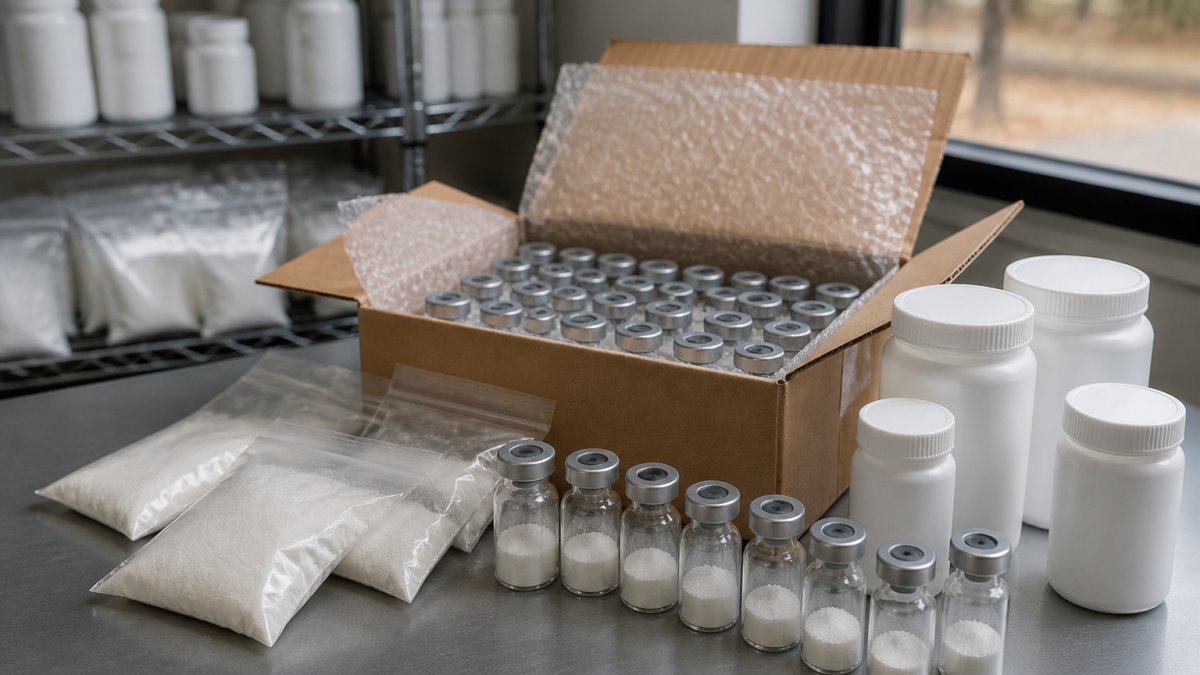
When sourcing research peptides at scale, bulk peptide pricing and discounts determine whether your budget stays sustainable.
At Rejuvenation Wellness Solutions, we know researchers need transparency when evaluating bulk peptide pricing.
Bulk peptide pricing follows a simple principle: the more you buy, the less you pay per unit.
The most useful metric when evaluating bulk peptide pricing is cost per milligram, which lets you compare vial sizes, suppliers, and order quantities on equal ground.
A 10 mg vial at $50 costs $5 per milligram; a 50 mg vial at $200 costs $4 per milligram. The larger vial looks pricier until you do the math, and across hundreds of milligrams, that difference compounds quickly.
Most researchers calculate price per milligram manually by dividing total cost by total milligrams. Pricing comparison tools like Peptide Price Index and Disclosed Labs price comparison tool automate this across vendors, surfacing which suppliers deliver the best per-milligram value for specific compounds.
The catch: price per milligram only tells part of the story.
Quantity discounts come in two flavors: multi-vial pack discounts and wholesale bulk tiers.
Multi-vial packs bundle multiple vials of the same product at a reduced per-unit price. You save per vial but commit to significant inventory of one compound.
Wholesale bulk tiers work differently. Vendors structure pricing around total order value or quantity thresholds. This lets you mix compounds and sizes while still hitting discount tiers.
Multi-vial discounts reward commitment to a single product: buy five vials instead of one, pay less per vial. The tradeoff is inventory risk if your research direction shifts or a batch shows stability issues.
Minimum orders vary, some start at two vials, others at five or more. Factor this into working capital: a $200 multi-vial discount sounds great until it requires $3,000 in upfront inventory.
Wholesale pricing tiers separate serious research operations from smaller exploratory projects. Rejuvenation Wellness Solutions works with individual researchers and institutional labs alike, since bulk purchasing patterns differ by research scope.
Wholesale suppliers typically offer tiered discounts: 5-10% off at one threshold, 15-20% at the next.
Retail pricing is usually fixed per vial regardless of quantity, with only modest breaks at certain thresholds.
Most vendors publish discounts as isolated percentages, making cross-vendor comparison nearly impossible. The table below shows how a typical tier structure translates into actual unit cost. Use it as a template: plug in each vendor’s thresholds and percentages, then compare cost per milligram at your target volume.
| Order Value Threshold | Typical Discount | Effective Cost on a $4.00/mg List Price | Cost per mg After Discount |
|---|---|---|---|
| Under $500 (retail) | 0% | $4.00 | $4.00 |
| $500-$1,499 | 10% | $4.00 | $3.60 |
| $1,500-$2,999 | 15% | $4.00 | $3.40 |
| $3,000-$4,999 | 20% | $4.00 | $3.20 |
| $5,000+ | 25% | $4.00 | $3.00 |
The percentages above are illustrative of common tier patterns, not a quote from any single vendor. The method is the point: convert every discount into a cost-per-milligram figure at your actual order size.
Per-unit savings only matter if you can consume the volume before it degrades or your research needs change. A simple break-even framework:
If the bulk order covers more months than shelf life or your research timeline allows, the discount is illusory.
When requesting a bulk peptide quote, you need specific information to compare fairly. A vague quote, “our best price on BPC-157”, tells you nothing about volume, vial size, or timeline.
Here’s what to request and compare:
| Item | Why It Matters | What to Ask |
|---|---|---|
| Price per milligram at your target quantity | Standardizes comparison across vial sizes | “What is your cost per mg for 500 mg total?” |
| Vial size options | Affects usability and storage | “What vial sizes do you offer for this compound?” |
| Minimum order quantity | Determines if the discount is accessible | “What is your minimum order for this product?” |
| Bulk discount thresholds | Shows when you hit the next price tier | “At what order values do your discounts apply?” |
| Certificate of Analysis availability | Verifies purity before you commit | “Does every batch include a COA?” |
| Shipping cost and timeline | Affects total landed cost | “What is shipping for a $2,000 order? How fast?” |
| Payment terms | Impacts cash flow | “Do you offer net 30 or require upfront payment?” |
Request quotes for multiple scenarios, a small pilot order, your typical monthly volume, and a larger bulk purchase, to see the full pricing curve and plan inventory strategically.
When buying bulk, the Certificate of Analysis is your insurance policy, documenting the purity, potency, and safety of every batch, critical when scaling up research.
The COA should state:
Not all vendors include COAs as standard, some charge extra, others provide them only on request.
Rejuvenation Wellness Solutions partners with WHO/GMP and ISO-certified manufacturers and 503B compounding pharmacies to ensure 99%+ pure products. Every product undergoes independent lab testing with a Certificate of Analysis included, no hidden costs, no surprises.
Shipping is the hidden cost in bulk peptide pricing. A $2,000 order looks attractive until you add $300 in overnight shipping.
When planning bulk purchases, request shipping costs upfront and compare total landed cost, not just peptide price.
Temperature-controlled shipping for peptides adds cost but is often necessary. If your supplier doesn’t mention insulation, dry ice, or temperature monitoring, ask.
Most pricing pages stop at the peptide price. The number that hits your budget is total landed cost: peptide price plus shipping, taxes or fees, payment processing charges, and the cost of meeting a minimum order.
A practical template for a single order:
| Cost Component | What to Capture | Example on a $2,000 Order |
|---|---|---|
| Peptide subtotal | List price minus discount tier | $2,000 less 15% = $1,700 |
| Shipping | Carrier, speed, temperature control | $75 for 2-day air with cold pack |
| Sales tax | State and local rate, if applicable | Varies by jurisdiction; confirm with vendor |
| Payment processing fee | Card surcharge or wire fee | 0-3% depending on method |
| Minimum-order adjustment | Cost of adding filler to hit a threshold | $0 if already above minimum |
| Total landed cost | Sum of the above | $1,775 plus tax and fees |
The example figures are illustrative. The discipline is what matters: every quote you receive should be converted into this table before you compare vendors.
Free-shipping thresholds are a pricing lever, not a gift. A $200 threshold encourages consolidation; a $1,000 threshold pushes larger commitments.
If a vendor offers free shipping at $500 and your order is $450, adding $50 of a compound you’ll use anyway is a clear win. Adding $50 of a compound you won’t use is not. Treat the threshold as a break-even calculation, not a target.
Payment terms affect cash flow as much as price. Some vendors require upfront payment; others offer net 30 for institutional accounts. A 2-3% card surcharge is common, and wires may carry fees on both ends.
Sales tax depends on nexus rules and your organization’s tax status. Research institutions and certain buyers may be exempt, but the exemption usually requires documentation before the order ships.
The peptide market has fragmented into specialized suppliers with different bulk pricing models. Rather than guessing which offers the best deal, consider using comparison tools to normalize pricing across the market.
Peptide Library aggregates vendor data and includes a reconstitution calculator, useful when you’re comparing different vial sizes and need to understand actual usable volume. ChemVerify peptide price comparison goes further, including vial sizes and Certificate of Analysis availability alongside price, so you’re comparing quality alongside cost.
Rejuvenation Wellness Solutions combines affordable bulk pricing with same-day fulfillment, UPS 2-day air shipping, and customer service by text, phone, and email within hours, not days.
Price matters, but so do COA availability, shipping speed, and customer responsiveness when something goes wrong.
Choosing the right bulk peptide supplier isn’t just about the lowest price, it’s about how pricing, quality, and service align with your research needs. Rejuvenation Wellness Solutions makes this easier with transparent bulk pricing, 99%+ pure peptides with independent lab testing, same-day fulfillment, and customer support by text, phone, or email. Shop with us and move your research forward with confidence.
Bulk peptide pricing depends on order quantity, vial size, product strength, and the supplier’s discount tier structure. Most suppliers calculate a base price per milligram, then apply percentage discounts as order volume increases. Total cost includes the peptide price, shipping, and any applicable fees. Request a detailed quote that breaks down price per milligram, discount percentages at each tier, and total landed cost so you can compare fairly across vendors.
Yes. Most suppliers offer quantity discounts through tiered pricing, multi-vial pack discounts, or wholesale pricing for bulk purchases. Discount amounts vary by vendor and product. Some offer free shipping above a certain order total (commonly $200 or more). Before committing, request a quote that shows the exact discount percentage and price per milligram at your intended order volume so you can verify the savings.
A complete bulk peptide quote should list: product name and strength, quantity and vial size, price per milligram, total product cost, applicable discount percentage and amount, shipping method and cost, Certificate of Analysis availability, batch number or lot information, and total landed cost. Verify that COA documentation is included or available separately. This checklist ensures you can compare quotes accurately across suppliers and confirm you’re receiving the purity and documentation your research requires.
Request the Certificate of Analysis (COA) from your supplier before purchase or as part of your bulk order. The COA should show the peptide’s purity percentage (typically 99%+), testing methodology, batch or lot number, expiration date, and the independent laboratory that performed the testing. Verify the lab’s credentials and cross-check the batch number with your shipment. Reputable suppliers provide COA documentation for every batch; if a vendor cannot supply it, that is a red flag.