

Last Updated: August 21, 2026
Peptide impurities compromise research validity and pose safety concerns that can invalidate studies or harm patients. Understanding these risks is foundational to responsible peptide research. At Rejuvenation Wellness Solutions, high-quality peptide supplies differ from substandard ones through impurity profiling: systematic identification and quantification of every molecular variant in a batch.
Sequence-related impurities include truncations (incomplete chains), deletions (missing amino acid segments), and epimers (amino acids in incorrect stereochemical configurations). These emerge during synthesis when coupling reactions fail or protecting group removal is incomplete.
Degradation products form after synthesis through oxidation, hydrolysis, or deamidation. Oxidation targets methionine and tryptophan residues, creating inactive or immunogenic forms. Hydrolysis breaks peptide bonds, creating shorter fragments. Deamidation converts asparagine and glutamine into aspartate and glutamate, altering charge and biological activity.
Process-related impurities include residual solvents (dimethylformamide, N-methylpyrrolidone, acetonitrile) and heavy metals (nickel, palladium, iron) from synthesis catalysts that remain if purification is incomplete.
Co-eluting impurities are molecules with similar chemical properties that don’t separate cleanly during purification, including isomers, aggregates, and modified forms that standard HPLC methods may miss entirely.
A peptide sample containing 85% target peptide and 15% truncation variants produces results that don’t reflect true pharmacology (peer-reviewed research). Your findings become noise, difficult to reproduce and impossible to build upon.
FDA Category 2 substances (peptides not yet approved for human use) require comprehensive impurity characterization before clinical trials (the FDA). Peer reviewers now routinely request Certificate of Analysis documentation, and journals increasingly demand proof that peptides meet stated purity specifications. A single retracted publication due to impure peptide batches damages credibility across your entire body of work.
Verifying peptide purity before research begins separates rigorous scientists from those who hope their suppliers are honest. The process involves obtaining a Certificate of Analysis, understanding its contents, and confirming the analytical methods are appropriate for your application.
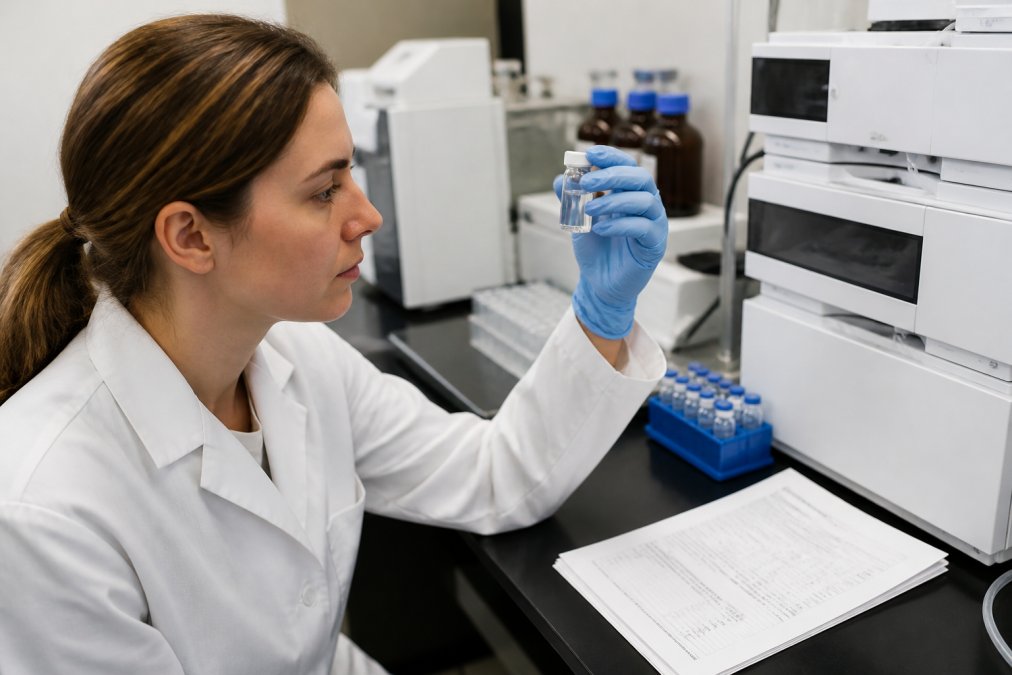
A Certificate of Analysis documents the purity percentage, identifies detected impurities, and specifies which analytical methods generated results. However, the purity percentage represents only what the stated analytical method can detect. A certificate claiming 99% purity via HPLC means the HPLC method resolved 99% of the dominant peak but may have missed co-eluting impurities, residual solvents, or heavy metals entirely.
Legitimate certificates include specific details: exact HPLC method, column type, mobile phase composition, detection wavelength, and run time. Vague certificates stating only "purity tested" or "meets specifications" without methodology should trigger skepticism. The certificate should also list detected impurities by name and percentage. If a certificate shows 99% purity but lists no impurities, the testing was incomplete.
HPLC (High-Performance Liquid Chromatography) is the industry standard for peptide purity assessment, separating molecules by size and chemical properties, then detecting them using UV absorbance. However, HPLC cannot distinguish between molecules with identical retention times or identify impurities without UV chromophores. Residual solvents and some heavy metals escape HPLC detection entirely.
Mass spectrometry (MS) complements HPLC by providing molecular weight information. Liquid chromatography-mass spectrometry (LC-MS) combines both techniques, identifying impurities by exact mass and catching truncations, deletions, and oxidation products that HPLC alone might miss.
The most rigorous suppliers use both methods. HPLC provides the purity percentage and identifies major variants. LC-MS confirms molecular identities and detects low-abundance impurities. For research peptides, demand both HPLC and LC-MS data in your Certificate of Analysis. Rejuvenation Wellness Solutions includes both analytical methods for every batch, ensuring complete transparency about what you’re receiving.
The FDA’s Chemistry, Manufacturing, and Controls guidelines for peptides evolved significantly heading into 2026, reflecting increased peptide development, supply chain vulnerabilities, and safety incidents in compounded peptide products.
CMC guidelines define what manufacturers must demonstrate about peptide production processes. The 2026 updates require tighter specifications for synthetic peptides, including mandatory impurity limits for sequence variants and degradation products.
Manufacturers must document synthesis routes, purification methods, and analytical procedures with granular detail, including step-by-step process validation showing each batch meets specifications consistently. Environmental monitoring during manufacturing, equipment qualification, and stability data demonstrating peptides remain within specification throughout shelf life are now required.
Process-related impurities receive heightened scrutiny. Manufacturers must identify all solvents, catalysts, and reagents used in synthesis, then prove they’ve been removed to acceptable levels. Batch consistency documentation is now mandatory, demonstrating that multiple batches produced using the same process yield comparable results.
The FDA classifies peptides into categories based on regulatory history and intended use. Category 1 peptides are FDA-approved drugs with established safety profiles. Category 2 peptides are not yet approved for human use but are being developed or used in clinical research. Category 3 peptides are research-only molecules with no human use history.
Category 2 substances face the most rigorous CMC requirements because their safety profile is incomplete. If you’re conducting research with peptides not yet approved by the FDA, your peptide supplier must meet Category 2 CMC standards, meaning comprehensive impurity profiling, validated analytical methods, and documented manufacturing processes.
Rejuvenation Wellness Solutions partners with WHO/GMP and ISO-certified manufacturers that exceed Category 2 requirements. Every peptide undergoes independent lab testing with a Certificate of Analysis, ensuring you receive products that meet or exceed regulatory standards for research use.
Immunogenicity, the ability of a peptide to trigger an immune response, represents a fundamental safety concern in peptide research and therapeutic development. When the immune system recognizes a peptide as foreign, it generates antibodies and T-cell responses that can neutralize the peptide, reduce efficacy, or cause adverse reactions.

The adaptive immune response operates through antibody production by B cells and T-cell activation. When a peptide contains sequence variants or degradation products, these non-target molecules can activate immune recognition pathways differently than the intended peptide.
Truncations and deletions create novel epitopes that the immune system hasn’t encountered before, potentially triggering stronger antibody responses. Oxidized methionine and tryptophan residues are recognized as "danger signals," potentially amplifying the adaptive immune response. A peptide sample containing even 5% oxidized variants may generate significantly stronger immune activation than the pure peptide (peer-reviewed research).
Repeated exposure to immunogenic peptide impurities can generate memory responses, making subsequent exposures more severe. This is why batch consistency matters: if one batch contains high oxidation levels and a second batch doesn’t, the immune response profile changes unpredictably between treatments.
Sequence-related impurities (truncations, deletions, epimers) pose the highest immunogenicity risk because they represent genuinely different molecules. Oxidation products rank second, as oxidized peptides are recognized as damaged, triggering innate immune pathways.
Aggregates, clusters of peptide molecules bound together, expose hydrophobic regions normally buried inside the peptide structure, creating novel epitopes. Residual solvents and heavy metal contaminants contribute to immunogenicity through indirect mechanisms, with heavy metals like nickel and palladium being known allergens that amplify adaptive immune responses.
Peptide degradation begins the moment synthesis completes. Oxidation, hydrolysis, and deamidation occur continuously, accelerated by heat, light, and humidity.
Oxidation targets methionine and cysteine, converting sulfide to sulfoxide and changing chemical properties. Hydrolysis breaks peptide bonds, shortening the chain and creating truncation variants, accelerating in aqueous solutions at elevated pH or temperature. Deamidation converts asparagine and glutamine to aspartate and glutamate, altering charge distribution and potentially eliminating biological activity.
A 99% pure peptide stored improperly may become 85% pure within months. Peptides should be stored frozen (below -20°C), protected from light, and maintained in low-humidity environments. Rejuvenation Wellness Solutions provides guidance on optimal storage for each peptide type, extending shelf life from weeks to years while preserving documented purity.
Truncations occur when a coupling reaction fails during synthesis, producing shorter chains alongside the intended product. Deletions represent missing amino acid residues within the sequence, forming when protecting groups fail to remove or interfere with coupling. A deletion of even a single amino acid can eliminate biological activity while maintaining similar chemical properties.
Epimers are amino acids in the wrong stereochemical configuration. L-amino acids can partially convert to D-amino acids during synthesis, particularly under alkaline conditions. D-amino acids are often more immunogenic because the immune system recognizes them as non-natural.
LC-MS analysis is essential for identifying sequence variants. HPLC alone often cannot distinguish truncations from full-length peptides if they have similar hydrophobicity. Mass spectrometry reveals exact molecular weights, immediately identifying any sequence variants present. A truncation missing critical epitope-defining residues may be more immunogenic than the full-length peptide, making comprehensive sequence variant analysis critical.
The peptide supply chain presents unique vulnerabilities. Unlike pharmaceutical manufacturing under FDA oversight, research peptide production occurs in diverse facilities with varying quality standards. Transparency becomes your primary defense against impure or contaminated peptides.
Demand complete traceability from your peptide supplier. You should know the manufacturer’s name, location, and certifications. Legitimate manufacturers hold WHO/GMP certification and ISO certifications, demonstrating third-party validation of their processes.
Request documentation of the manufacturing facility’s quality systems, including standard operating procedures, environmental monitoring data, and equipment maintenance records. Verify that your supplier uses independent third-party laboratories for Certificate of Analysis testing, removing conflicts of interest and ensuring objective assessment.
Establish relationships with suppliers who maintain batch-level traceability, allowing you to request synthesis date, purification method, and analytical data for any batch. This documentation enables you to track performance across multiple batches and identify trends.
Rejuvenation Wellness Solutions maintains complete transparency with every order. We partner exclusively with WHO/GMP and ISO-certified manufacturers, and every peptide undergoes independent lab testing. Your Certificate of Analysis documents the exact synthesis date, analytical methods used, and detected impurities.
The regulatory environment for peptide research tightened significantly in 2026. FDA CMC guidelines now require comprehensive impurity profiling, validated analytical methods, and documented manufacturing controls. Journals increasingly demand Certificates of Analysis before publication. Institutional review boards scrutinize peptide quality documentation before approving clinical studies.
This landscape demands a peptide supplier committed to transparency and quality. Rejuvenation Wellness Solutions meets these requirements through partnerships with WHO/GMP and ISO-certified manufacturers, independent lab testing with detailed Certificates of Analysis for every batch, and same-day fulfillment with UPS 2-day air shipping. Our team responds to questions via text, phone, and email within hours.
Shop with Rejuvenation Wellness Solutions and access the high-purity research peptides your work demands, backed by the analytical rigor your research deserves.
Peptide impurities fall into several categories: sequence variants (truncations, deletions, and epimers), degradation products from oxidation, residual solvents, heavy metal contaminants, and co-eluting impurities from manufacturing. Truncations occur when peptide chains break during synthesis, while epimers form when amino acids racemize. Oxidation products develop when peptides degrade over time or during storage. Understanding these types helps researchers assess safety and efficacy in their work.
Request a Certificate of Analysis from your supplier that documents purity testing results. Look for HPLC chromatography data showing the percentage of the target peptide, and mass spectrometry results confirming molecular weight. Verify that testing was performed by an independent laboratory using validated analytical methods. Ask suppliers about their quality control standards and whether they comply with FDA CMC guidelines. Reputable suppliers provide detailed documentation before purchase.
Impurities can trigger an adaptive immune response that reduces peptide efficacy and creates safety concerns. Sequence variants, oxidation products, and residual solvents may be recognized as foreign by the immune system, leading to antibody formation and reduced bioavailability. This is why impurity profiling is critical for drug development and research. Lower impurity levels directly correlate with reduced immunogenicity risk and more predictable research outcomes.
Industry standards typically require 95% or higher purity for research-grade peptides, with pharmaceutical-grade peptides at 99% or higher. FDA CMC guidelines specify purity thresholds based on the peptide's intended use and risk classification. For Category 2 substances and synthetic peptide drugs, stricter standards apply. Your specific research requirements and regulatory framework will determine the acceptable threshold. Always verify purity specifications with your supplier before committing to a purchase.
This article was written using GrandRanker








