
Last Updated: September 5, 2026
Peptide impurities are unintended byproducts or degradation products that form during the synthesis, purification, or storage of synthetic peptide drugs, and they matter because they can compromise both the safety and the validity of your research results. When you purchase a vial labeled “99% pure,” the remaining fraction is not inert filler; it is a complex mixture of sequence-related variants and process contaminants that can trigger unintended biological responses or skew your experimental data. At Rejuvenation Wellness Solutions LLC, we work daily with researchers who need to distinguish between a reliable product and one that introduces hidden variables into their work. Below, we break down what these impurities are, how they form, and the practical steps you can take to verify peptide purity before your results depend on it.
Peptide impurities are any molecular species in a peptide product that differ from the intended amino acid sequence or that originate from the synthesis process itself. They fall into two broad categories: sequence-related impurities, which are variants of the target peptide, and process-related impurities, which include residual reagents, solvents, and cleavage byproducts from manufacturing.
The distinction matters because each category carries different risks. Sequence-related impurities are structurally similar to your target peptide, making them difficult to remove and easy to miss in routine analysis. Process-related impurities are often easier to detect but can be equally problematic for your assays. Understanding which type you are dealing with shapes how you interpret a Certificate of Analysis and whether a given batch is suitable for your specific research application.
Impurities arise from the inherent inefficiency of solid-phase peptide synthesis (SPPS), where each amino acid coupling step proceeds with 99%-99.5% efficiency under ideal conditions. While that sounds reliable, a 30-mer peptide requires 60+ coupling and deprotection cycles; even at 99.5% per step, the cumulative yield of full-length product drops to roughly 86%, meaning the remaining 14% is a mixture of failure sequences and byproducts (PubMed). Real-world syntheses rarely achieve even that, as steric hindrance, aggregation, and incomplete activation reduce coupling efficiency further.
The most abundant sequence-related impurities are deletion peptides, chains missing one or more internal amino acids. These form when a coupling reaction fails and the unreacted N-terminus is not capped. In the absence of capping, the failed site can react in the next cycle, producing a peptide with an internal deletion that is difficult to separate from the target because it differs by only one amino acid. Manufacturers using capping agents (typically acetic anhydride) after each coupling step convert failed sites into acetylated truncations, which are easier to remove chromatographically because they lack the full sequence. The trade-off is that capping creates a population of truncated peptides that must be thoroughly resolved by preparative HPLC.
Methionine and cysteine residues are particularly prone to post-synthesis modification. Methionine oxidizes to methionine sulfoxide under ambient oxygen, especially during cleavage and lyophilization. Cysteine residues can form incorrect disulfide bonds or undergo beta-elimination, producing dehydroalanine, which reacts further to form lanthionine or other cross-linked species. For disulfide-rich peptides (e.g., those with multiple cysteines), oxidative folding is a critical step; incomplete or incorrect folding yields scrambled isomers that are biologically inactive but structurally similar to the target. These oxidation products often appear only after purification, meaning they can be absent from the Certificate of Analysis if testing occurs immediately after lyophilization.
Standard cleavage conditions use trifluoroacetic acid (TFA) with scavengers like triisopropylsilane or water. While effective, TFA can catalyze tert-butyl cation reattachment to electron-rich residues such as tryptophan, tyrosine, and cysteine, forming tert-butylated adducts. These adducts are notoriously difficult to remove and are a common cause of unexplained mass spectrometry peaks at +56 Da. Aspartimide formation is another acid-driven side reaction, occurring at Asp-Gly or Asp-Ser sequences, where the aspartic acid side chain cyclizes to form a five-membered ring. Aspartimide intermediates then open to yield both alpha- and beta-linked products, the latter being a significant impurity that alters peptide backbone geometry.
Every amino acid coupling carries a small risk of racemization, where the chiral center of the activated amino acid is epimerized. Histidine and cysteine are the most susceptible due to their side-chain pKa values. The resulting D-amino acid isomers are identical in mass and nearly identical in hydrophobicity to the L-form, making them extremely difficult to resolve by standard reversed-phase HPLC. A D-isomer at a single position can change the peptide’s secondary structure, receptor affinity, and resistance to enzymatic degradation, sometimes increasing stability, but more often altering bioactivity in unpredictable ways.
Beyond sequence errors, process-related impurities persist from the manufacturing environment. Residual TFA from cleavage is the most common, and it can remain bound to the peptide even after lyophilization. Levels of 5%-10% TFA by weight are not unusual in research-grade peptides, which can significantly acidify aqueous solutions and interfere with cell-based assays (peer-reviewed research). Scavengers, coupling reagents (e.g., HATU, HOBt), and piperidine from deprotection steps can also remain at trace levels. These contaminants are not detected by UV absorbance at 214 nm, the standard wavelength for peptide detection, because they lack peptide bonds. Mass spectrometry or ion chromatography is required to identify them, yet many Certificates of Analysis report only HPLC purity, leaving process contaminants invisible to the buyer.
Impurities also form after release through storage-related pathways. Hydrolysis of asparagine and glutamine side chains to aspartic and glutamic acid occurs slowly in lyophilized powder but accelerates in solution. Deamidation rates depend on pH, temperature, and the neighboring amino acid sequence; Asn-Gly sequences deamidate most rapidly, with half-lives measured in days at physiological pH and 37°C. Even lyophilized peptides are not immune, residual moisture above 2%-3% enables hydrolysis and oxidation over months of storage. This is why manufacturers specify storage at −20°C or below and why researchers should request stability data rather than assuming a peptide remains identical to its release profile indefinitely.
Peptide impurities pose a significant safety risk because they can trigger an unwanted adaptive immune response in vivo. The immune system is highly sensitive to molecular variation; even a single amino acid deletion or a D-amino acid isomer can create a neo-epitope that the body recognizes as foreign. This is particularly concerning for therapeutic peptides, where impurity-driven immunogenicity can reduce efficacy or cause adverse reactions in patients.
For research applications, the concern is different but equally serious. If you are studying immune responses or using peptides as antigens, impurities can confound your results by generating responses to the wrong molecular species. Regulatory bodies have recognized this risk, and guidance documents now emphasize that impurity profiles must be characterized and controlled throughout drug development, not just at the final release stage.
The regulatory landscape for peptide quality is defined by ICH guidelines Q3A and Q3B, which address impurities in new drug substances and products. These guidelines establish thresholds for reporting, identifying, and qualifying impurities, and they are enforced by the FDA for products marketed in the United States. The core principle is that any impurity present above a certain level must be identified and assessed for safety, a process that becomes more stringent as the impurity level increases.
The FDA guidance on peptide drug products and related ICH documents require manufacturers to demonstrate that their products are consistent batch to batch. This is where a Certificate of Analysis becomes essential, as it documents the specific impurity profile of each batch and provides evidence of regulatory compliance. For researchers, understanding these guidelines helps you ask the right questions about the products you purchase and the documentation you should expect from suppliers.
Verifying peptide purity before you begin experiments is a multi-step process that goes beyond reading a single number on a product page. The first step is to request and review the Certificate of Analysis for the specific batch you intend to purchase, not a representative example from the manufacturer’s website. The certificate should include the purity percentage, the analytical method used, and the impurity profile.
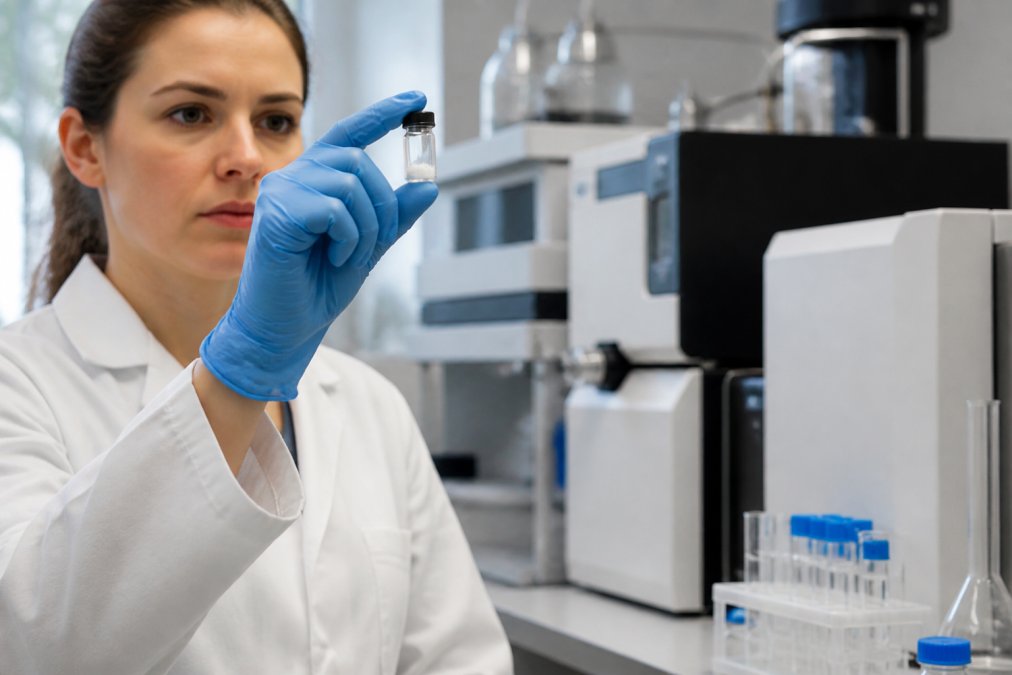
The second step is to check which analytical methods were used for characterization. Reversed-phase chromatography is the standard for purity assessment, but mass spectrometry provides critical confirmation of the molecular weight and identity. A product verified by both methods offers stronger evidence of quality than one verified by chromatography alone. The third step is to confirm that the testing was performed by an independent laboratory rather than solely by the manufacturer, which reduces the risk of biased results.
Interpreting a Certificate of Analysis requires knowing which numbers matter and how they relate to your application. Start by locating the purity percentage, typically reported as a single value from HPLC analysis. A purity of 99% or higher is standard for research-grade peptides, but the impurity profile matters more than the absolute number.
Work through the certificate systematically: first, confirm the peptide sequence and molecular weight match your order; second, review the chromatographic purity and note the retention time of the main peak; third, examine the list of identified impurities and their percentages. Pay attention to whether the certificate reports a single purity value or a detailed impurity breakdown, as the latter provides more useful information for risk assessment. Suppliers that provide comprehensive certificates with full analytical validation demonstrate a commitment to quality that directly supports your research.
Choosing a supplier is the most effective mitigation strategy you can implement, because impurity control is determined upstream by the manufacturer’s synthesis and purification processes. Look for manufacturers that operate under WHO/GMP and ISO-certified conditions, as these certifications require documented quality systems and consistent process controls.
Suppliers that partner with 503B compounding pharmacies and provide independent lab testing with a Certificate of Analysis offer an additional layer of verification. These partnerships signal that the supplier has invested in quality infrastructure beyond the minimum required for basic peptide sales. When you receive your product, store it according to the manufacturer’s recommendations, as improper storage can create degradation products that were not present at release.
The presence of peptide impurities is not a minor technical detail; it is a fundamental variable that can invalidate your experiments and compromise the safety of therapeutic candidates. Understanding how impurities form, how to detect them, and how to interpret quality documentation is essential for any researcher working with synthetic peptides.
At Rejuvenation Wellness Solutions LLC, we provide peptides that are 99%+ pure, sourced from WHO/GMP and ISO-certified manufacturers, with every batch undergoing independent lab testing. Our comprehensive product kits include everything you need for your research, and our team is available by phone, text, or email to answer questions about your specific application.
Peptide impurities are generally grouped into four categories: process-related impurities (reagents, solvents, cleavage byproducts), product-related impurities (degradation products, oxidation), sequence-related impurities (deletion, insertion, or truncated sequences), and enantiomeric impurities (D-amino acid isomers). Each type can affect the safety and efficacy of the final product. For research purposes, understanding which type is present helps you assess the risk to your study’s validity and interpret the Certificate of Analysis provided by your supplier.
For most research applications, 98% purity is often considered the minimum acceptable threshold, but it is not ideal for all studies. Higher purity, such as 99% or above, reduces the risk of sequence-related impurities interfering with your results. The acceptable level depends on your specific research goals and the sensitivity of your assays. Always review the Certificate of Analysis to identify what the remaining percentage consists of, as certain impurities can have a disproportionate effect on biological activity.
The most reliable way to verify peptide purity is to review the Certificate of Analysis (CoA) from the manufacturer. Look for the purity percentage determined by high-performance liquid chromatography (HPLC) and check the mass spectrometry data confirming the molecular weight. For critical studies, consider independent third-party lab testing. Also, confirm the supplier uses validated analytical methods and follows GMP guidelines, which provides greater confidence in the accuracy of the reported purity.
The immunogenicity of peptide impurities is a major concern because even small amounts of sequence-related impurities can trigger an unintended adaptive immune response in biological systems. This can skew experimental data, particularly in in vivo studies, and lead to false conclusions about the peptide’s activity. Impurities that mimic the target sequence but with subtle changes may also generate antibodies that cross-react with the native peptide, complicating the interpretation of results and posing safety risks in clinical development.
Process-related impurities originate from the manufacturing process itself. These include residual solvents, reagents, capping agents, and cleavage byproducts that remain after synthesis and purification. Product-related impurities, on the other hand, are variants of the desired peptide that form during synthesis or storage, such as degradation products, oxidized forms, and truncated sequences. Distinguishing between them matters because process impurities often indicate inadequate purification, while product impurities may point to instability in the peptide’s structure or formulation.
Ensuring the integrity of your research starts with the quality of your materials. Choose a supplier that provides verified purity, transparent documentation, and responsive support. Get started with Rejuvenation Wellness Solutions LLC and run your experiments with confidence in every batch.
This article was written using GrandRanker