

Last Updated: July 31, 2026
Understanding how to read peptide labels is essential for anyone conducting independent research or working in a clinical setting. The labels on research-grade peptides contain critical information about purity, potency, storage requirements, and regulatory compliance that directly impacts the safety and validity of your work. At Rejuvenation Wellness Solutions LLC, we’ve compiled this comprehensive guide to demystify what you’re actually looking at when you receive a vial.
Every research-grade peptide vial displays standardized information designed to communicate safety, composition, and handling requirements. Incorrect interpretation can compromise your entire study. A vial labeled "100 mg" doesn’t tell you the actual concentration until you understand the lyophilized powder format and reconstitution requirements.
Legitimate manufacturers include batch numbers, expiration dates, storage temperature ranges, and independent lab testing results. The label should reference a Certificate of Analysis (COA) that you can request and verify. If a supplier’s label lacks any of these elements, that’s a red flag.
The key information every peptide label must display includes the compound name in both standard nomenclature and chemical identifier format, total mass in milligrams, purity percentage (typically ≥99%), molecular weight, batch number, expiration date, and storage instructions. Additionally, the label should indicate whether the peptide is lyophilized (freeze-dried powder) or in solution, and provide reconstitution guidance if applicable.
The compound name on your peptide label appears in multiple formats because different research contexts require different naming conventions. The primary compound name typically uses three-letter amino acid symbols separated by hyphens. For example, "Ala-Gly-Val-Leu" represents alanine-glycine-valine-leucine, reading from the N-terminus (beginning) to the C-terminus (end). This directionality matters because reversing the sequence creates a completely different compound.
Many labels also include one-letter amino acid codes for compact reference. The same peptide would appear as "AGVL" in one-letter notation. The amino acid sequence directly determines the peptide’s biological activity and properties. A palmitoyl modification might be noted as "Pal-" at the start of the sequence, indicating a fatty acid chain attached to the N-terminus. Your label should also display the chemical identifier, often a catalog number or CAS number, which provides a unique reference for database searches and regulatory compliance.
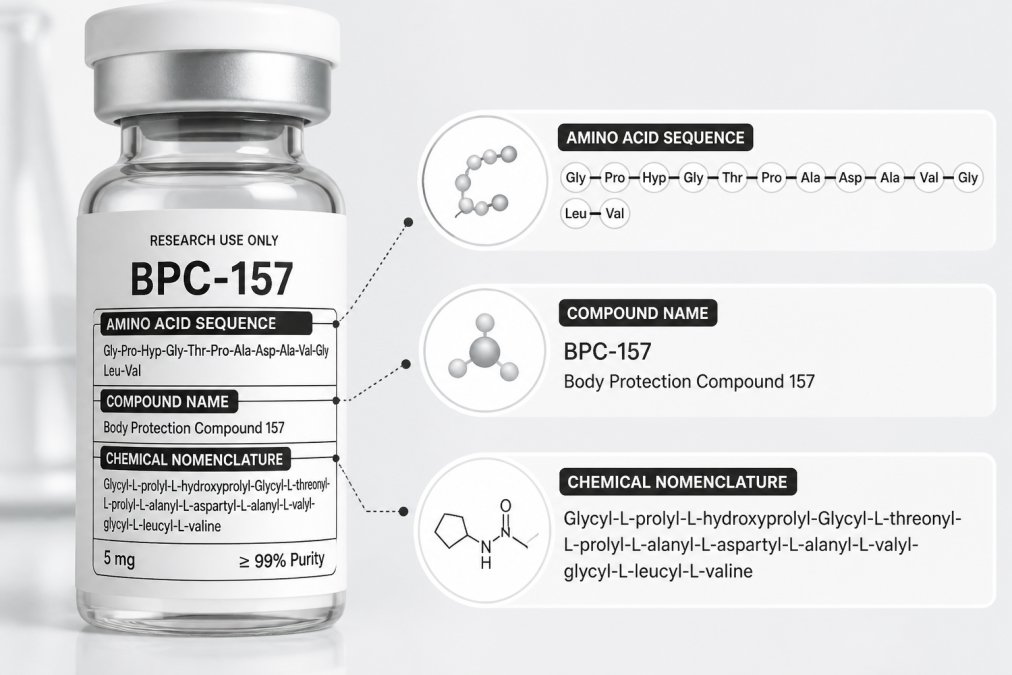
Purity percentage is where many researchers get misled. A label stating ">=99% purity" means that 99% or more of the compound consists of the target peptide, with the remaining 1% being water, salt, or other minor contaminants. This measurement comes from high-performance liquid chromatography (HPLC) analysis. A legitimate COA will show the HPLC chromatogram with the main peptide peak clearly separated from any impurities.
However, purity percentage and net peptide content are two different measurements. A vial might contain 100 mg of lyophilized powder with 99% purity, but only 99 mg of that represents actual usable peptide. The remaining 1 mg consists of water molecules, residual salts, or other non-peptide material.
Distinguishing between purity and net peptide content requires looking at both the label and the COA. The label states total mass and purity percentage. The COA provides the HPLC analysis showing how that purity was determined and confirms the identity of the main compound through mass spectrometry.
Reading molecular weight and total mass information requires understanding how these two measurements relate to your research calculations. The molecular weight (MW) appears in Daltons (Da) or kiloDaltons (kDa) and represents the mass of a single peptide molecule.
Molecular weight is essential for reconstitution math. If your peptide has a molecular weight of 1,234 Da and you’re dissolving 50 mg in 5 mL of bacteriostatic water, you need this number to calculate molar concentration. For example, a peptide with MW 1,500 Da dissolved at 50 mg in 5 mL creates a 10 mg/mL solution by weight. But if you need to express this as molarity (moles per liter), you divide 10 mg/mL by 1,500 Da and convert to get approximately 6.67 millimolar concentration.
The label should clearly state both the total mass in milligrams and the molecular weight in Daltons. Some labels also include a "net peptide content" calculation that multiplies total mass by purity percentage, making your math simpler.
Understanding lyophilized powder and reconstitution is where theoretical knowledge becomes practical application. A lyophilized peptide is freeze-dried powder, the peptide has been dissolved, frozen, and then the water removed under vacuum. This process preserves the peptide’s stability and extends shelf life significantly compared to liquid formulations.
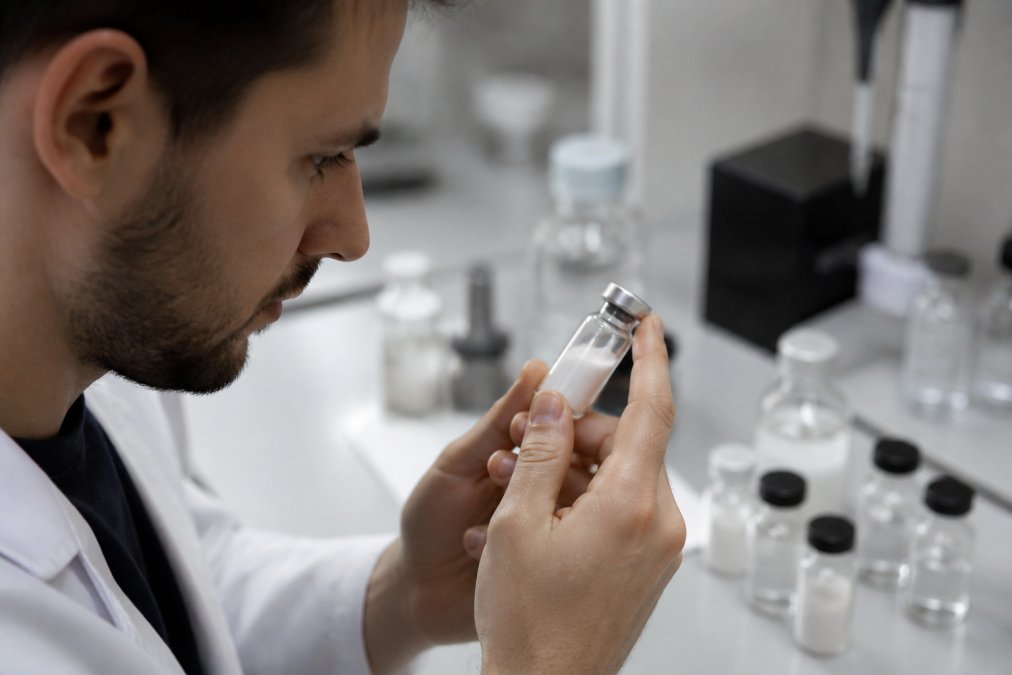
When you receive a lyophilized peptide, you’re looking at a small amount of white or off-white powder at the bottom of the vial. To use this peptide in your research, you must reconstitute it by dissolving it in an appropriate solvent.
Bacteriostatic water is the standard solvent for peptide reconstitution in research settings. This water contains 0.9% benzyl alcohol, which prevents bacterial growth and allows you to store the reconstituted solution for extended periods. The label should specify "reconstitute with bacteriostatic water" or provide similar guidance. Never use regular distilled water or sterile saline, as these lack the bacteriostatic properties and will degrade your solution.
Using bacteriostatic water for proper dilution requires a specific technique. Draw the calculated volume of bacteriostatic water into a syringe. Slowly inject it into the peptide vial at an angle, allowing the water to run down the side of the vial rather than splashing directly onto the powder. Let the vial sit for 5-10 minutes, then gently swirl (never shake) until the powder fully dissolves.
The basic concentration formula is straightforward: concentration (mg/mL) = total mass (mg) ÷ volume (mL). If you have 50 mg of peptide and you dissolve it in 5 mL of bacteriostatic water, your concentration is 10 mg/mL. However, you must account for purity when calculating usable peptide content.
Here’s a practical example: your label shows 100 mg total mass at 99% purity with a molecular weight of 1,567 Da. You want a 10 mg/mL solution. First, calculate actual peptide content: 100 mg × 0.99 = 99 mg of usable peptide. Next, determine volume needed: 99 mg ÷ 10 mg/mL = 9.9 mL of bacteriostatic water.
Converting between different measurement units is where many researchers make errors. Research protocols might specify dosing in micrograms (µg), but your vial label shows milligrams (mg). Remember that 1 mg = 1,000 µg. If your protocol calls for 50 µg per kilogram of body weight and you have a 10 mg/mL solution, you need to convert: 50 µg = 0.05 mg, so you’d need 0.05 mg ÷ 10 mg/mL = 0.005 mL or 5 µL of your reconstituted solution.
| Measurement Task | Formula | Example |
|---|---|---|
| Usable peptide content | Total mass × purity % | 100 mg × 99% = 99 mg |
| Concentration by weight | Total peptide ÷ volume | 99 mg ÷ 10 mL = 9.9 mg/mL |
| Volume needed for target concentration | Desired peptide ÷ concentration | 99 mg ÷ 10 mg/mL = 9.9 mL |
| Micrograms to milligrams | µg ÷ 1,000 | 500 µg = 0.5 mg |
| Molar concentration | (mg/mL ÷ MW) × 1,000 | (10 mg/mL ÷ 1,567 Da) × 1,000 = 6.38 mM |
Dosage calculations require precision because small errors compound through your research protocol. A 10% error in concentration calculations can invalidate your entire study’s results.
A Certificate of Analysis is your proof that the label claims are legitimate. This document comes from an independent third-party laboratory that has tested the peptide and confirmed its identity, purity, and composition.
A valid COA must include the batch number, which links the specific vial you received to the test results. The COA should display the compound name, molecular formula, molecular weight, and CAS number. Most importantly, it includes the HPLC chromatogram showing the purity analysis. The main peptide peak should represent ">=99% of the total area under the curve. The COA also includes mass spectrometry results confirming the molecular weight matches the expected value within a narrow tolerance (usually ±0.1%).
Cross-checking label claims against COA data is a three-step process. First, verify the batch number on your vial matches the batch number on the COA. Second, confirm the total mass stated on the label matches the amount tested in the COA. Third, ensure the purity percentage on the label matches the HPLC analysis percentage on the COA. If any of these don’t align, contact your supplier immediately.
Understanding HPLC analysis and mass spectrometry results requires basic familiarity with what these tests measure. HPLC (high-performance liquid chromatography) separates the peptide from other compounds based on their chemical properties. The resulting chromatogram shows peaks for each compound present. A pure peptide shows one dominant peak representing ">=99% of the total area. Mass spectrometry measures the exact mass of molecules in your sample, confirming the molecular weight matches the expected value within a narrow tolerance (usually ±0.1%).
Storage conditions and light sensitivity requirements are printed on your label for a reason, peptides degrade under improper conditions, and degraded peptides produce unreliable research results. The label should specify a temperature range, typically -20°C or -80°C for long-term storage of lyophilized peptides.
Lyophilized peptides stored at -20°C typically remain stable for 2-3 years. Storage at -80°C extends stability to 5+ years. Many peptides are sensitive to light, particularly those containing aromatic amino acids like tryptophan or tyrosine. The label may indicate "protect from light" or show that the vial is amber-colored to block light exposure.
Batch number, expiration date, and vial integrity checks are your final quality verification steps before using a peptide. The batch number appears on both the label and the COA, allowing you to match your vial to its test results. The expiration date indicates when the manufacturer guarantees the peptide’s stability under proper storage conditions. Vial integrity checks involve visual inspection before opening. Look for cracks, cloudiness in the powder (suggesting moisture exposure), or discoloration. If the seal appears compromised or the powder looks unusual, don’t use it.
The label should indicate that the peptide is "for research use only" and not approved for human consumption. Additionally, the label should include the supplier’s contact information and any relevant certifications. Rejuvenation Wellness Solutions LLC partners with WHO/GMP and ISO-certified manufacturers, and every product undergoes independent lab testing with a Certificate of Analysis.
Reading peptide labels accurately is the foundation of reliable research. The label communicates everything you need to know about the compound’s identity, composition, stability, and proper handling. When you understand what each element means, from amino acid nomenclature to purity percentages to storage requirements, you’re equipped to make informed decisions about your research materials.
Rejuvenation Wellness Solutions LLC provides detailed labels backed by independent lab testing, WHO/GMP certified manufacturing, and responsive customer support.
A complete research-grade peptide label must include: compound name and amino acid sequence, molecular weight, total mass and dosage units, purity percentage (typically ≥99%), batch/lot number, expiration date, storage conditions, manufacturer information, and a reference to the Certificate of Analysis (COA). The label should also indicate whether the peptide is lyophilized powder or liquid, and provide reconstitution instructions with bacteriostatic water recommendations. Missing any of these elements is a red flag for quality or legitimacy.
The purity percentage on the label (e.g., ≥99%) should match the analytical certificate's HPLC analysis results. Cross-check the batch number on the label with the batch number on the COA to ensure they correspond. The COA will show detailed HPLC chromatography data and mass spectrometry results that confirm the purity claim. If the label states higher purity than the COA shows, or if the batch numbers don't match, the product may be misrepresented or counterfeit.
Peptide dosage calculation requires understanding concentration: Concentration (mg/mL) = Total Peptide Mass (mg) ÷ Reconstitution Volume (mL). For example, if a 10 mg vial is reconstituted with 10 mL of bacteriostatic water, the concentration is 1 mg/mL. Labels should provide the total mass and reconstitution volume so you can calculate the final concentration. Always verify these numbers match the lyophilized powder weight and ensure you're using the correct bacteriostatic water volume for accurate dosing in your research.
Red flags include: blurry, smudged, or poorly printed text; missing batch number or expiration date; vague or incomplete storage instructions; no reference to a Certificate of Analysis; grammatical errors or unusual formatting; labels that don't match the vial size; missing molecular weight or purity percentage; and lack of manufacturer contact information. Topical and injectable peptides should have distinctly different label language. If you cannot verify the label information against an independently tested COA, the product's authenticity and quality are questionable.
This article was written using GrandRanker








