

Last Updated: July 28, 2026
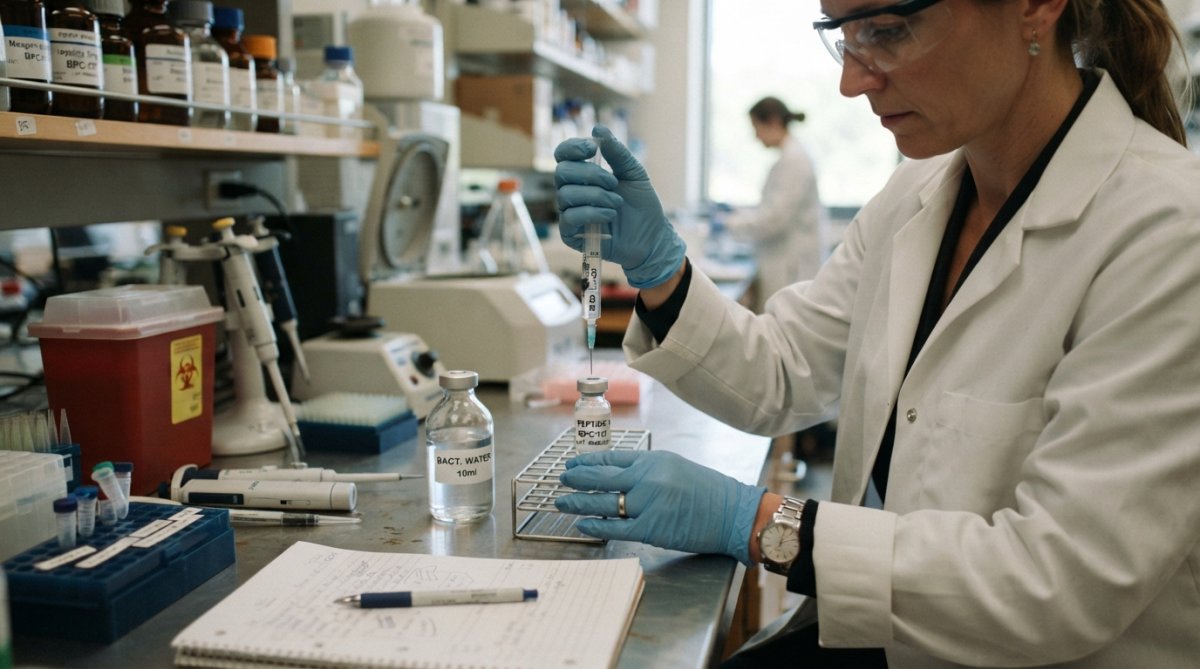
Peptide reconstitution is dissolving lyophilized (freeze-dried) peptide powder into liquid solvent to create a usable solution for research, clinical trials, or laboratory applications. Proper reconstitution directly impacts your results, data integrity, and project timeline. Lyophilized peptides are shelf-stable, but improper reconstitution can denature peptides, introduce contamination, create concentration errors, or produce cloudy solutions that compromise research. According to NIH laboratory best practices for peptide handling, proper aseptic technique and solvent selection reduce contamination rates by up to 90%.
Successful peptide reconstitution requires specific equipment. Sterile syringes and needles (29-gauge or smaller insulin syringes) minimize pressure changes and reduce peptide denaturation. Bacteriostatic water or sterile saline serves as your primary solvent, always pharmaceutical-grade from verified sources. Alcohol swabs (70% isopropyl alcohol) maintain aseptic conditions. Sterile glass vials with rubber septa and aluminum caps prevent leaching and contamination. Refrigeration equipment (2-8°C standard refrigerator; -20°C or -80°C freezer for long-term storage) is essential. pH paper or calibrated pH meter verifies appropriate pH ranges. Sterile gauze and sharps containers ensure safe disposal per OSHA regulations.
Rejuvenation Wellness Solutions LLC provides comprehensive reconstitution kits including peptides, bacteriostatic water, syringes, and alcohol swabs, everything needed to start immediately.
| Equipment/Material | Purpose | Critical Specification |
|---|---|---|
| Insulin syringe | Drawing and transferring solvent | 29-gauge or smaller needle |
| Bacteriostatic water | Primary reconstitution solvent | Pharmaceutical-grade, sterile |
| Alcohol swabs | Maintaining aseptic conditions | 70% isopropyl alcohol |
| Glass vials | Storing reconstituted peptide | Rubber septum, aluminum cap |
| Refrigerator/Freezer | Cold chain storage | 2-8°C or -20°C minimum |
| pH meter | Verifying solution pH | Calibrated, accurate to ±0.1 pH |
| Sharps container | Safe needle disposal | OSHA-compliant biohazard container |
Bacteriostatic water contains benzyl alcohol, a preservative that inhibits bacterial and fungal growth, making it ideal for peptides used over weeks or months. The downside: benzyl alcohol can affect certain assays or cause mild irritation in sensitive tissues.
Sterile saline (0.9% sodium chloride) contains no preservatives and won’t interfere with assays or biological systems. However, contamination risk increases significantly once opened. Sterile saline-reconstituted peptides should be used within days, not weeks.
A common approach: use bacteriostatic water for longer-term storage and sterile saline for single-use or short-term applications.
Step 1: Prepare Your Workspace (5 minutes)
Set up a clean, organized bench. Wipe down your work surface with 70% alcohol and let it dry completely. Gather all materials within arm’s reach.
Step 2: Calculate Your Reconstitution Volume (2 minutes)
Determine solvent volume needed based on desired final concentration and peptide amount. Write down your target concentration and required volume.
Step 3: Inspect the Peptide Vial (1 minute)
Lyophilized peptide should be white or off-white powder, tightly packed at the vial bottom. If it appears clumpy, wet, or discolored, do not use it.
Step 4: Clean the Vial Septum (1 minute)
Vigorously wipe the rubber septum with an alcohol swab for 10-15 seconds. Let alcohol evaporate completely before proceeding.
Step 5: Draw Up Your Solvent (2 minutes)
Using an insulin syringe, draw up the calculated solvent volume slowly and steadily. Push out any air before proceeding.
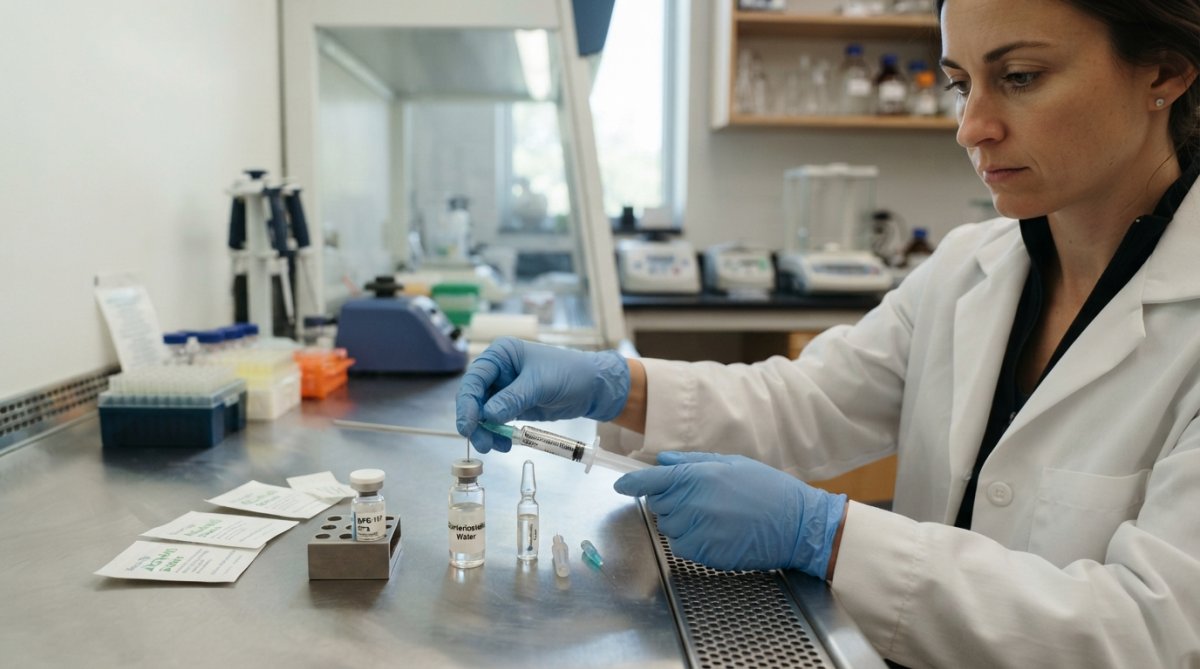
Step 6: Inject Solvent Into the Peptide Vial (2 minutes)
Insert the needle through the septum at a slight angle. Inject solvent slowly and steadily, rapid injection creates pressure waves that denature peptides.
Step 7: Allow Dissolution (5-15 minutes)
Let the vial sit undisturbed for 5-15 minutes. If powder remains after 10 minutes, gently swirl the vial, don’t shake vigorously.
Step 8: Verify Complete Dissolution (2 minutes)
Hold the vial up to light. The solution should be clear or slightly cloudy. Undissolved powder or visible particles indicate incomplete dissolution or contamination.
Step 9: Check pH (2 minutes)
Test a tiny sample using pH paper or calibrated pH meter. Most peptides should fall in the 4.0-8.0 range.
Step 10: Store Appropriately (1 minute)
Label your vial clearly with peptide name, concentration, reconstitution date, and your initials. Store immediately in the refrigerator (2-8°C) for 2-4 weeks or in the freezer (-20°C or lower) for longer-term storage.
Aseptic technique is foundational to successful reconstitution. Never let non-sterile surfaces contact your peptide solution or vial interiors. Wash hands thoroughly before beginning and use sterile nitrile gloves throughout. Change gloves between handling different vials to prevent cross-contamination.
Keep needles and syringes sterile, once opened, they remain sterile only until contacting non-sterile surfaces. Minimize air exposure by working quickly near open vials and away from fans or air vents. Use firm, circular motions with alcohol swabs for 10-15 seconds and let alcohol evaporate completely before injecting.
:::pro tip
Reconstitute multiple vials one at a time rather than assembly-line style. This reduces air exposure time for each vial and minimizes cross-contamination risk.
:::
The basic formula: Concentration = (Mass of peptide) / (Volume of solvent)
If you have 10 milligrams of peptide in 10 milliliters of solvent, your concentration is 1 mg/mL.
Account for peptide purity. If your peptide is 95% pure, actual peptide mass = (Labeled mass) × (Purity percentage). For 10 mg at 95% purity: 10 mg × 0.95 = 9.5 mg of actual peptide.
For dosing: If your peptide is 1 mg/mL and you need 100 micrograms per dose, draw up 0.1 mL (100 μL).
| Desired Concentration | 50 mg Peptide | 100 mg Peptide | 200 mg Peptide |
|---|---|---|---|
| 1 mg/mL | 50 mL solvent | 100 mL solvent | 200 mL solvent |
| 2 mg/mL | 25 mL solvent | 50 mL solvent | 100 mL solvent |
| 5 mg/mL | 10 mL solvent | 20 mL solvent | 40 mL solvent |
| 10 mg/mL | 5 mL solvent | 10 mL solvent | 20 mL solvent |
Verify your math before reconstituting. Write down calculations and have a colleague check if possible.
A cloudy reconstituted peptide solution is a red flag. Clarity indicates successful dissolution.
Incomplete dissolution is the most common cause, white or off-white particles remain suspended. Let the vial sit at room temperature for another 15-30 minutes. If waiting doesn’t help, try gentle swirling for 30 seconds.
Precipitation occurs when dissolved peptide comes out of solution due to pH drift, temperature changes, or solvent concentration changes. Check the pH. If significantly shifted, the peptide is degrading and should be discarded.
Bacterial or fungal contamination creates cloudiness that worsens over time and develops a distinct musty or sour smell. Do not use contaminated peptides.
Peptide aggregation happens when individual peptide molecules clump together, appearing as fine particles or slight haze. Some aggregation is normal, but significant aggregation reduces bioavailability.
Peptides are pH-sensitive. Check your peptide documentation for the ideal pH range. Most peptides perform best in the 4.0-8.0 range. Bacteriostatic water is typically pH 5.5-6.5; sterile saline is closer to neutral (pH 7.0-7.4).
If your peptide needs a specific pH outside these ranges, you may need to buffer your solvent using phosphate-buffered saline (PBS) or acetate buffers. Start with bacteriostatic water or sterile saline, measure the pH of your reconstituted solution, and adjust if necessary using small amounts of dilute HCl or NaOH.
How you store reconstituted peptide determines its usable lifespan. Store immediately after full dissolution and pH verification. Room temperature (20-25°C) is acceptable for hours only. Refrigeration (2-8°C) extends usable life to 2-4 weeks. Freezing (-20°C or lower) extends usable life to months or years.
The cold chain matters. Once frozen, keep frozen. Don’t thaw, use some, and refreeze. Freeze-thaw cycles damage peptides through ice crystal formation and osmotic stress. Aliquot your reconstituted peptide into smaller portions before freezing, using only what you need.
Aliquoting strategy: If you reconstituted 10 mL but use only a few hundred microliters at a time, divide into 1 mL aliquots in separate sterile vials. Freeze all but one. This minimizes freeze-thaw cycles and extends usable life significantly.
Protect from light if peptides are light-sensitive. Label everything clearly with peptide name, concentration, reconstitution date, your initials, and expiration date (typically 3-6 months after reconstitution, depending on storage temperature).
During freezing, water crystallizes into ice, concentrating remaining solutes and potentially causing peptides to precipitate or aggregate. During thawing, rapid temperature changes introduce osmotic stress and peptide aggregation. Slow thawing minimizes stress.
Minimize freeze-thaw cycles. This is the key principle. Every cycle introduces stress. Aliquot before freezing to avoid the problem entirely. Thaw slowly in the refrigerator (2-8°C), not at room temperature. Allow 2-4 hours for a 1 mL vial to thaw completely and use promptly after thawing.
In the refrigerator (2-8°C), most peptides remain usable for 2-4 weeks, assuming proper aseptic technique and no contamination.
In the freezer (-20°C), most peptides remain usable for 3-6 months.
In a -80°C ultra-low freezer, peptides can remain stable for a year or longer.
Factors that shorten shelf life: oxidation (peptides with methionine or cysteine residues), aggregation (hydrophobic peptides), pH drift, and contamination. Bacteriostatic water helps prevent microbial growth, but aseptic technique remains essential.
Rejuvenation Wellness Solutions LLC provides peptides with Certificates of Analysis detailing expected shelf life under different storage conditions, eliminating guesswork and helping you plan research timelines.
Mistake 1: Using non-sterile water. Always use pharmaceutical-grade bacteriostatic water or sterile saline.
Mistake 2: Reconstituting too much at once. Reconstitute only what you’ll use within 2-4 weeks.
Mistake 3: Injecting solvent too quickly. Fast injection creates pressure spikes that denature peptides. Slow, steady injection takes an extra 30 seconds but protects your peptide.
Mistake 4: Shaking vigorously to dissolve. Vigorous shaking introduces air and foam, accelerating oxidation. Swirl gently instead.
Mistake 5: Not checking pH. pH drift indicates degradation or contamination.
Mistake 6: Freezing without aliquoting. Aliquot before freezing to avoid multiple freeze-thaw cycles.
Mistake 7: Using old syringes or needles. Use fresh, sterile syringes and needles for each reconstitution.
Mistake 8: Not labeling vials clearly. Label everything immediately after reconstitution.
Mistake 9: Touching the needle or syringe tip. Use a new syringe if contamination occurs.
Mistake 10: Assuming the peptide is fine because it looks fine. A peptide can look clear and still be partially degraded.
Sharps containers are mandatory. Any needle or syringe used during peptide reconstitution must go into a designated sharps container. Your sharps container should be easily accessible from your work area. When three-quarters full, replace it. Don’t overfill.
Contaminated materials beyond sharps. Alcohol swabs, gauze, and gloves that contacted your peptide solution should go in a biohazard bag, not regular trash.
Liquid waste. Follow your institution’s guidelines for disposing of leftover reconstituted peptide, some allow dilution and drain disposal; others require incineration.
Documentation and training. OSHA requires training for anyone handling sharps and biohazardous waste. Keep documentation of this training. If you accidentally stick yourself with a contaminated needle, follow your institution’s protocol immediately, which typically involves washing the wound, reporting the incident, and seeking medical evaluation.
According to OSHA bloodborne pathogens standard, proper sharps handling and disposal reduce needle stick injuries by over 80%.
Peptide reconstitution done correctly is the foundation of successful research. The steps are straightforward, but details matter enormously. A careful, methodical approach pays dividends in data quality and research reproducibility.
Rejuvenation Wellness Solutions LLC provides high-purity peptides with Certificates of Analysis documenting purity and stability expectations. They offer comprehensive reconstitution kits including peptides, bacteriostatic water, syringes, and alcohol swabs, eliminating sourcing hassles and ensuring material compatibility. With same-day order fulfillment and UPS 2-day shipping, you can start your research immediately. Reach out via text, phone, or email for guidance on peptide selection and reconstitution protocols tailored to your specific research needs.
FDA guidance on peptide drug manufacturing
Peptide reconstitution is the process of dissolving lyophilized (freeze-dried) peptide powder in a reconstitution solvent, typically bacteriostatic water or sterile saline, to create a usable liquid solution. This is critical for research because it converts stable, shelf-stable powder into a bioavailable form suitable for in vitro studies, laboratory experiments, and subcutaneous or intramuscular administration. Proper reconstitution preserves peptide stability, maintains bioavailability, and ensures accurate dosing for reproducible research outcomes.
Bacteriostatic water is the most common choice for peptide reconstitution because it contains benzyl alcohol (0.9%), which inhibits bacterial growth and extends shelf life of reconstituted solutions. Sterile saline (0.9% sodium chloride) is preferred when the peptide is pH-sensitive or when bacteriostatic water may cause precipitation. The choice depends on your peptide's solubility profile and intended application. Always verify compatibility with your specific peptide's technical documentation before selecting a reconstitution solvent.
To calculate concentration: divide the peptide mass (in milligrams) by the total reconstitution volume (in milliliters). For example, 10 mg peptide in 1 mL = 10 mg/mL concentration. To determine dosage, multiply your desired dose (in micrograms) by the concentration, then divide by 1000 to convert to milliliters for injection. Always account for the peptide's molecular weight and purity percentage (e.g., 99% pure) when calculating accurate concentrations. Use an insulin syringe for precise microdose measurements.
Cloudy solutions typically result from incomplete dissolution, bacterial contamination, or pH imbalance. To troubleshoot: gently swirl (never vortex vigorously, which causes denaturation) the vial for 2-3 minutes to improve solubility; ensure the reconstitution solvent is at room temperature; verify correct pH using a buffer solution if needed; and confirm aseptic technique was followed. If cloudiness persists after gentle swirling, the peptide may have aggregated due to freeze-thaw cycles or improper storage. Discard and reconstitute a fresh vial using proper cold chain management.
Reconstituted peptides typically remain stable for 2-4 weeks when stored at 2-8°C (refrigeration) in sterile, sealed vials. For longer stability, freeze reconstituted aliquots at -20°C or -80°C, though freeze-thaw cycles can reduce peptide stability and bioavailability. Always use sterile handling and aseptic technique during aliquoting. Store away from light, and monitor for signs of denaturation or bacterial growth. Consult your peptide's Certificate of Analysis for specific shelf-life guidance, as stability varies by peptide sequence and molecular weight.
This article was written using GrandRanker








